


South Korea's fabless market accounts for just 1% of global semiconductor production, with the US dominating, and Taiwan gaining ground.
 Published2022.04.11 15:59
한국 "팹리스 IC부문에 취약해", 일본 반도체는 몰락
21년 글로벌 상위 10개 팹리스 기업 미국·대만 독식
퀄컴, 엔비디아 등 미국이 주도하는 글로벌 반도체 시장에서 반도체 강국의 입지를 다지려는 한국이 세계 시장에서 2위를 차지했으나 팹리스 IC부문에서 매우 취약하다는 평가를 받아 우려를 낳고 있다.
6일 시장조사기관 IC인사이츠에 따르면 본사를 두고 있는 국가 기준으로 미국이 전세계 반도체 시장을 압도하고 있는 것으로 나타났다. 미국은 팹리스에서 높은 점유율을 보이며 IDM 비중과의 조화를 이뤘다는 평가를 받았다.
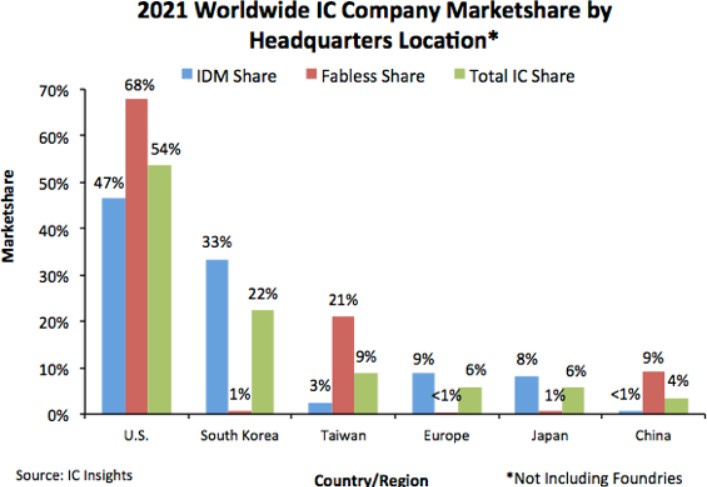
2021년 매출 기준 순수 파운드리를 제외한 IDM과 팹리스 IC부문을 합한 전체 점유율에서 미국 기업이 54%를 기록했으며 한국 기업이 22%로 그 뒤를 이었다. 대만 업체들은 팹리스 IC부문 매출에 힙입어 9%, 유럽과 일본 기업은 6%를 기록했다. 중국은 4%에 불과해 반도체 시장에서 낮은 점유율을 보였다.
세부항목별 점유율을 보면 미국은 IDM 47%, 팹리스 68%로 팹리스에서 상당한 우위를 보였다. IC인사이츠는 “전반적으로 IDM, 팹리스 등 전체 반도체 산업 시장 점유율에서 미국이 가장 균형을 이루고 있다”고 평가했다.
한국은 IDM 33%, 팹리스 1%를 기록해 일본의 IDM 9%와 팹리스 1%와 함께 “한국은 일본과 더불어 팹리스 IC 부문에서 취약하다”는 평가를 받았다. 대만은 IDM 3%, 팹리스 21%를 차지했으며 중국은 IDM 1%, 팹리스 9%로 두 나라가 모두 IDM 비중이 매우 낮다고 언급했다.
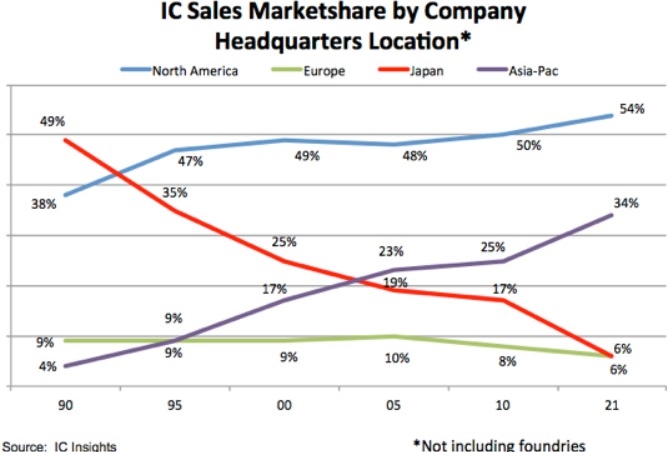
반도체 시장 점유율에서 각국의 추이를 살펴보면 일본의 몰락은 극명한 반면 한국·대만과 같은 아시아권 국가의 발전은 두드러졌다. 90년대 49% 시장 점유율로 절반에 가까운 수준으로 세계시장을 압도한 일본의 반도체 기업들은 21년 기준 6% 수준으로 전락해버렸다. 반면 아시아권은 4%에서 34%로 급격히 상승했다. 이밖에 유럽은 완만한 하락세를 그리며 6%까지 떨어지고 있으며 북미권은 54%까지 치솟으며 시장 점유를 절반 넘게 가져갔다.
특히 대만의 성장이 매서운데 IC인사이츠는 2020년 반도체 산업 시장 점유율에서 대만이 유럽을 처음으로 추월했다고 설명했다. 이는 팹리스 업체들의 매출이 점유율 상승에 기여한 바가 크다. 파운드리에서도 TSMC를 중심으로 강세를 보이는 대만에서 자국 내 최대 팹리스 업체인 미디어텍까지 성장세를 보였다. 전세계 스마트폰 AP 시장에서 5분기 연속 시장 점유율 1위(40%)를 차지한 미디어텍은 21년 기준 약 176억달러가 넘는 매출을 기록했다. 마찬가지로 대만에 본사를 둔 노바텍, 리얼텍이 각각 약 48억달러와 37억달러의 매출을 달성했다.
.jpg)
트렌드포스에서 발표한 전세계 상위 10개 팹리스 기업에 2021년 기준 미국과 대만이 독식하는 결과를 보여줬다. 미국의 퀄컴(1위), 엔비디아(2위), 브로드컴(3위), AMD(5위), 마벨(7위), 자일링스(9위)가 순위권을 차지하며 팹리스 부문 저력을 과시했으며 대만은 미디어텍(4위), 노바텍(6위), 리얼텍(8위), 하이맥스(10위)가 나머지를 모두 독식하며 양강체제를 굳혔다. 반면 한국은 세계 팹리스 상위 10위권 안에 이름을 올리지 못했다.
국내 팹리스 최대 기업은 LX세미콘으로 지난해 1조9천억원(약 15억달러)에 가까운 매출을 기록하며 전년대비 63%가 넘는 성장을 이뤄 10위권 가까이 도달했다는 평가이다. 2020년 1조원 매출을 넘긴 뒤 반도체 호황에 힘입어 2조원대 연매출을 바라보고 있는 것이다. 다만 디스플레이구동칩(DDI)를 주력으로 삼고 있어 상대적으로 낮은 단가로 인해 수익성 개선과 고성능 칩 개발이 앞으로의 해결 이슈로 남아있다.
.jpg)
팹리스·시스템 IC 매출의 비중은 앞으로 높아질 전망인데 2002년 전체 반도체 시장에서 13%에 불과했던 팹리스·시스템 IC의 매출 비중은 2020년 기준 32.8%까지 껑충 뛰어올라 사상 최고치를 경신했다. IC인사이츠는 “장기적으로 팹리스·시스템 IC공급업체가 차지할 시장점유율은 향후 5년간 30대 중반을 유지할 것”으로 내다봤다. 전체 반도체 시장에서 팹리스 업체는 2010년부터 10년 간 연평균 8%의 성장을 보인 반면 IDM 기업은 연평균 3% 성장해 대조적인 성장율을 보였다.
국내기업의 파운드리-팹리스 업체 간 연계가 필요하다는 말도 나오는 상황이다. 대만은 자국 파운드리-팹리스 간 커플링을 통해 설계부터 생산까지의 반도체 공급망 기반을 튼튼하게 다지고 있다. 반면 국내 팹리스 기업은 대체로 중소기업들인데다가 반도체 수요가 폭증하는 시장 속에서 글로벌 팹리스 업체들의 주문량에 밀려 입지가 더욱 좁아지는 형편에 처했다.
이에 권칠승 중소벤처기업부 장관은 지난해 11월 발표한 중소 팹리스 지원 방안을 통해 중소 팹리스의 생태계 진입에 힘을 싣고 있다. 권 장관은 이날 “대중소 상생으로 중소팹리스의 파운드리 수급난을 낮추고, 설계부터 생산·판매에 이르기까지 중소 팹리스에 대한 전주기 지원”을 약속했다.
한편, 국내 팹리스 업계 성장을 도모하기 위해선 전문인력 수급부터 시작돼야 하는 만큼 반도체 업계에서는 인재 양성에 두 팔을 걷어붙이고 있다. SK하이닉스는 서강대와 협약해 시스템반도체 공학과를 신설하기 위한 협무협약을 체결한 한편 최근 LX세미콘은 KAIST에 반도체 관련 미래기술을 연구하기 위한 ‘LX세미콘 미래연구센터’를 설립했다.
Comments
Related news
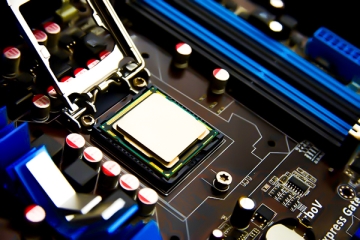
Fostering the System Semiconductor Industry, Demand-Linked Fabless is the Key
System semiconductors are specialized in computation and control, unlike memory semiconductors which are specialized in storage. Additionally, while the memory semiconductor ecosystem is centered on IDMs that handle both design and production simultaneously, the system semiconductor ecosystem has well-established division of labor between fabless companies that handle design and foundries that handle production. To grow the system semiconductor industry further than it currently is, it is necessary to foster and support fabless companies that are capable of customer-centric semiconductor design specialized in specific tasks, rather than foundries which have high barriers to entry.
2021.01.19by 이수민 기자
Intel's entry into the foundry market is negative for Korea.
Due to accelerated semiconductor self-sufficiency driven by the U.S. reshoring policy, the accelerated collaboration between foundries and fabless companies within the United States is viewed negatively for Korea's foundry industry, and opinions have been raised that preparations are necessary to stabilize semiconductor supply and demand in our country.
2021.06.24by 배종인 기자
.jpg)
Fabless Growth Depends on Talent and Investment
It has been suggested that for the growth of domestic system semiconductor fabless companies, there is a need for active investment from specialized fund managers (GPs) with capabilities in both nurturing and securing professional talent and providing portfolio support expertise specialized in semiconductors.
2021.11.30by 배종인 기자
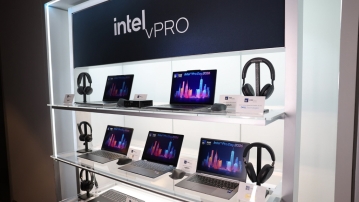
Intel Unveils Next-Generation 'Core Ultra Series 3' and vPro Platform for Enterprise PCs
Intel has officially unveiled the "Intel Core Ultra Series 3" for next-generation enterprise PCs and the latest vPro platform, addressing a wide range of demands from enterprise notebooks to high-performance workstations.
2026.03.26by 배종인 기자
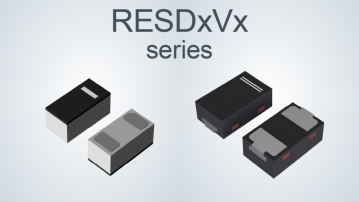
ROHM Launches ESD Protection Diode Compatible with High-Speed Interfaces of 10Gbps or Higher
Semiconductor specialist ROHM has developed the 'RESDxVx series' of ESD (electrostatic discharge) protection diodes capable of responding to next-generation high-speed data communication environments exceeding 10Gbps, simultaneously enhancing both signal quality maintenance required in high-speed interfaces and IC protection performance.
2026.03.26by 배종인 기자











