



Materials Research Institute and Solar Optics Develop New Solar Technology
 Published2022.04.18 13:38
Convergence of new optical materials and organic-based solar cells
Improved efficiency from 3 hours and 30 minutes per day to over 6 hours
Increased stability by maintaining and managing the panel without external environmental influences
The Korea Institute of Materials Science announced on the 18th that Dr. Lim Dong-chan's research team, together with Solar Optics Co., Ltd., a solar power generation module research company, recently succeeded in developing a 'new solar power generation system technology by fusing optical application new materials using optical fibers and organic-based solar cells.'
This research achievement is significant in that it significantly improves the efficiency of existing solar power generation facilities. Existing solar power plants utilize a flat panel structure that vertically absorbs sunlight to generate electricity. Consequently, their economic feasibility has consistently been questioned in terms of energy efficiency per unit area. The flat, two-dimensional structure of current solar panels has limitations in that it has an efficiency of about 24% per area due to issues with light receptivity and optimal angle, and it can only achieve maximum efficiency within an average of 3 hours and 30 minutes per day.
The joint research team redesigned the organic-based solar cell structure to maximize light scattering by processing nano-sized holes on the surface of optical fibers and to maximize the absorption of scattered light. This allowed them to arrange optical fibers and horizontal solar panels in a vertical three-dimensional structure, maintaining basic efficiency for long periods of time regardless of the angle at which the light is received. This not only improved the power generation efficiency of the solar panel, but also extended the maximum efficiency period of the solar panel to an average of more than six hours per day.
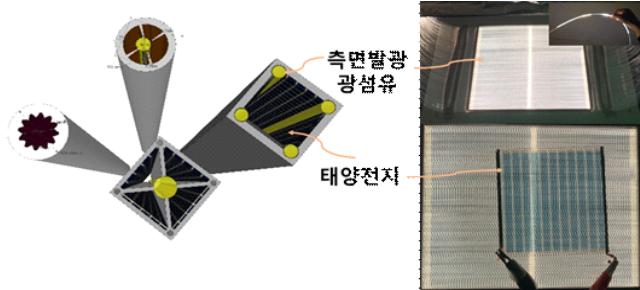
This research is notable for applying side-emitting optical fibers to bring existing solar energy into indoor environments (a fiber-optic-solar cell hybrid system). This approach allows for safe maintenance and management of panels from unstable external environments, while also improving stability. It also enables the adoption of high-efficiency panels, previously unavailable due to their sensitivity to external factors such as heat, dust, and humidity. It was evaluated that development and mass production of various high-efficiency products can be expected in the future.
Lim Dong-chan, a senior researcher at the Korea Institute of Materials Science, said, “Organic-based solar cells are continuously being developed with material technologies that have a power generation efficiency of over 20%,” adding, “There are concerns in the market that the stability of organic materials is vulnerable to external environments such as heat and moisture due to their organic material characteristics.”
He added, “If this technology is commercialized, it will be possible to drastically reduce the area by about one-fifth or more compared to existing solar panels, and it is expected to have groundbreaking applications in mobile solar power generators, electric vehicles, and distributed power generation systems.”
Meanwhile, the Korea Institute of Materials Science possesses organic-based solar cell technology in various forms, including flexible, lightweight, colorful, and transparent. Recently, the institute is also developing solar cells capable of generating power using not only natural light but also indoor lighting such as fluorescent lamps and LEDs.
In addition, Solar Optics Co., Ltd. is developing a charge/discharge battery module for optical fiber solar cells through its subsidiary, Eigertech Energy Co., Ltd.

Comments
Related news
Perovskite solar cell moisture vulnerability problem solved.
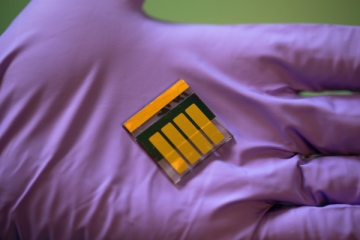
A material has been developed that solves the moisture vulnerability problem, which was a bottleneck in the commercialization of perovskite solar cells, the next-generation solar cell technology. A joint research team from UNIST and KIER developed a hole transport layer material with superior performance that does not absorb moisture by replacing hydrogen with fluorine in the spiro-structured hole transport layer. It exhibits strong hydrophobicity, a property similar to oil that prevents mixing with water, thereby not absorbing moisture.
2020.09.25by 이수민 기자
UNIST Challenges Development of 35% Efficiency Super Solar Cells
UNIST challenges the development of a super solar cell achieving 35% efficiency over five years, contributing to carbon neutrality and the advancement of Korea's photovoltaic industry.
2021.12.22by 배종인 기자
KIMM Successfully Mass-Produces Adhesive-Free Nano-Optical Devices
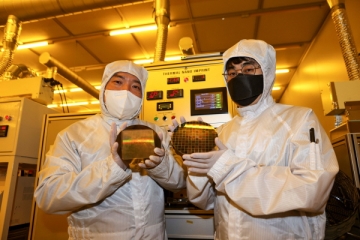
The Korea Institute of Machinery and Materials has developed, for the first time globally, a large-scale manufacturing technology for nano-optoelectronic devices based on chemically-adsorbed nanoimprint transfer that requires no adhesive, which is expected to significantly improve production processes for high-cost nano-optoelectronic devices used in various fields ranging from nano-photodetectors to nano-LEDs and nano-solar cells, thereby enhancing economic feasibility.
2022.03.17by 배종인 기자

Intel Unveils Next-Generation 'Core Ultra Series 3' and vPro Platform for Enterprise PCs
Intel has officially unveiled the "Intel Core Ultra Series 3" for next-generation enterprise PCs and the latest vPro platform, addressing a wide range of demands from enterprise notebooks to high-performance workstations.
2026.03.26by 배종인 기자
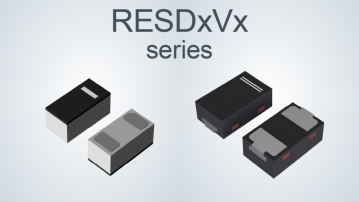
ROHM Launches ESD Protection Diode Compatible with High-Speed Interfaces of 10Gbps or Higher
Semiconductor specialist ROHM has developed the 'RESDxVx series' of ESD (electrostatic discharge) protection diodes capable of responding to next-generation high-speed data communication environments exceeding 10Gbps, simultaneously enhancing both signal quality maintenance required in high-speed interfaces and IC protection performance.
2026.03.26by 배종인 기자











