



Korea Must Accelerate Autonomous Driving Regulation Improvements
 Published2022.04.25 15:40
.jpg)
▲ Comparison of Autonomous Driving Systems in Major Countries (Source: KERI)
Maintenance according to technical level 3 or higher
As the global autonomous driving market grows to over $1 trillion by 2035 and the commercialization of autonomous driving gains momentum, there are growing calls in Korea to improve related regulations to commercialize Level 3 or higher autonomous driving.
The Korea Economic Research Institute argued on the 24th that as competition to secure a leading position in the autonomous vehicle market intensifies among major countries such as the United States, Germany, and Japan, Korea's institutional improvements are slow compared to the speed of legal and institutional reforms in these countries, making it urgent to reform the system to match the stage of technological development for the commercialization of autonomous driving.
Korea established the 'Act on Promotion of Commercialization and Support for Autonomous Vehicles', the 'Regulations on Safety Operation Requirements and Test Operations of Autonomous Vehicles', the 'Rules on Performance and Standards of Automobiles and Automobile Parts', the 'Automobile Management Act', and the 'Automobile Liability Insurance Act' from 2018 to last year.
On the other hand, it was found that no further legal or institutional improvements are being made for the commercialization of Level 3 or higher autonomous vehicles.
According to the Korea Economic Research Institute, driving distance and data accumulation of Korea's autonomous driving pilot services It was analyzed that the scale is insufficient compared to major countries such as the United States, and that the country is falling behind in the competition for the commercialization of Level 3 or higher autonomous vehicles.
On the other hand, countries such as the United States, Germany, and Japan have refined laws and systems related to autonomous driving and have already established the legal requirements for Level 3 vehicles to actually operate.
In 2016, the United States announced the Federal Autonomous Vehicle Policy (FAVP) and presented guidelines for each stage of autonomous driving, deciding to allow the operation of Level 3 or higher vehicles in accordance with the laws of each state government.
Germany plans to enact legislation in 2021 allowing the operation of Level 4 fully autonomous vehicles and enable full-time operation by the end of 2022.
Japan amended the Road Transport Vehicles Act in 2019 to establish a system to allow the operation of Level 3 autonomous vehicles and approved the commercial sale of Honda's Level 3 autonomous driving system.
In addition, fierce competition for the commercialization of Level 3 autonomous vehicles is unfolding, centered around major global automakers.
Tesla of the United States is promoting its Full Self-Driving (FSD) mode by unveiling technology that allows the vehicle to move without a human driver, and this is evaluated as Level 2.5 to 3.
Honda of Japan launched the Legend, an autonomous vehicle equipped with Level 3 capabilities, in March 2021.
Level 3, which the Honda Legend has obtained, is an autonomous driving type certification established by the Japanese Ministry of Land, Infrastructure and Transport, and the autonomous driving system can operate the vehicle instead of the driver only under specific conditions, such as driving on highways or driving on general roads at speeds of 50 km/h or less.
German automaker Mercedes-Benz also launched an S-Class at the end of 2021 that meets the Level 3 autonomous driving technology approval regulations (UN-R157).
UN-R157 is an international standard for automobiles established by the United Nations Economic Commission for Europe. Mercedes-Benz’s autonomous driving technology, Drive-Pilot, operates on specific sections of highways and at speeds of 60 km/h or less.
Hyundai Motor, a major domestic automaker, plans to develop 'HDP (Highway Driving Pilot),' a highway autonomous driving technology evaluated as Level 3, by the end of 2022 and install it in the Genesis 'G90.'
HDP enables autonomous driving at speeds up to 60 km/h even with hands off, and the system automatically accelerates and decelerates when entering or exiting intersections.
According to KPMG, the global market size for autonomous vehicles is projected to grow at an average annual rate of 41% from $7.1 billion in 2020 to $1 trillion in 2035.
In addition, according to the Korea Automotive Research Institute, more than half of new car sales in 2030 are expected to be equipped with Level 3 or higher autonomous driving technology.
The Korea Economic Research Institute pointed out that amidst a global craze for autonomous vehicle development, it is urgent to establish regulations for the commercialization of Level 3 or higher autonomous driving in Korea.
He emphasized that relevant laws must be revised rapidly in Korea as well, keeping pace with the speed of technological development.
In this regard, the Korea Economic Research Institute explained that to commercialize Level 3 autonomous driving in Korea, it is necessary to revise relevant laws, including relaxing driver duty of care for each autonomous driving mode, establishing requirements and exceptions for platooning, developing communication standards for autonomous vehicles connected to networks, implementing security measures for autonomous driving systems, and establishing road section marking standards for the mixed operation of autonomous and non-autonomous vehicles.
Furthermore, it was added that to commercialize Level 4 autonomous driving, a road and communication infrastructure management system must be established to prevent accidents, including creating a simplified license for autonomous driving, establishing grounds for driving prohibitions and disqualifications, setting up a certification system for structural changes, revising device standards such as seat arrangements, and establishing safety standards for parking lots in preparation for remote parking. />
Lee Kyu-seok, an associate research fellow at the Korea Economic Research Institute, emphasized, “Major global automakers are launching ‘Level 3’ autonomous vehicles and striving for technological development,” adding, “Improving regulations related to autonomous vehicles is urgent to support the development of autonomous vehicles by domestic automakers and strengthen their competitiveness in the global market.”

Comments
Related news
.jpg)
Autonomous Driving Commercialization, Sensor Problems Must Be Solved
While expectations for the commercialization of autonomous vehicles are growing, it appears that automakers have yet to find a definitive answer on which image sensor combination is optimal for driving and safety.
2022.04.04by 성유창 기자
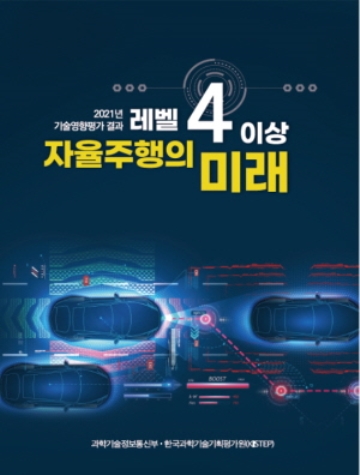
Ministry of Science and ICT Summary of Policy Recommendations for Level 4 Autonomous Driving
A publication has been released that compiles the results of discussions between experts and citizens regarding the impact that Level 4 or higher autonomous driving technology will have on the economy, society, and culture.
2022.04.06by 성유창 기자
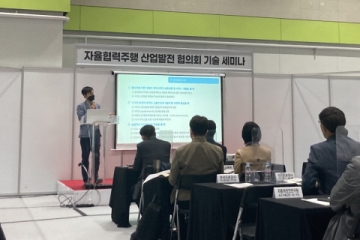
Seeking Ways to Advance Autonomous Driving… V2X and Precision Maps in One Place
A forum for information exchange seeking advanced measures in autonomous cooperative driving has been established, bringing together leading autonomous driving technologies including V2X solutions, high-precision road maps, and simulation for autonomous driving development.
2022.04.14by 성유창 기자
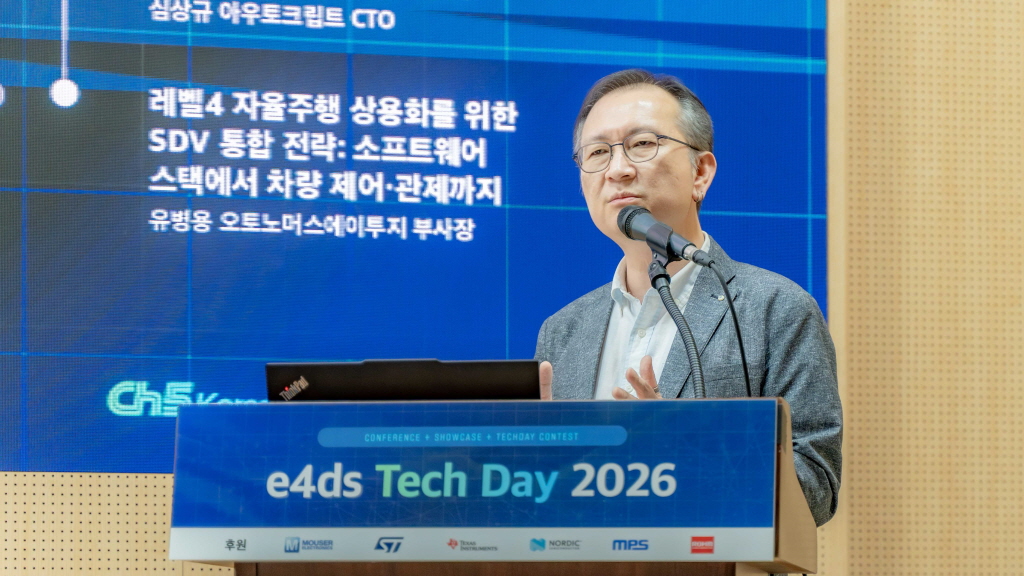
[e4ds Tech Day 2026 ⑨] Sim Sang-gyu, Autocrypt CTO: "In the Physical AI Era, Automotive Security Must Extend Beyond the Vehicle"
At e4ds Tech Day 2026, Sim Sang-gyu, CTO of Autocrypt, explained automotive cybersecurity strategies in the era of Physical AI and SDV (Software-Defined Vehicle). Automobiles are evolving as part of an ecosystem connected to AI, cloud, chargers, IoT, and robots, and he emphasized that the scope of security must expand beyond the vehicle interior to the entire connected environment. In particular, AI model tampering, adversarial attacks, OTA updates, and EV charger hacking were identified as major threats. He explained that response measures require zero trust, AI model integrity protection, intrusion detection, Security by Design and Default, and full lifecycle security management, and that proactive security system establishment beyond regulatory compliance is critical for securing future mobility competitiveness.
2026.10.12by 배종인 기자

Practical HIL Construction Strategy for Automotive and Off-Highway Controller Validation
As vehicle E/E architecture transitions to zonal structures and shifts to software-defined vehicles (SDV), the number of controllers (ECUs) requiring validation and software complexity are surging dramatically. Meanwhile, real vehicle testing cannot provide repeated verification under identical conditions and entails lead time and safety concerns. This white paper explains the principles of HIL (Hardware-in-the-Loop) validation and the structure of the NI platform composed of PXI, SLSC, and VeriStand, and through two actual implementation cases—Camera Record & Replay HIL for In-Cabin Monitoring Controller (ICMU) and Forklift Controller (VCU) HILS—describes how controller-level regression testing becomes possible. Additionally, it explicitly states application boundaries and limitations, such as lack of A2B support.
2026.10.12by 편집부











