



South Korea’s Semiconductor Market Share in China and China Plummets
 Published2022.04.25 16:23
New Government Urgently Needs Corporate Support to Maintain Semiconductor Super-Gap
As South Korea's semiconductor market share in China has plummeted following U.S. semiconductor supply restrictions, opinions have been raised within the new government that it is urgent to strengthen corporate support, including R&D investment, to maintain Korea's semiconductor super-gap.
The Federation of Korean Industries announced on the 25th that, following the US semiconductor supply restrictions imposed in 2019 on Huawei and SMIC—key pillars of China's semiconductor ambitions—it analyzed changes in market share for Chinese semiconductor imports by major countries and regions including Taiwan, Korea, ASEAN 6 (Vietnam, Singapore, Thailand, Philippines, Malaysia, Indonesia), Japan, and the US. The results showed that compared to 2018, Taiwan's market share increased by 4.4%p and Japan's by 1.8%p in 2021, while Korea's market share decreased by 5.5%p.
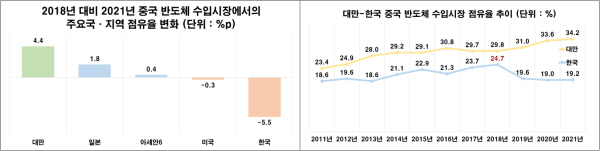
▲ Changes in market share against China
In 2021, China's semiconductor imports increased by 37.2% compared to 2018, the year immediately preceding the start of U.S. semiconductor supply restrictions against China, while semiconductor imports from Taiwan and Japan increased by 57.4% and 34.8%, respectively.
The increase in China's semiconductor imports from Taiwan is due to U.S. sanctions This is analyzed as a result of Chinese domestic companies and foreign-invested enterprises in China increasing imports of Taiwanese semiconductor chips as their purchases of U.S. semiconductors were blocked.
In contrast, China's semiconductor imports from South Korea increased by only 6.5%, as China's imports of South Korean memory in 2021 decreased by 13.7% compared to 2018 due to the impact of Huawei's suspension of purchasing South Korean memory following US regulations and falling memory semiconductor prices.
On the other hand, China's imports of microcontrollers (Mc-Controller Units), which are key non-memory semiconductors for home appliances, and other semiconductors from Korea increased by 69.3% and 67.7%, respectively.
In 2021, China's semiconductor imports amounted to $468.6 billion, which is about 1.8 times its crude oil imports of $255 billion. Semiconductors are important to the Chinese economy, to the extent that China's share of global semiconductor demand in 2020, based on the location of production countries, reached 60%.
Against this backdrop, China declared its ambition to become a semiconductor powerhouse in 'Made in China 2025' in 2015 and mobilized its full national capabilities to achieve a semiconductor self-sufficiency rate of 40% by 2020 (70% by 2025), but the actual semiconductor self-sufficiency rate in 2020 was only 15.8%.
According to IC Insights, in 2020, most of the semiconductor integrated circuits (ICs) produced in China were manufactured by foreign companies operating in China, such as TSMC, SK Hynix, Samsung, Intel, and UMC, while the share of local Chinese companies was only 36.5%.
On the other hand, China's semiconductor industry in 2021 (based on semiconductor integrated circuits) continues to grow quantitatively, with sales increasing by 61.0% and production volume by 94.0% compared to 2018.
The U.S. semiconductor industry anticipates that over the next 10 years, China, through robust support from its central government, will [fall] behind global majors in the fields of advanced node foundry production, equipment, and materials, where the gap is significant.It is expected that the number of cars will decrease.
In fact, SMIC, China's number one foundry company, announced a new investment of $5 billion (approximately 6.16 trillion won) in February of this year to expand its semiconductor production capacity, and Huahong Semiconductor, the number two company, set out to raise approximately 15 billion yuan (approximately 2.9 trillion won) through a secondary listing on the Shanghai Stock Exchange to secure investment funds.
Kim Bong-man, Head of the International Division at the Federation of Korean Industries, said, “As major countries such as the United States, China, Europe, and Japan are mobilizing their national capabilities to accelerate the establishment of an independent semiconductor ecosystem and the restructuring of supply chains, the new government launching in May must strengthen policy support, such as R&D investment and tax benefits for semiconductor companies, to secure a global lead for K-semiconductors.”
In fact, among the top five global semiconductor companies with the highest proportion of government subsidies relative to sales among 21 companies from 2014 to 2018, three were Chinese companies (SMIC 6.6%, Huahong 5%, Tsinghua Unigroup 4%), and US semiconductor companies also received a significant amount of government subsidies (Micron 3.8%, Qualcomm 3%, Intel 2.2%), whereas Samsung Electronics and SK Hynix were only 0.8% and 0.5%, respectively.
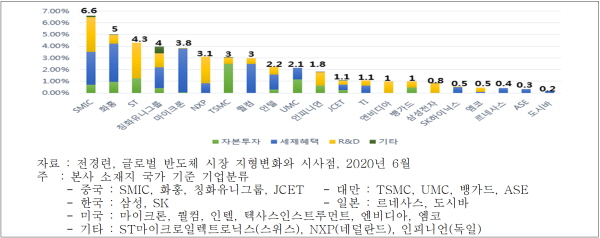
▲ OECD Analysis: Ratio of Government Subsidies to Revenue of Global Semiconductor Companies, 2014–2018 (Unit: %)
Director Kim Bong-man stated, “In mid-April, the Transition Committee designated the ‘Support Measures for Securing a Super-Gap in Semiconductors’ as a national agenda item for the new government.“The decision to review this marks the first step toward securing a super-gap in K-semiconductors, and I look forward to the government rapidly promoting the inter-ministerial development of the system semiconductor industry and strengthening of the global supply chain cooperation system immediately upon its launch,” he said.

Comments
Related news

"The US and China Must Maintain a Strategic, Symbiotic Relationship in the Global Supply Chain."
As US-China disputes expand into national security and advanced technology sectors, and uncertainties in global economic growth increase due to COVID-19 and protectionist trade policies across countries, experts have reached consensus that a strategic symbiotic relationship must be maintained between the United States and China. The Korea International Trade Association held a seminar on "2022 Global Trade Environment Outlook and Response Strategies" to discuss this year's trade prospects.
2022.01.14by 성유창 기자
.jpg)
“Parts are extremely difficult to come by, there is no 1K resistance”
Domestic component manufacturers are facing difficulties as production is disrupted by severe component shortages, with some components experiencing supply constraints. Due to high dependence on China for small components, there is a growing call for the need to create an environment that supports the revival of small component suppliers that have been struggling, in order to ensure the survival of Korea's electronics industry.
2022.01.21by 배종인 기자
Korea's semiconductor exports fiercely compete with East Asian countries... China and Taiwan in hot pursuit
Taiwan and China's improved export competitiveness is becoming pronounced, and semiconductor competition between South Korea and major East Asian countries is intensifying.
2022.04.05by 명세환 기자

Intel Unveils Next-Generation 'Core Ultra Series 3' and vPro Platform for Enterprise PCs
Intel has officially unveiled the "Intel Core Ultra Series 3" for next-generation enterprise PCs and the latest vPro platform, addressing a wide range of demands from enterprise notebooks to high-performance workstations.
2026.03.26by 배종인 기자

ROHM Launches ESD Protection Diode Compatible with High-Speed Interfaces of 10Gbps or Higher
Semiconductor specialist ROHM has developed the 'RESDxVx series' of ESD (electrostatic discharge) protection diodes capable of responding to next-generation high-speed data communication environments exceeding 10Gbps, simultaneously enhancing both signal quality maintenance required in high-speed interfaces and IC protection performance.
2026.03.26by 배종인 기자











