



Kia's "Getting Fair Value," Driving Sharp Q1 Earnings Growth
 Published2022.04.27 08:48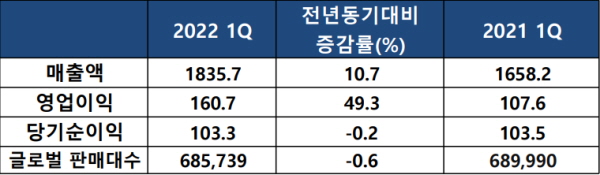
▲Kia 2022 Q1 Business Results Summary (Revenue, Operating Profit, Net Income unit: 100 million won, Sales Volume unit: units)
Revenue up 10.7% YoY, Operating Profit up 49.2%
Securing high-margin vehicle-focused sales structure…Expanding revenue and profitability
Kia Corporation held a corporate briefing (IR) via conference call at its headquarters in Yangjaedong, Seoul on the 22nd and announced that it sold 685,739 units (down 0.6%) in Q1 2022 on a wholesale basis, with the following business results: △Revenue of 18.357 trillion won (up 10.7%) △Operating profit of 1.6065 trillion won (up 49.2%) △Ordinary income of 1.518 trillion won (up 15.1%) △Net income of 1.0326 trillion won (down 0.2%). (IFRS consolidated basis)
Kia's global sales in Q1 2022 were △121,664 units in the domestic market, down 6.5% year-over-year △564,075 units overseas, up 0.7% year-over-year, for a total of 685,739 units globally, down 0.6% year-over-year on a wholesale basis.
Despite new Sportage launch effects and optimal production efforts, the domestic market declined 6.5% year-over-year due to production disruptions from semiconductor and other component supply shortages, which resulted in decreased sales of major models such as Sorento and Carnival.
The overseas market also experienced continued inventory shortages due to production disruptions from semiconductor shortages, but strong demand across all vehicle types continued in most regions. Through flexible production adjustments and redirecting Russian market sales volumes to other regions following shipment suspensions, sales disruptions were minimized, achieving significant sales increases in the North America, Europe, and India regions.
Q1 revenue reached 18.357 trillion won, up 10.7% year-over-year, despite decreased sales volume due to production disruptions. This was driven by higher average selling prices resulting from increased trim and specification levels of sold models and expanded RV proportions, along with won-dollar exchange rate appreciation.
The cost of revenue ratio improved by 2.1 percentage points year-over-year to 80.4%, as increased material costs and reduced sales volume were offset by significant revenue growth that diluted cost increases.
Operating profit improved significantly as Kia implemented a "getting fair value" pricing strategy by raising target profit margins by model type and substantially reducing incentives, leveraging improved product quality and enhanced brand recognition. This resulted in record-level average selling price increases.
The sales proportion of profitable RVs reached a record high of 61.3%, up 1.6 percentage points from the prior year period, and with favorable exchange rate effects, profitability improved significantly.
As a result, Q1 operating profit increased 49.2% year-over-year to 1.6065 trillion won, and the operating profit margin improved by 2.3 percentage points to 8.8%.
Meanwhile, Kia analyzed performance related to expanded eco-friendly vehicle sales as the company makes company-wide efforts for successful transformation into a "sustainable mobility solutions" company alongside the Q1 results announcement. (Retail sales basis hereinafter)
Kia's eco-friendly vehicle sales in Q1 this year reached 110,043 units, up 75.2% year-over-year, and the proportion of eco-friendly vehicle sales among total sales reached 15.8%, expanding by 6.9 percentage points from the prior year.
By type: △Hybrid vehicles composed of Niro, Sorento, and Sportage recorded 51,025 units (up 68.7% YoY) △Plug-in hybrid vehicles centered on Niro, Seed, and Sorento recorded 15,868 units (up 4.3% YoY) △Electric vehicles including EV6 and Niro EV recorded 43,150 units (up 148.9% YoY).
Particularly, in the domestic and Western Europe (EU+EFTA) markets, the EV6 that won the European Car of the Year award added to continued strong sales of the Niro EV, the existing flagship electric vehicle model, significantly expanding electric vehicle sales proportions to 7.6% domestically (2.7% last year) and 16.1% in Western Europe (10.6% last year).
Additionally, according to research by JATO, a global automotive industry research organization, Kia sold a total of 14,269 electric vehicles in the Western European market through February this year, recording an 8.7% market share and ranking as the second-place electric vehicle brand. (1st place: Tesla, 10.0%)
Last year, Kia sold a total of 63,419 units annually with a 5.4% market share, ranking 6th, but this year as EV6 sales ramp up, the company has established itself as a leading brand in the European electric vehicle market.
A Kia official stated, "Strong demand for Kia vehicles continues across all vehicle types and regions, and we are actively responding to production disruption environments through flexible production adjustments by model type and region. In Q2, we expect parts supply to improve and seasonal effects to materialize, leading to a full-scale recovery in sales."
While closely monitoring the continued COVID-19-related measures in some markets such as recent lockdowns in China's Shanghai region, rising raw material prices due to international instability, and concerns about reduced purchasing power due to inflation, Kia anticipates visible performance improvement from Q2 onward.
As domestic social distancing measures have been lifted recently, most COVID-19 impacts are expected to recede from Q2 onward, and semiconductor supply conditions are expected to ease somewhat, with global automobile demand projected to recover gradually.
Accordingly, Kia plans to maximize factory utilization rates in conjunction with improved parts and semiconductor supply conditions to rapidly absorb waiting demand and pursue sales expansion.
In particular, regarding the continued supply shortage despite strong demand sustained across all global regions, Kia will make every effort to resolve waiting demand through efforts including diversifying parts supply chains and maximizing available inventory and logistics efficiency.
Additionally, based on improved brand and product quality, Kia plans to continuously upgrade product and trim mix to maximize profitability.
Regarding the eco-friendly vehicle market, Kia anticipates that electric vehicle sales will expand even faster due to favorable global market reception of major electric vehicles such as EV6 and competitive new electric vehicle model launches by major automotive manufacturers.
Kia plans to intensify efforts in expanding eco-friendly vehicle sales, including the EV6 that proved its top-tier product quality by winning the European Car of the Year award and the new Niro, thereby increasing electric vehicle profitability and further strengthening brand positioning and electric vehicle market leadership as a "sustainable mobility solutions company."
Comments
Related news
Hyundai Motor, Q1 sales mix improvement and favorable exchange rate effects
Hyundai Motor's operating profit increased year-on-year despite lower sales volume, as improved sales mix centered on Genesis and SUVs, combined with favorable exchange rate effects from improved regional mix focused on developed countries, offset the volume decline.
2022.04.26by 성유창 기자
GAIA-Festa 2026, Autonomous Driving, AI, and Aerospace Experts Gather…Discussing Global Cooperation in the 'Silicon Intelligence Era'
GAIA-Festa 2026, which will be held in Suwon on October 27, is an industry-academia-research exchange event that explores the present and future of future mobility and AI technology through the global conference D-G2CAM 2026 and the international contest D-AMGC 2026. Domestic and international experts will share the latest research in autonomous driving, 5G/6G mobility, space technology, and data protection fields, while university students will showcase robots and physical AI prototypes that they have independently developed. Additionally, through poster presentations, corporate exhibitions, international cooperation meetings, and signing ceremonies, a platform will be established to connect the research capabilities and industrial needs of the Gyeonggi region with a global cooperation network.
2026.10.13by 배종인 기자

[e4ds Tech Day 2026 ⑨] Sim Sang-gyu, Autocrypt CTO: "In the Physical AI Era, Automotive Security Must Extend Beyond the Vehicle"
At e4ds Tech Day 2026, Sim Sang-gyu, CTO of Autocrypt, explained automotive cybersecurity strategies in the era of Physical AI and SDV (Software-Defined Vehicle). Automobiles are evolving as part of an ecosystem connected to AI, cloud, chargers, IoT, and robots, and he emphasized that the scope of security must expand beyond the vehicle interior to the entire connected environment. In particular, AI model tampering, adversarial attacks, OTA updates, and EV charger hacking were identified as major threats. He explained that response measures require zero trust, AI model integrity protection, intrusion detection, Security by Design and Default, and full lifecycle security management, and that proactive security system establishment beyond regulatory compliance is critical for securing future mobility competitiveness.
2026.10.12by 배종인 기자
Practical HIL Construction Strategy for Automotive and Off-Highway Controller Validation
As vehicle E/E architecture transitions to zonal structures and shifts to software-defined vehicles (SDV), the number of controllers (ECUs) requiring validation and software complexity are surging dramatically. Meanwhile, real vehicle testing cannot provide repeated verification under identical conditions and entails lead time and safety concerns. This white paper explains the principles of HIL (Hardware-in-the-Loop) validation and the structure of the NI platform composed of PXI, SLSC, and VeriStand, and through two actual implementation cases—Camera Record & Replay HIL for In-Cabin Monitoring Controller (ICMU) and Forklift Controller (VCU) HILS—describes how controller-level regression testing becomes possible. Additionally, it explicitly states application boundaries and limitations, such as lack of A2B support.
2026.10.12by 편집부
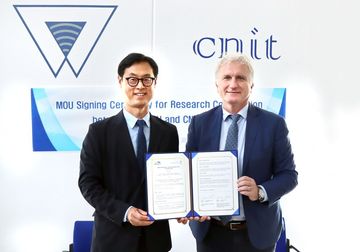
Korea Automotive Research Institute Signs MOU with Italy National Institute for Wireless Communications
The Korea Automotive Research Institute will sign an MOU with Italy's National Institute for Wireless Communications and launch joint research on next-generation mobility technologies based on 6G, V2X, and connected vehicles. The two organizations will conduct research to apply advanced wireless communication technologies to vehicles and discover international joint projects to advance next-generation connected vehicle technology development.
2026.10.12by 배종인 기자











