


Intel Develops Off-Road Autonomous Vehicle Simulation Platform for U.S. Defense Advanced Research Projects Agency
 Published2022.04.27 09:36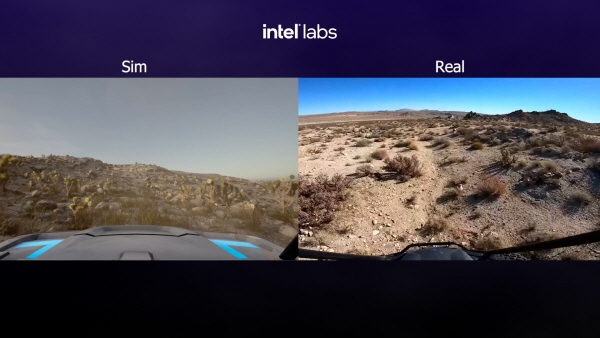
Aims to reduce development costs and bridge the gap between simulation and real-world environments.
Intel announced on the 27th that it has been selected as a developer for the Defense Advanced Research Projects Agency (DARPA) program to develop advanced simulation solutions for off-road autonomous ground vehicles, together with the Computer Vision Center (CVC) in Barcelona, Spain, and the University of Texas at Austin.
The Robot Autonomy with Resilience in Complex Environments – Simulation (RACER-Sim) program aims to create a next-generation off-road simulation platform to reduce development costs and bridge the gap between simulation and real-world environments.
German Roth, Director of Autonomous Agents at Intel Labs, said, “Intel Labs has already achieved results in advancing autonomous vehicle simulation through various projects, including the CARLA simulator.” “Intel is proud to participate in the RACER-Sim program and continue to contribute to the further advancement of off-road robots and autonomous vehicles,” said a representative. “Together with experts from the Barcelona Center for Computer Vision and the University of Texas at Austin, we have established a multi-purpose open platform to accelerate the development of off-road ground robots in all types of environments and conditions.”
In autonomous driving, the gap between public roads and off-road conditions remains significant. While many simulation environments exist, only a tiny fraction are large-scale autonomous driving simulation environments optimized for off-road conditions. Furthermore, real-world demonstrations continue to be the primary method used to verify system performance.
Off-road autonomous vehicles face practical challenges, such as insufficient road networks as well as extreme terrain featuring rocks and all kinds of vegetation. These conditions increase the development and testing costs of off-road autonomous vehicles and act as factors that slow down their progress.
The RACER-Sim program aims to solve these problems by providing advanced simulation technology to develop and test solutions, thereby shortening the time required to build and verify AI-powered autonomous systems.
The RACER-Sim program consists of two courses spanning a total of 48 months, aiming to accelerate the entire research and development process for off-road autonomous ground vehicle design.
In the first phase, Intel is focusing on developing a new simulation platform and mapping tools on an unprecedented scale that mimic complex offload environments—including physics, sensor modeling, and terrain complexity—with the highest accuracy. Creating large-scale simulation environments is a resource-intensive task and one of the biggest challenges in simulation work. Intel Labs' simulation platform is set to provide customized mapping capabilities in the future, such as creating large-scale new virtual environments of over 100,000 square miles with just a few clicks.
In the second phase, Intel Labs plans to implement new algorithms without using actual robots in collaboration with partner organizations participating in the RACER program to accelerate the research and development process. Subsequently, they intend to verify the robot's performance in simulation to save significant time and resources. In addition, they plan to develop Sim2Real technology, a concept that involves training a robot in a simulation to acquire skills and then transferring those skills to a real-world robotic system. Through this, the research team plans to directly train an off-road autonomous ground vehicle in a simulation.
Intel expects that the new simulation tool will significantly improve the development of autonomous systems using virtual testing, thereby greatly reducing the risks, costs, and development delays associated with existing test and verification protocols. Moving forward, the simulation platform plans to provide AI models prepared for real-world implementation, going beyond technical verification.
Comments
Related news
Intel Enters Automotive Semiconductor Foundry
Intel Foundry Services has announced the launch of a dedicated automotive group and plans to enter the automotive foundry market, raising tensions across the industry including Samsung.
2022.02.18by 성유창 기자
Intel and QuTech to Produce Large-Scale Silicon Qubits
As major IT companies like Google and IBM are accelerating their quantum computer development, Intel has achieved progress in the quantum computer development competition by successfully manufacturing silicon qubits on a large scale.
2022.04.15by 명세환 기자
.jpg)
Intel Announces Expansion of Discrete GPUs... Preparing for Next-Gen ZetaScale
"We've always wanted Intel to expand into discrete graphics" Just as the world has hoped, Intel employees themselves have long anticipated Intel's expansion into the discrete GPU market, much like Intel Fellow Aditya Navale, who has devoted more than 20 of his 30 years at Intel to graphics technology.
2022.04.20by 명세환 기자

[e4ds Tech Day 2026 ⑨] Sim Sang-gyu, Autocrypt CTO: "In the Physical AI Era, Automotive Security Must Extend Beyond the Vehicle"
At e4ds Tech Day 2026, Sim Sang-gyu, CTO of Autocrypt, explained automotive cybersecurity strategies in the era of Physical AI and SDV (Software-Defined Vehicle). Automobiles are evolving as part of an ecosystem connected to AI, cloud, chargers, IoT, and robots, and he emphasized that the scope of security must expand beyond the vehicle interior to the entire connected environment. In particular, AI model tampering, adversarial attacks, OTA updates, and EV charger hacking were identified as major threats. He explained that response measures require zero trust, AI model integrity protection, intrusion detection, Security by Design and Default, and full lifecycle security management, and that proactive security system establishment beyond regulatory compliance is critical for securing future mobility competitiveness.
2026.10.12by 배종인 기자

Practical HIL Construction Strategy for Automotive and Off-Highway Controller Validation
As vehicle E/E architecture transitions to zonal structures and shifts to software-defined vehicles (SDV), the number of controllers (ECUs) requiring validation and software complexity are surging dramatically. Meanwhile, real vehicle testing cannot provide repeated verification under identical conditions and entails lead time and safety concerns. This white paper explains the principles of HIL (Hardware-in-the-Loop) validation and the structure of the NI platform composed of PXI, SLSC, and VeriStand, and through two actual implementation cases—Camera Record & Replay HIL for In-Cabin Monitoring Controller (ICMU) and Forklift Controller (VCU) HILS—describes how controller-level regression testing becomes possible. Additionally, it explicitly states application boundaries and limitations, such as lack of A2B support.
2026.10.12by 편집부











