


Software that identifies drugs that can be made from chemical waste
 Published2022.04.29 14:04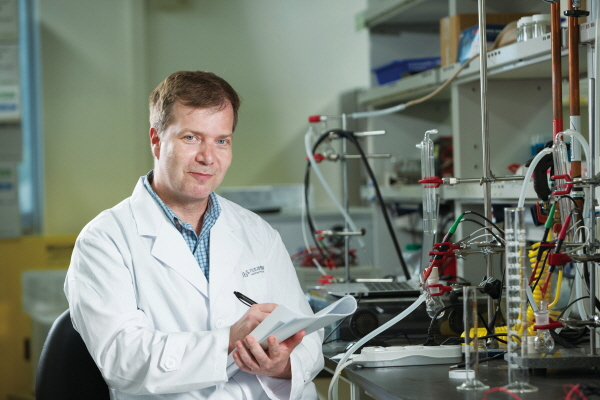
▲ Professor Bartosz Żybowski
Software Design Process Demonstration of 'On-site Production Pharmaceutical Machinery'
Software has been developed that can synthesize high-value pharmaceuticals or pesticides from chemical process waste.
According to a paper published in Nature on the 27th by UNIST Distinguished Professor Bartosz Grzybowski (Group Leader of the IBS Center for Advanced Soft Matter), this software can be used to produce 300 high-value pharmaceutical substances from a total of 189 types of chemical waste. These include the antipyretic analgesic ibuprofen and the blood pressure regulating drug carvedilol.
A Nature editorial that specifically featured this study described it as "the latest example contributing to the advancement of 'green chemistry' aimed at reducing the emission of hazardous substances."
Unwanted byproducts are generated in pharmaceutical processes for manufacturing drugs or chemical processes such as extracting biodiesel from biomass. Many of these byproducts are substances that are difficult to store for long periods or are toxic. Phenol produced during the coal refining process is a typical example.
If these by-products are recycled and converted into useful materials, it is possible to protect the environment and save on storage costs; however, it is not easy to find materials that can be produced using by-products as raw materials and the methods to synthesize them. This is because the combinations of materials that can be synthesized from raw materials are infinite, and even for the same substance, there are multiple ways to synthesize it, resulting in a much greater number of possibilities.
The software developed by the research team can drastically shorten this process. It not only identified 300 types of commercial drugs that can be synthesized from 189 chemical byproducts, including phenol, but also provides their synthesis pathways. By selecting synthesis conditions, it can filter out methods that use harmful solvents or require high temperatures.
The research team also conducted an experiment to synthesize actual drugs by running a 'pharmaceutical machine for on-site production' developed by a U.S. company, following the synthesis pathway designed by the software.
Notably, the main components of three drugs (muscle relaxants, sedatives, and anesthetics) used for the symptomatic treatment of severe COVID-19 could be synthesized according to the method designed by this software.
Meanwhile, this software was developed based on the software of the same name by Allchemy, a U.S. company. Allchemy is a company founded by Professor Bartosz Grzybowski and his research colleagues.

Comments
Related news
UNIST and Yonsei Medical Center Join Hands for Smart Healthcare
UNIST (President Yong-Hoon Lee) and Yonsei University Health System (Director Dong-Seop Yoon) will strengthen research capabilities and contribute to advances in medical technology through the joint promotion of research in the smart healthcare field.
2022.01.10by 배종인 기자
UNIST on the verge of commercializing 6G devices
A UNIST research team has proposed communication device technology capable of rapidly identifying OAM signals by utilizing self-designed metasurfaces, and is drawing expectations that this will accelerate the commercialization of 6G communications.
2022.03.22by 배종인 기자
UNIST develops artificial skin that can hear sound
An interface technology for controlling robots using artificial skin capable of hearing sound has been developed, and it is expected to be applied to avatar robots and other virtual reality, augmented reality, and Internet of Things applications in the future.
2022.03.28by 배종인 기자
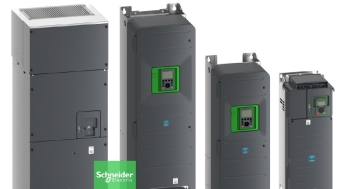
Schneider Aims for Building Energy Savings and Operational Stability with Next-Generation HVAC Drives
Schneider Electric has unveiled its next-generation HVAC drive product line 'Altivar HVAC'. The new product line's key features center on enhanced energy savings, system operational stability, and building management system integration. The products are divided into 'ATH200' for OEM and small equipment applications, and 'ATH600' for environments requiring continuous operation and advanced control. The company plans to expand the application scope from commercial buildings to facilities where HVAC system stability is critical, such as hospitals, airports, and data centers. The announcement includes over 30% energy savings, operation from -10°C to +60°C, Modbus and BACnet support, and compatibility with low global warming potential refrigerants.
2026.03.26by 명세환 기자
Ecolab Expands AI Data Center Cooling Business Through Acquisition of CoolIT
Ecolab has agreed to acquire CoolIT Systems, a liquid cooling company for AI data centers, for approximately $4.75 billion. The transaction is expected to close by Q3 2026, subject to regulatory approvals. CoolIT has been supplying direct-to-chip cooling-based coolant distribution units, cold plates, and manifolds, serving hyperscale data centers and colocation operators as customers. This acquisition is a measure to address the high-heat and high-density server environments created by AI proliferation. Ecolab plans to combine its water management and digital monitoring capabilities with CoolIT's hardware technology to expand its data center cooling business.
2026.03.26by 명세환 기자











