



[International Electric Vehicle Expo] Jeju TP Leads the Way in Electric Vehicle Charging Infrastructure and Utilization of Waste Batteries
 Published2022.05.06 10:52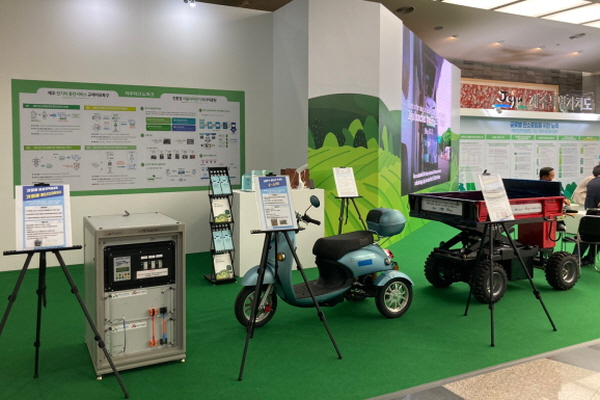
Introducing the Jeju EV Charging Service Regulatory-Free Zone's Key Projects
Recycling of waste batteries to power livestock and wind turbines
At the 9th International Electric Vehicle Expo, which has been held at the Jeju Convention Center since the 3rd, Jeju Technopark introduced various projects that highlight Jeju's unique characteristics, such as the Jeju Electric Vehicle Charging Service Regulatory Free Zone and the field of waste battery research.
The Jeju Electric Vehicle Charging Service Regulatory Free Zone, designed to revitalize the local economy and establish a model for its expansion through electric vehicle charging services, was established in 14 regions, including the Jeju Advanced Science and Technology Park. Designated from December 2019 to December 2023, four core projects are currently underway.
The first core business is ‘improving charging infrastructure to reduce charging times.’ This project aims to improve the performance of existing 50kW chargers by incorporating an equivalent energy storage system (ESS) to achieve a total capacity of 100kW. Current regulations lack certification standards for EV chargers that combine existing chargers with ESS, making them incapable of meeting the facility standards required for EV charging business registration. Jeju Technopark has requested a special exception to this requirement, requiring the establishment and approval of new EV charging facility standards that meet the certification requirements. This charging infrastructure not only reduces charging times by 50%, but also offers the advantage of enabling emergency charging in the event of a power outage or other disaster.
The second is a "mobile charging service for minimizing space occupied." This involves demonstrating a mobile electric vehicle charger equipped with an ESS. It is designed to be pushed and moved by users. Currently, due to insufficient certification standards for mobile chargers equipped with ESS, they cannot meet the facility criteria required for EV charging service providers. The biggest advantage of mobile chargers is that they can be used even without dedicated parking spaces.
A "charging infrastructure sharing platform" is also a key initiative. This platform allows others to charge privately owned chargers for a fee when the owner is not using them. Currently, only qualified charging operators are allowed to operate charging businesses, making sharing non-public chargers impossible. Sharing charging infrastructure is expected to alleviate the shortage of chargers and significantly improve operational efficiency.
The final key project on display is "Electric Vehicle Diagnostic Service Based on Charging Data." This demonstration demonstrates the feasibility of EV diagnostic services on mobile inspection vehicles. There's also hope that this could lead to the development of new mobile-based business models. While electric vehicles have a simpler structure than internal combustion engine vehicles, regulations prohibit diagnostics on vehicles while in motion. Jeju Technopark requested a special exemption to ease standards to allow electric vehicle performance status and inspections using mobile inspection vehicles, and received temporary approval in November of last year.
The Jeju Technopark Energy Convergence Center will secure its own battery technology centered on the electric vehicle battery industrialization infrastructure and foster the local energy industry through research in areas where local companies can prioritize utilization.
The center said it is continuously researching how to utilize spent electric vehicle batteries. When returned, spent batteries are stored in a battery storage facility and then tested in a process lab to determine whether they can be reused or recycled. Afterwards, they are classified by grade. Grades A and B are reused, while grades C, D, and E are recycled. The EV Battery Industrialization Center currently stores approximately 250 batteries, most of which are Grades A and B. The center collaborates with local companies to develop prototypes using tested spent batteries, demonstrating the utility of these batteries and contributing to regulatory easing.
Nickel and cobalt, the main raw materials for batteries, are both imported. The argument is that if recycling technology becomes more advanced, battery prices will drop, which will naturally lead to lower electric vehicle prices.
There are also challenges in utilizing waste batteries on Jeju Island. Electric vehicles cannot be scrapped at regular junkyards. There is only one electric vehicle junkyard on Jeju Island. Even at this location, they must be sent inland for recycling, but Ministry of Environment regulations prohibit their export. There is no word yet on when legislation allowing inland shipments will be passed. In 2017, we were only given permission to accept returns at the center.
The center said that the reason they do not proceed down to the cell level, even though they are storing everything including battery packs and modules, is because the process of moving from modules to cells itself is difficult due to lack of purchasing power and the difficulty in conducting process tests such as voltage and current.
Despite institutional and policy challenges, Jeju Technopark is committed to electric vehicle-related projects. Its ESS, made from recycled waste batteries, is designed to last for over 10 years and is being deployed at Jeju Island livestock facilities to benefit the lives of Jeju residents. Furthermore, it is leading the way in eco-friendly energy by installing waste batteries in wind turbines.
Comments
Related news
.jpg)
[International Electric Vehicle Expo] Organizing Committee Chairman Kim Dae-hwan: "National and local governments must proactively pursue electric vehicle policies."
"If policies and systems that can clearly present a vision for expanding electric vehicle adoption are established, the era of carbon neutrality could arrive much faster than anticipated."
2022.05.04by 성유창 기자
[e4ds Tech Day 2026 ⑨] Sim Sang-gyu, Autocrypt CTO: "In the Physical AI Era, Automotive Security Must Extend Beyond the Vehicle"
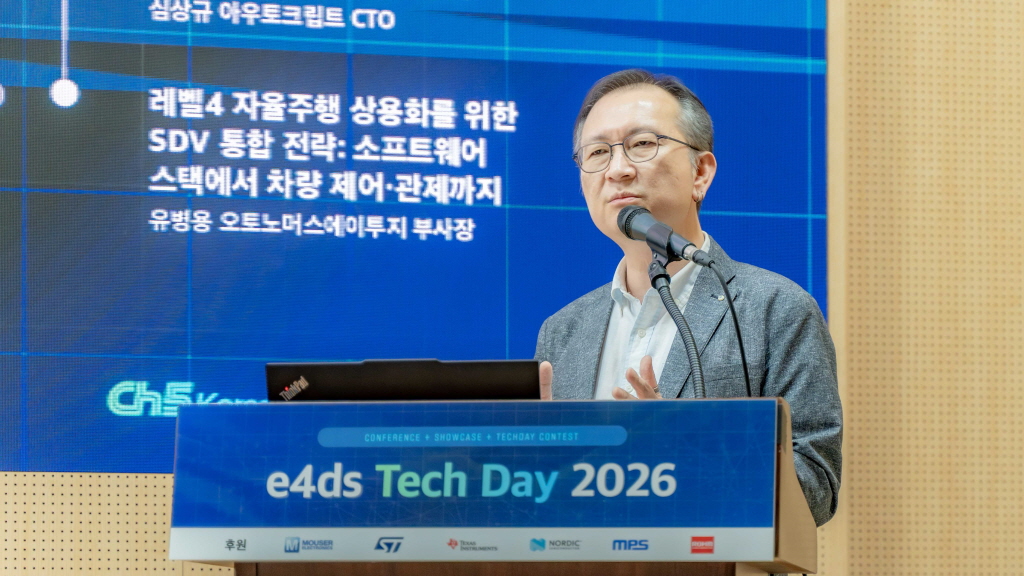
At e4ds Tech Day 2026, Sim Sang-gyu, CTO of Autocrypt, explained automotive cybersecurity strategies in the era of Physical AI and SDV (Software-Defined Vehicle). Automobiles are evolving as part of an ecosystem connected to AI, cloud, chargers, IoT, and robots, and he emphasized that the scope of security must expand beyond the vehicle interior to the entire connected environment. In particular, AI model tampering, adversarial attacks, OTA updates, and EV charger hacking were identified as major threats. He explained that response measures require zero trust, AI model integrity protection, intrusion detection, Security by Design and Default, and full lifecycle security management, and that proactive security system establishment beyond regulatory compliance is critical for securing future mobility competitiveness.
2026.10.12by 배종인 기자

Practical HIL Construction Strategy for Automotive and Off-Highway Controller Validation
As vehicle E/E architecture transitions to zonal structures and shifts to software-defined vehicles (SDV), the number of controllers (ECUs) requiring validation and software complexity are surging dramatically. Meanwhile, real vehicle testing cannot provide repeated verification under identical conditions and entails lead time and safety concerns. This white paper explains the principles of HIL (Hardware-in-the-Loop) validation and the structure of the NI platform composed of PXI, SLSC, and VeriStand, and through two actual implementation cases—Camera Record & Replay HIL for In-Cabin Monitoring Controller (ICMU) and Forklift Controller (VCU) HILS—describes how controller-level regression testing becomes possible. Additionally, it explicitly states application boundaries and limitations, such as lack of A2B support.
2026.10.12by 편집부
Korea Automotive Research Institute Signs MOU with Italy National Institute for Wireless Communications
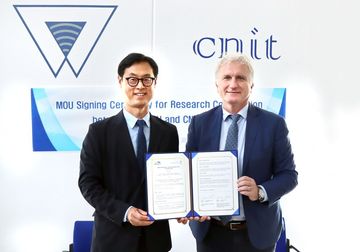
The Korea Automotive Research Institute will sign an MOU with Italy's National Institute for Wireless Communications and launch joint research on next-generation mobility technologies based on 6G, V2X, and connected vehicles. The two organizations will conduct research to apply advanced wireless communication technologies to vehicles and discover international joint projects to advance next-generation connected vehicle technology development.
2026.10.12by 배종인 기자
Color Accuracy Issues in Vehicle Interior Ambient Lighting and Intelligent LED Drivers
Vehicle interior ambient lighting is spreading across all price segments, and the level of color accuracy required of lighting designers is rising accordingly. This white paper quantitatively addresses why temperature drift and individual variations of RGB LEDs cannot be corrected by standard constant-current drivers, and explains an intelligent LED driver approach that integrates an MCU, calibration data, and a LIN network interface into the driver. It covers implementation details of the LITIX Interior TLD4020-3ET currently in production, portfolio roadmap, and evaluation/development environments, and clarifies application boundaries including lack of 48V support, lack of RGBi/ISELED support, and absence of direct optical degradation diagnostics.
2026.10.08by 명세환 기자











