



[International Electric Vehicle Expo] World Electric Vehicle Council General Assembly, “‘EVs’ Key to Low-Carbon Policy”
 Published2022.05.09 13:50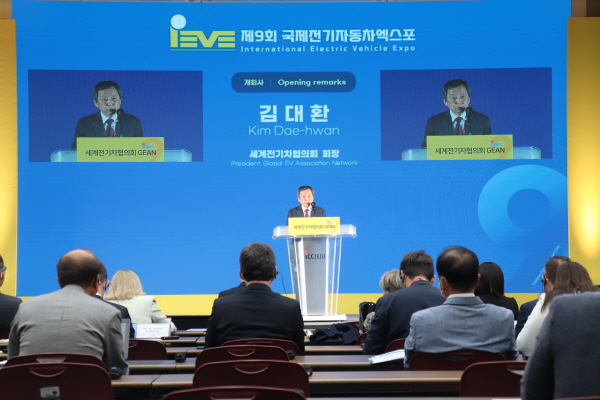
▲ GEAN Chairman Kim Dae-hwan (Photo: Sung Yoo-chang)
Rapid pace of EV transition… Including environment in buyer choices
Carbon Neutrality Is Not Just Korea's Problem... Global Solidarity Is Essential
GEAN held its 7th Annual General Meeting at the 9th International Electric Vehicle Expo, held at the Jeju Convention Center on the 3rd.
Kim Dae-hwan, Chairman of the Council and Co-Chair of the Expo, Maria Castillo Fernandez, Ambassador of the EU Delegation to Korea, and Kim Hyo-jeong, Director of the Ministry of Environment, gave presentations, and officials from various countries attended.
In his opening remarks, Chairman Kim noted that the transition to electric vehicles is happening faster than expected, interpreting this as environmental factors being included in buyers' choices. He conveyed that the world is striving to lower production costs and increase adoption rates to keep pace with this trend.
He said, “Electric cars are no longer the cars of the future.” "It is changing the landscape of the automotive industry, the corporate value of EV companies is skyrocketing day by day, and customers' choices are becoming clearer," he said, adding that "electric vehicles will play a key role in global low-carbon policies" and proposed expanding the related ecosystem.
Chairman Kim continued, “The International Electric Vehicle Expo is now the Olympics of e-mobility with the participation of over 40 countries worldwide,” adding, “This expo, consisting of over 100 sessions, has become an event worthy of its nickname as the Davos Forum of electric vehicles.”
In her congratulatory remarks, Ambassador Maria Castillo Fernandez emphasized solidarity in preparation for climate change.
Ambassador Fernandez stated, “The adoption of electric vehicles as part of carbon neutrality is a challenge that Korea, the EU, and others must overcome together,” adding, “The goal of reducing greenhouse gas emissions by more than 20% is an important policy and a major challenge for Europe as well.”
He went on to assess that Jeju is a leading local government in Korea pursuing carbon neutrality policies and could be an excellent partner with European countries.
Kim Hyo-jeong, Director of the Air Future Strategy Division at the Ministry of Environment, stated, “The automotive industry is a broad sector connected to various manufacturing industries,” adding, “The transition to electric vehicles will bring about changes not only in the environment but also in diverse other areas.”
Regarding policy, it was announced that 100% of public vehicles would be converted to zero-emission vehicles by 2022 and the battery exchange system for delivery motorcycles would be expanded.
He stated that private investment in electric vehicle charging infrastructure is active and emphasized the importance of moving forward together with the private sector and industry. He also stated that regarding charging infrastructure, they are designing a megastation at the War Memorial of Korea in Yongsan that combines charging, culture, and amenities.
In his keynote speech, Lim Chun-taek, President of the Korea Energy Economics Institute, explained that the battery market has grown explosively.
The price of lithium-ion batteries, which was $1,191 per kWh in 2010, fell by 89% to $137 in 2020, and the ESS market is expected to grow to 358 GW by 2030.
He stated that the growth of the battery market also affects the electric vehicle market, and according to Bloomberg New Energy Finance, 54% of global new car sales in 2040 will be electric vehicles.
With the rise of renewable energy following the Paris Climate Agreement, it accounted for 82% of new installed capacity in 2020. The importance of policies and systems was also emphasized, noting that while renewable energy accounted for 98.4% of electricity production in Norway and 44.5% in Germany in 2020, it was only 7.1% in Korea.
Comments
Related news
.jpg)
[International Electric Vehicle Expo] Organizing Committee Chairman Kim Dae-hwan: "National and local governments must proactively pursue electric vehicle policies."
"If policies and systems that can clearly present a vision for expanding electric vehicle adoption are established, the era of carbon neutrality could arrive much faster than anticipated."
2022.05.04by 성유창 기자
[International Electric Vehicle Expo] Korean Peninsula Policy Forum, A Venue of Promises for Inter-Korean Cooperation in EV Development
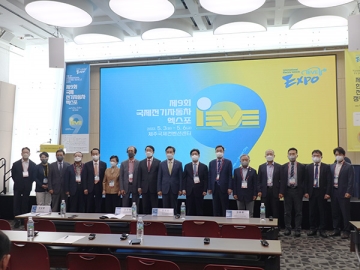
The 4th Korea Peninsula Policy Forum was held on May 3rd at the 9th International Electric Vehicle Expo (IEVE), which takes place from May 3rd (Tuesday) to 6th (Friday) at the Jeju International Convention Center (ICC JEJU) and throughout the Jungmun Tourism Complex.
2022.05.06by 김예지 기자
[International Electric Vehicle Expo] Jeju TP Leads the Way in Electric Vehicle Charging Infrastructure and Utilization of Waste Batteries
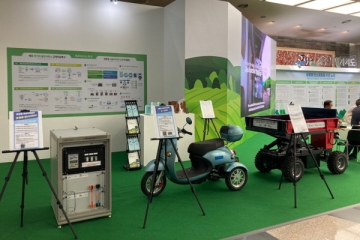
Jeju Technopark is moving closer to establishing an innovation and growth special zone for the electric vehicle-related industry that can be disseminated through research in electric vehicle charging and post-use battery sectors.
2022.05.06by 성유창 기자
[International Electric Vehicle Expo] Samsung SDI: "Achieving Electric Vehicle Battery Efficiency Through Appropriate Mechanisms"
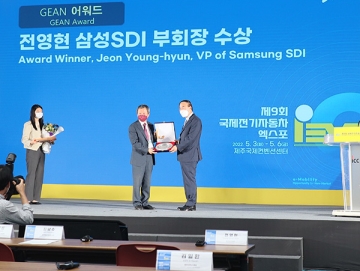
At the opening ceremony of the '9th International Electric Vehicle Expo (IEVE)', Vice Chairman Jeon Young-hyun received the World Electric Vehicle Association Award, and Vice President Jang Rae-hyuk, head of the Development Division of the Medium and Large Battery Business Unit, delivered the keynote speech.
2022.05.06by 김예지 기자
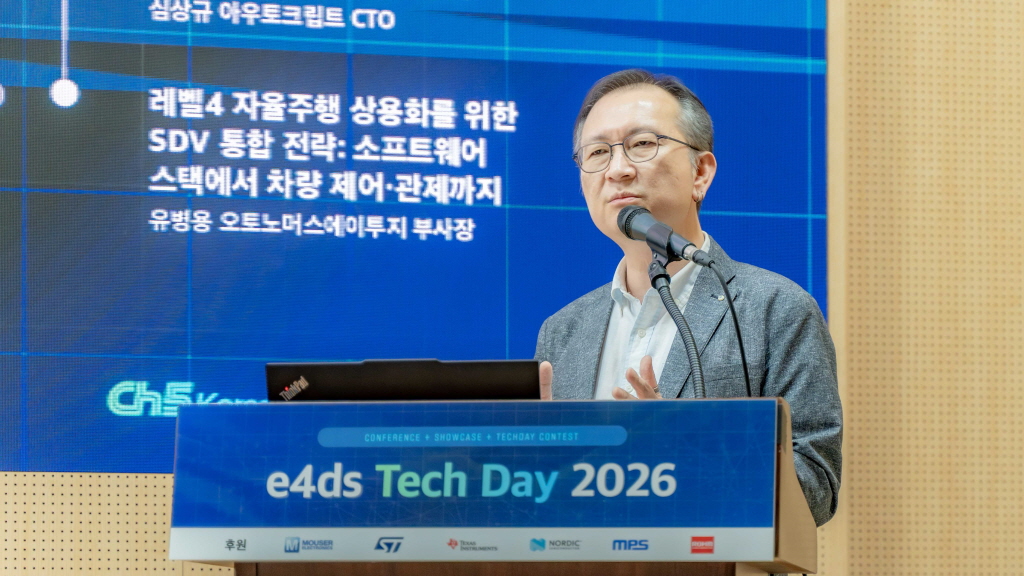
[e4ds Tech Day 2026 ⑨] Sim Sang-gyu, Autocrypt CTO: "In the Physical AI Era, Automotive Security Must Extend Beyond the Vehicle"
At e4ds Tech Day 2026, Sim Sang-gyu, CTO of Autocrypt, explained automotive cybersecurity strategies in the era of Physical AI and SDV (Software-Defined Vehicle). Automobiles are evolving as part of an ecosystem connected to AI, cloud, chargers, IoT, and robots, and he emphasized that the scope of security must expand beyond the vehicle interior to the entire connected environment. In particular, AI model tampering, adversarial attacks, OTA updates, and EV charger hacking were identified as major threats. He explained that response measures require zero trust, AI model integrity protection, intrusion detection, Security by Design and Default, and full lifecycle security management, and that proactive security system establishment beyond regulatory compliance is critical for securing future mobility competitiveness.
2026.10.12by 배종인 기자











