


[Technical Contribution] Starry Chai, ADI Manager – Automotive PMIC with Low IQ, Minimum On-Time, and Low EMI
 Published2022.05.17 09:37
MAX20057 maintains voltage regulation due to extremely low operating current requirements.
Includes spread spectrum function to lower peak EMI, contributing to size reduction.
■ Latest Cars with Surge in Power Demand Must Have Low Static Current and Low EMI
Despite improved fuel efficiency, the demand for electricity is growing as the latest cars continue to add advanced features.
Various convenience features, telematics connectivity, and infotainment functions provide information to the driver through the vehicle cluster and head-up display, and these functions are controlled using touchscreens and switches on the center console (commonly referred to as the radio head unit) (Figure 1).

▲Figure 1: Vehicle instrument cluster and center console
This article examines the design challenge of supplying multiple power rails to these systems using the vehicle's battery as the input power.
This paper describes the challenge of maintaining low quiescent current (IQ) and low EMI while supporting the required regulator output voltage range, and introduces a new automotive power management IC (PMIC) that meets these requirements.
■ Requirements for High-Efficiency DC-DC Converters />
To limit heat generation in automotive applications, a highly efficient DC-DC converter is required to meet the automotive manufacturer's stringent quiescent current requirements.
These converters must operate even at low battery input voltages to support cold crank and start-stop events.
A common approach to handling cold crank is to use multiple PMICs (and related components) to step down the battery voltage across two buck regulator stages.
This approach not only complicates circuit design and layout but also increases the size of the solution.
In addition, it is more susceptible to EMI interference, making it difficult to meet EMI standard requirements such as CISPR Class 5.
Another problem is that when the load is suddenly disconnected from the vehicle battery (load dump event), the rail voltage can momentarily spike, potentially generating a destructive transient voltage reaching 40V.
■ Use of highly integrated PMIC, simplified design
Instead of using a 2-stage step-down, the design can be simplified by using a highly integrated PMIC such as the MAX20057 shown in Figure 2. This PMIC offers several advantages over other automotive PMICs.
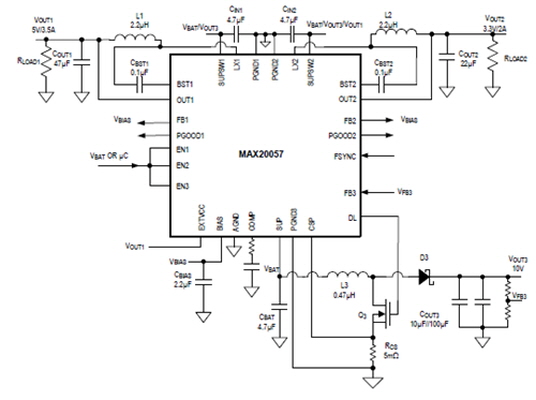
▲Figure 2: The MAX20057 provides a 36V boost controller and dual 3.5A/2A synchronous buck converters for automotive applications.
The MAX20057 is a highly integrated 3-output PMIC that includes two synchronous buck converters (3.5A and 2A) and one asynchronous boost controller.
The boost controller provides variable voltage (rated at 10V) to the buck converters, allowing the buck converters to maintain regulation even if the battery voltage drops to 2V during cold cranking.
Buck converters operate over a wide input voltage range of 3.5V to 36V and have extremely low operating current requirements of 10A (VOUT = 5V) and 8A (VOUT = 3.3V), making them particularly suitable for maintaining voltage regulation when the vehicle is turned off for a long time.
■ Spread Spectrum, EMI Mitigation
To mitigate EMI, a critical issue, this PMIC includes a user-selectable spread spectrum function. By using this function, peak EMI levels can be significantly reduced.
This feature reduces the magnitude of spurious energy by spreading it across a wide frequency band.
The regulator switching frequency is fixed at 400 kHz or 2.1 MHz. Using a high switching frequency allows for the use of smaller external components, reduces output voltage ripple, and prevents interference in the AM band.
In addition, this PMIC can be programmed to operate in one of three modes depending on the required performance, such as forced fixed frequency operation, skip mode operation with ultra-low quiescent current, and phase synchronization operation with respect to an external clock.
■ High voltage conversion ratio
Although there are several automotive PMIC products that include a buck regulator and provide low output voltage over a relatively wide input range, these products operate at low switching frequencies.
The reason is that the minimum voltage conversion ratio (VOUT/VIN) is limited due to the regulator's controllable minimum 'on-time' (typically 60ns to 120ns).
For proper fixed-frequency PWM operation and optimal efficiency, the buck regulator must operate in continuous conduction mode (CCM) during normal operation.
When it is CCM, the minimum input-to-output voltage ratio is determined according to the following formula.
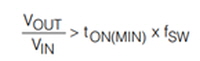
Therefore, assuming the buck regulator has a minimum 'on-time' of 120ns and an input voltage of 12V, the output voltage cannot be set below 3V to maintain CCM at 2.1MHz (considering actual design margins, there may be cases where it cannot be below 5V).
Before a lower outputPulse skipping is required to achieve the desired pressure (reduction in effective duty cycle).
On the other hand, doing this increases unwanted EMI. To maintain a constant switching speed, the switching frequency must be lowered, but this also has a negative impact on EMI performance.
This is exactly what differentiates the MAX20057 from other automotive regulators.
Since the rated minimum 'on-time' is only 20ns, the buck regulators in this PMIC are theoretically capable of an output voltage as low as 0.5V (2.1MHz switching frequency with a 12V battery input).
This is lower than the minimum output voltage specification (1V) that can be regulated, so a low voltage rail can be provided without the need to lower the switching frequency.
Therefore, excellent EMI performance can be maintained at a low output voltage.
Another version of this PMIC, the MAX20457, is a dual 3.5/2.5A buck converter (without a boost controller), and the MAX20458 is a product that integrates a single 3.5A buck converter and a boost controller.
All of these products are pin-compatible (enabling a single-board design across various applications) and operate within an automotive temperature range of -40°C to +125°C.
■ High-efficiency PMIC overcomes design challenges with low 'on-time'
In this article, we examined how to supply power to the infotainment, telematics, and head unit systems located in the vehicle's cluster and center console.
Some solutions may have the problem of having to compromise on the output voltage range for EMI performance.
We introduced a highly efficient automotive PMIC that overcomes these design challenges with low 'on-time'.
This PMIC features all of the stop-start function. Suitable for use in vehicles of this type.
※ This article was written by Starry Tsai, Business Manager for Automotive Power at Analog Devices, Inc.

Comments
Related news

ADI Launches Millimeter Wave 5G Chipset
Analog Devices has launched a millimeter-wave (mmW) 5G chipset that enables wireless system designs to be implemented in a compact and simple manner, and is drawing expectations that it will reduce the number of components required for 5G wireless.
2022.03.31by 배종인 기자
ADI Receives Highest Level of Automotive Security Certification for wBMS
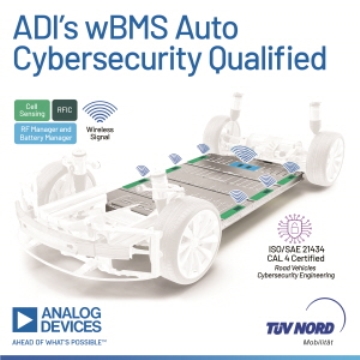
Analog Devices' wireless battery management system (wBMS) has obtained the highest level of automotive cybersecurity certification, meeting the reliability standards required by the industry.
2022.04.01by 배종인 기자
.jpg)
ADI Announces Ethernet Solutions for Building Automation
Analog Devices launches an Ethernet solution for small edge devices with limited power consumption, leading the digitalization of building automation networks.
2022.04.29by 강정규 기자
GAIA-Festa 2026, Autonomous Driving, AI, and Aerospace Experts Gather…Discussing Global Cooperation in the 'Silicon Intelligence Era'
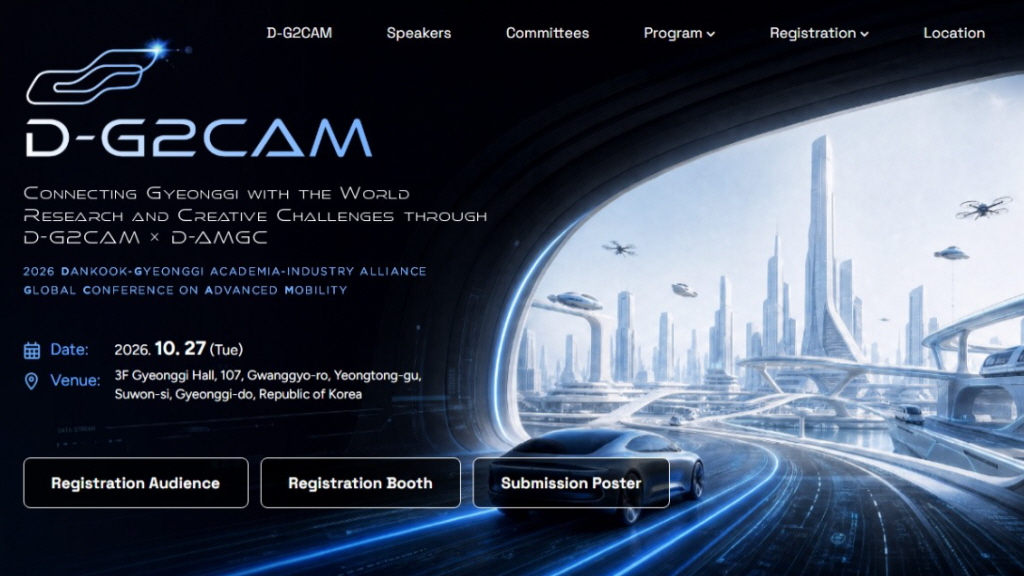
GAIA-Festa 2026, which will be held in Suwon on October 27, is an industry-academia-research exchange event that explores the present and future of future mobility and AI technology through the global conference D-G2CAM 2026 and the international contest D-AMGC 2026. Domestic and international experts will share the latest research in autonomous driving, 5G/6G mobility, space technology, and data protection fields, while university students will showcase robots and physical AI prototypes that they have independently developed. Additionally, through poster presentations, corporate exhibitions, international cooperation meetings, and signing ceremonies, a platform will be established to connect the research capabilities and industrial needs of the Gyeonggi region with a global cooperation network.
2026.10.13by 배종인 기자
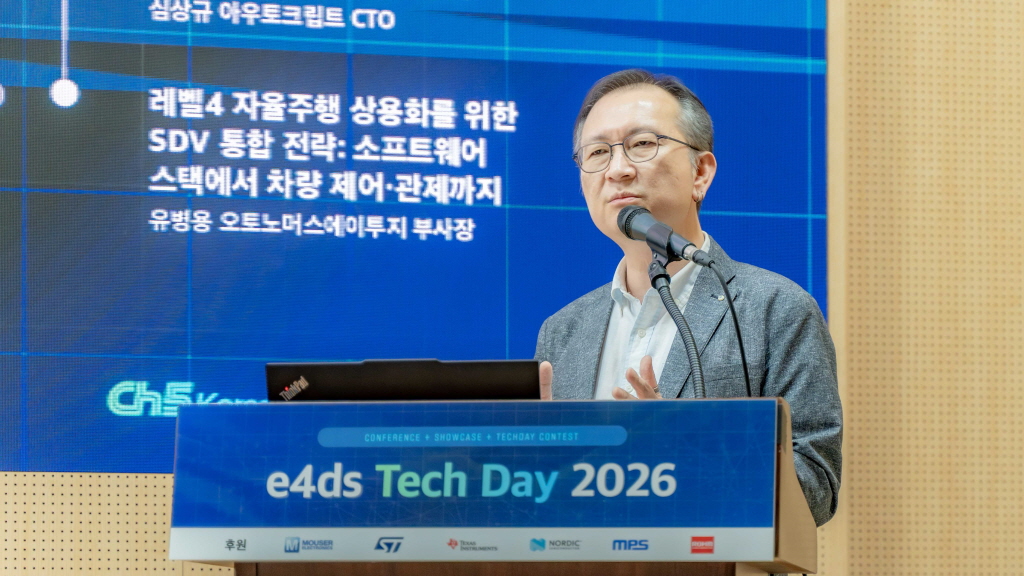
[e4ds Tech Day 2026 ⑨] Sim Sang-gyu, Autocrypt CTO: "In the Physical AI Era, Automotive Security Must Extend Beyond the Vehicle"
At e4ds Tech Day 2026, Sim Sang-gyu, CTO of Autocrypt, explained automotive cybersecurity strategies in the era of Physical AI and SDV (Software-Defined Vehicle). Automobiles are evolving as part of an ecosystem connected to AI, cloud, chargers, IoT, and robots, and he emphasized that the scope of security must expand beyond the vehicle interior to the entire connected environment. In particular, AI model tampering, adversarial attacks, OTA updates, and EV charger hacking were identified as major threats. He explained that response measures require zero trust, AI model integrity protection, intrusion detection, Security by Design and Default, and full lifecycle security management, and that proactive security system establishment beyond regulatory compliance is critical for securing future mobility competitiveness.
2026.10.12by 배종인 기자











