


Global NEV sales surpass 2 million units, up 80% year-over-year.
 Published2022.05.17 09:53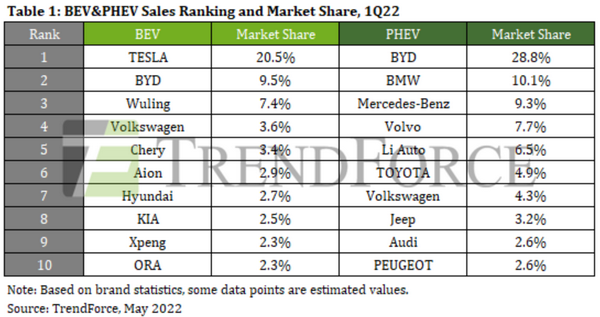
▲Global BEV & PHEV sales rankings and market share in Q1 2022 (Source: TrendForce)
Tesla solidifies its lead, with sales up 68% year-over-year.
The Russo-Ukrainian War is keeping the secondary battery industry on edge.
According to TrendForce data, total sales of new energy vehicles (NEVs, including battery electric vehicles, plug-in hybrid electric vehicles, and fuel cell vehicles) in the first quarter of 2022 reached 2,004,000 units, representing an average annual growth rate of 80%.
Battery electric vehicles (BEVs) saw the strongest growth, selling 1.508 million units. Plug-in hybrid electric vehicles (PHEVs) sold 493,000 units.
Despite a 7% year-on-year decline in global auto sales in the first quarter due to factors such as a semiconductor shortage, the Russia-Ukraine conflict, and China's pandemic lockdown and preventive measures, NEV sales achieved remarkable growth.
Among BEV brands, Tesla ranked first with over 310,000 units sold in the first quarter, giving it a 20.5% market share. Chinese automaker BYD ranked second with 143,000 units sold and a 9.5% market share.
Tesla's first-quarter sales of 310,048 units also represent a 68% increase over the same period last year. As sales increased, production of the flagship models, Model X and Y, also increased by 69% year-on-year to 305,407 units in the first quarter.
BYD, which announced in April that it would stop producing fossil fuel vehicles and fully transition to a NEV manufacturer, saw its BEV sales surge 271% in the first quarter compared to the same period last year.
Last year, on the other hand, small cars and low-priced models such as Chery's Ant and Changan's Benben were released, and Wuling, a subsidiary of SAIC-GM, had been in second place since the launch of the Wuling Hongguang MINI in 2020, but fell to third place in the first quarter of 2022.
BYD also stood out in the PHEV market. BYD once again broke its quarterly sales record. In the first quarter of 2022, it sold 142,000 units, achieving a market share of 28.8%. TrendForce predicted that with the launch of various PHEV models, it will become increasingly difficult for a small number of companies to secure a significant market share.
The industry expects that most automakers will adopt a strategy prioritizing electric vehicle production. Accordingly, growth in NEV sales is also expected in 2022.
Eco-friendly vehicles continue to gain popularity in Korea. According to data from the Ministry of Trade, Industry and Energy, domestic sales of eco-friendly vehicles reached 126,940 units between January and April 2022, accounting for 24.6% of total sales. This represents a 35.1% increase compared to the same period last year. Although overall sales decreased by 13% to 516,039 units due to the automotive semiconductor shortage, the proportion of eco-friendly vehicles increased, confirming their growing presence.
The global trend toward eco-friendly vehicles also presents a bleak outlook. The Russo-Russian War has hampered battery cost stability. Nine percent of nickel production, a key fuel for electric vehicle batteries, comes from Russia. Nickel prices, which had soared to $42,995 per ton on March 7th due to the war, fell to $26,105 on May 16th. While this may seem like a relief, it is still 41.2% higher than the previous year's average.
SNE Research reported on the 16th that if Russian nickel sanctions become reality, it will inevitably impact the price of nickel for secondary batteries. The South Korean government also reconsidered the sale of the Ambatovy mine in Madagascar, which it had been considering, and emphasized the importance of supply stabilization. As long as the war continues, the secondary battery industry is unlikely to relax.
Hyundai Motor Company is investing 9 trillion won to build a dedicated electric vehicle (EV) plant in Georgia, USA, and fierce competition is expected among the global EV industry. Hyundai Motor Group's aggressive investment is interpreted as an attempt to dominate the North American EV market, where companies like Tesla, GM, and Volkswagen are fiercely competing.
The industry reported that the government and companies are deeply concerned about resource issues and market dominance in new energy vehicles, which have emerged as a future food source.
Comments
Related news
Benz, Tesla, BMW, etc. recalled due to SW errors
Seven global automakers, including Mercedes-Benz, Tesla, and BMW, are recalling vehicles due to manufacturing defects including software issues.
2022.05.12by 성유창 기자
Hyundai Mobis' Competitiveness in 'Future Car SW Platform' Development Rises
Hyundai Mobis announced on the 12th that it has signed a memorandum of understanding with German company Vector to jointly develop an AUTOSAR-based software platform.
2022.05.12by 성유창 기자
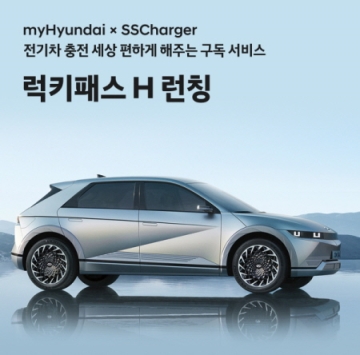
Hyundai Motor Launches Subscription-Based Electric Vehicle Charging Plan
Hyundai Motor announced on the 16th that it will launch "Lucky Pass H," a subscription-based electric vehicle charging rate plan product targeting its electric vehicle customers.
2022.05.16by 성유창 기자
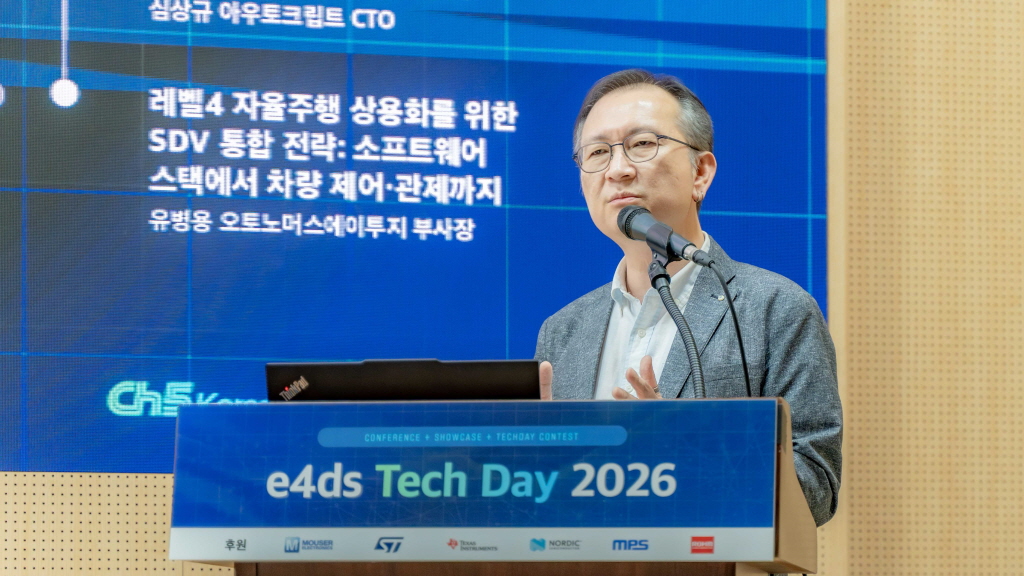
[e4ds Tech Day 2026 ⑨] Sim Sang-gyu, Autocrypt CTO: "In the Physical AI Era, Automotive Security Must Extend Beyond the Vehicle"
At e4ds Tech Day 2026, Sim Sang-gyu, CTO of Autocrypt, explained automotive cybersecurity strategies in the era of Physical AI and SDV (Software-Defined Vehicle). Automobiles are evolving as part of an ecosystem connected to AI, cloud, chargers, IoT, and robots, and he emphasized that the scope of security must expand beyond the vehicle interior to the entire connected environment. In particular, AI model tampering, adversarial attacks, OTA updates, and EV charger hacking were identified as major threats. He explained that response measures require zero trust, AI model integrity protection, intrusion detection, Security by Design and Default, and full lifecycle security management, and that proactive security system establishment beyond regulatory compliance is critical for securing future mobility competitiveness.
2026.10.12by 배종인 기자
Practical HIL Construction Strategy for Automotive and Off-Highway Controller Validation
As vehicle E/E architecture transitions to zonal structures and shifts to software-defined vehicles (SDV), the number of controllers (ECUs) requiring validation and software complexity are surging dramatically. Meanwhile, real vehicle testing cannot provide repeated verification under identical conditions and entails lead time and safety concerns. This white paper explains the principles of HIL (Hardware-in-the-Loop) validation and the structure of the NI platform composed of PXI, SLSC, and VeriStand, and through two actual implementation cases—Camera Record & Replay HIL for In-Cabin Monitoring Controller (ICMU) and Forklift Controller (VCU) HILS—describes how controller-level regression testing becomes possible. Additionally, it explicitly states application boundaries and limitations, such as lack of A2B support.
2026.10.12by 편집부











