


We will support labor transitions, including job transfers and career training, in line with the shift to future vehicles.
 Published2022.05.23 09:02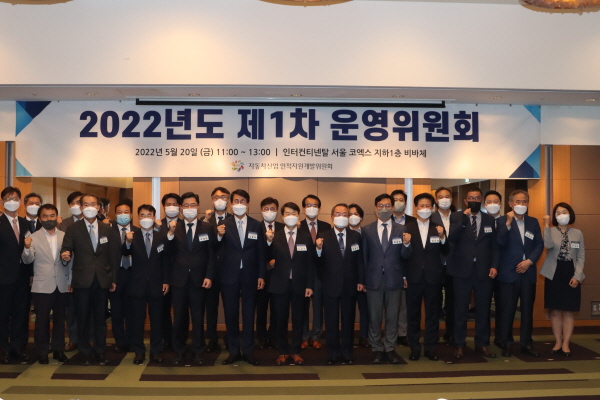
▲On the 20th, the ‘1st Steering Committee’ was held at the Vivace Hall of the InterContinental Seoul COEX in Gangnam-gu, Seoul. (Photo courtesy of Korea Automotive Research Institute)
The Automotive Industry Human Resources Development Committee held its first steering committee meeting.
Identifying the needs of the automotive industry workforce and standardizing future automotive industry job skills.
The Korea Automobile Research Institute (KARI), the representative organization of the Automotive Industry Human Resources Development Committee (hereinafter referred to as the Automotive ISC), held the '1st Steering Committee' at the Vivace Hall of the InterContinental Seoul COEX in Gangnam-gu, Seoul on the 20th.
The Automotive ISC was established in July of last year by the Korea Automotive Research Institute, the Ministry of Employment and Labor, and the Korea Human Resources Development Institute for Industry to support the following: △ identifying the demand for human resources in the future automobile sector due to the rapid transformation of the automobile industry; △ standardizing job skills in the future automobile industry; and △ providing customized human resource development centered on the field.
The event was attended by approximately 40 key figures from the private, public, and research sectors in the automobile industry, including Na Seung-sik, the chairman of the Automobile ISC, as well as Ryu Kyung-hee, the director of the Ministry of Employment and Labor's Job Skills Policy Bureau, Park Jae-young, the director of the Ministry of Trade, Industry and Energy's Manufacturing Industry Policy Bureau, Kim Dong-wook, vice president of Hyundai Motor Company, Jeong Moo-young, managing director of Ssangyong Motor Company, Kim Joo-hong, director of the Korea Automobile Manufacturers Association's Policy Research Institute, Kang Soon-geun, president of the Korea Automobile Specialized Maintenance Association, and Heo Geon-soo, professor at Hanyang University.
Ryu Kyung-hee, Director General of the Ministry of Employment and Labor, who attended the event, said, “I hope that the Automotive ISC will play a major role in solving the problem of customized human resource development that the industry is facing by identifying the supply and demand of human resources by job type and establishing the National Competency Standards (NCS) for the future automobile sector.”
Park Jae-young, policy officer at the Ministry of Trade, Industry and Energy, said, "In the midst of fierce global competition, our companies have an advantage.In order to take the lead, we must first reform the human resource system to be able to cultivate key talents suitable for the future automobile field,” he said. “It is very encouraging that the Automotive ISC has started this discussion, and I hope that the Automotive ISC will serve as a milestone in cultivating talents essential to the industrial field in the future.”
At the event, the following were reported: △The progress and mid- to long-term plans for the automobile ISC business, and △The 2022 automobile ISC business plan.
The first agenda item was to report on the status of recruitment of participating organizations for the Automotive ISC since its launch, the establishment of a business plan for 2022, and the progress of business implementation, while also announcing a mid- to long-term plan with a vision of representative governance for future automotive human resource development.
The second agenda item highlighted the current status of future vehicle workforce demand and the need for strengthened workforce support, and shared the implementation plans of the Automotive ISC, including its unique business, autonomous planning business, and individual business.
We anticipate that this event will serve as a catalyst for the full-scale activities of the Automotive ISC, proactively reflecting the needs of the future vehicle market within the automotive industry and playing an effective role in systematic human resource development and employment revitalization in the automotive industry.
Na Seung-sik, Chairman of the Automotive ISC, said, “I hope that the automotive industry will take a leap forward by taking advantage of this major turning point in its history to establish a sustainable human resource development system.” He added, “As the representative organization of the Automotive ISC, we will do our best to improve the human resource development system, including thorough analysis of core duties and technical capabilities and NCS development, to fit the future industrial structure.”
Comments
Related news

KAMA·ACEA, “Adjusting the Speed of Transition to the EV Era Is Essential”
The Korea Automobile Manufacturers Association (KAMA) held a regular consultation meeting with the European Automobile Manufacturers Association (ACEA) in Brussels, Belgium on the 10th local time.
2022.05.13by 성유창 기자
Hanjaeyeon and Saenggiwon Join Forces to Strengthen Competitiveness in the Future Automotive Industry
The Korea Automotive Research Institute (hereinafter referred to as KARI) is joining hands with the Korea Institute of Industrial Technology (hereinafter referred to as KITECH) to lead the development of the future automotive industry.
2022.05.17by 성유창 기자

[e4ds Tech Day 2026 ⑨] Sim Sang-gyu, Autocrypt CTO: "In the Physical AI Era, Automotive Security Must Extend Beyond the Vehicle"
At e4ds Tech Day 2026, Sim Sang-gyu, CTO of Autocrypt, explained automotive cybersecurity strategies in the era of Physical AI and SDV (Software-Defined Vehicle). Automobiles are evolving as part of an ecosystem connected to AI, cloud, chargers, IoT, and robots, and he emphasized that the scope of security must expand beyond the vehicle interior to the entire connected environment. In particular, AI model tampering, adversarial attacks, OTA updates, and EV charger hacking were identified as major threats. He explained that response measures require zero trust, AI model integrity protection, intrusion detection, Security by Design and Default, and full lifecycle security management, and that proactive security system establishment beyond regulatory compliance is critical for securing future mobility competitiveness.
2026.10.12by 배종인 기자

Practical HIL Construction Strategy for Automotive and Off-Highway Controller Validation
As vehicle E/E architecture transitions to zonal structures and shifts to software-defined vehicles (SDV), the number of controllers (ECUs) requiring validation and software complexity are surging dramatically. Meanwhile, real vehicle testing cannot provide repeated verification under identical conditions and entails lead time and safety concerns. This white paper explains the principles of HIL (Hardware-in-the-Loop) validation and the structure of the NI platform composed of PXI, SLSC, and VeriStand, and through two actual implementation cases—Camera Record & Replay HIL for In-Cabin Monitoring Controller (ICMU) and Forklift Controller (VCU) HILS—describes how controller-level regression testing becomes possible. Additionally, it explicitly states application boundaries and limitations, such as lack of A2B support.
2026.10.12by 편집부
Korea Automotive Research Institute Signs MOU with Italy National Institute for Wireless Communications
The Korea Automotive Research Institute will sign an MOU with Italy's National Institute for Wireless Communications and launch joint research on next-generation mobility technologies based on 6G, V2X, and connected vehicles. The two organizations will conduct research to apply advanced wireless communication technologies to vehicles and discover international joint projects to advance next-generation connected vehicle technology development.
2026.10.12by 배종인 기자











