


[EV/EV Charger Workshop] KEPCO Accelerates Expansion of Electric Vehicle Charging Infrastructure
 Published2022.05.24 11:16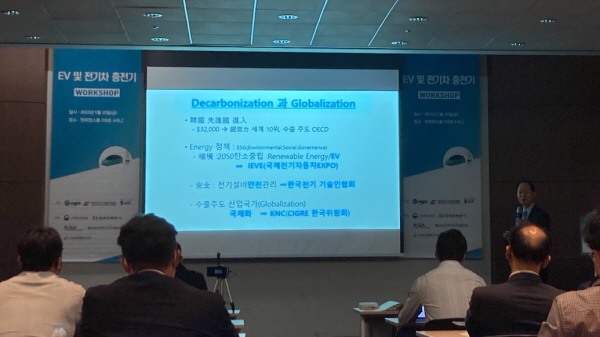
▲Lee Dong-il, Secretary General of the Sigre Korea Committee, is giving a presentation.
Establish 1.7 million public rapid chargers and 500,000 slow chargers by 2025.
Allocate at least 5% of outdoor parking spaces nationwide to eco-friendly vehicles.
At the 'EV and Electric Vehicle Charger Workshop' held by the Cigre Korea Committee on the 20th, Song Nam-hoon, Vice President of Korea Electric Power Corporation, announced that the company will respond to climate change by reducing carbon dioxide emissions (CO2eq) by 29.7 million tons by distributing 4.5 million electric and hydrogen vehicles by 2030.
Last October, the government raised its target to reduce national greenhouse gas emissions by 40% by 2030 compared to 2018 levels. As part of this effort, the transportation sector also set a goal of distributing over 4.5 million zero-emission vehicles, reducing emissions by 37.8% by 2030 compared to 2018 levels.
As of March 2022, there are 258,253 electric vehicles and 106,620 public chargers installed, including 15,725 rapid chargers and 90,895 slow chargers. The growth rate of electric vehicles is very fast, with the number of electric vehicles increasing 44-fold from 5,853 in 2015 and the number of public chargers increasing 158-fold.
Charging policies are also evolving to achieve the goal of 1.13 million electric vehicles by 2025 and 3 million by 2030. At least 5% of all off-street parking spaces nationwide will be designated as dedicated spaces for eco-friendly vehicles. Furthermore, the law includes a mandatory purchase system for eco-friendly vehicles for public institutions. All vehicles purchased by public institutions last year were also eco-friendly.
As demand for electric vehicles grows, significant investment is being made in charging infrastructure. KEPCO announced plans to install 17,000 public fast chargers and 500,000 slow chargers by 2025. Fast chargers will be installed at highway and national highway rest areas, public parking lots, and other locations. Slow chargers will be installed at a ratio of at least one charger for every two electric vehicles at residences, workplaces, and other locations. To prevent a charger shortage, mandatory installation of electric vehicle charging facilities was expanded and the ratio of charging stations increased in January 2022.
KEPCO is developing and implementing a platform service that provides convenience to charging service providers and drivers. The platform serves as an intermediary, supporting "roaming," where charging service providers provide services to subscribers through partnered third-party chargers even in areas where their own chargers are not available. We have made it possible to roam with all other companies through KEPCO's platform without having to build a group-specific roaming system between businesses.
Despite the considerable efforts of domestic industry, academia, and research institutes, China is considered the leader in the charging market and the first country to achieve 50% domestic electric vehicle sales.
In a previous interview with our newspaper, Kim Dae-hwan, chairman of the World Electric Vehicle Association, emphasized, “In order to develop domestic electric vehicles, we must first establish systems and policies that can support startups and venture companies that can enter the market and shine,” and “For this, active policy support from the national and local governments is necessary.”
Major countries around the world are implementing both regulations and support measures to promote the spread of electric vehicles.
Italy has offered a five-year ownership tax exemption to BEV buyers, while nine states in the U.S. have announced regulations mandating the sale of eco-friendly vehicles.
China offers a 10% tax exemption on electric vehicle purchases, and Japan offers various benefits, including subsidies for charging station installation and operating costs for charging business operators.
Driven by the global rise of electric vehicles and policies in major countries, the forecast predicts that internal combustion engine vehicles will increase until 2027 and then decline, while electric vehicles are expected to account for 34% of all vehicle sales, reaching 32 million units in 2030.
Meanwhile, Cigre (Conseil International des Grands Reseaux Electriques) is an international organization for power grids founded in Paris in 1921 and is the world's largest industry-centered technical council for the development of current and future power technology. The Korean Committee was founded in 1979 and supports research and technology development activities by domestic experts and hosts integrated workshops.
Comments
Related news
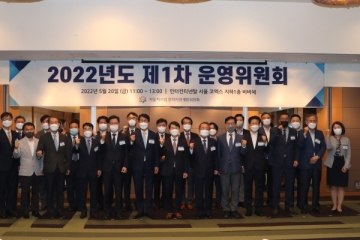
We will support labor transitions, including job transfers and career training, in line with the shift to future vehicles.
The automotive industry is beginning to actively pursue field-oriented, customized workforce development based on standardized future vehicle industry job competencies in response to the structural transformation of the future vehicle industry.
2022.05.23by 성유창 기자

From Jeju Airport to Jungmun by self-driving car
From the second half of 2022, it appears that autonomous vehicles will be able to traverse Jeju Island end-to-end.
2022.05.24by 성유창 기자

[e4ds Tech Day 2026 ⑨] Sim Sang-gyu, Autocrypt CTO: "In the Physical AI Era, Automotive Security Must Extend Beyond the Vehicle"
At e4ds Tech Day 2026, Sim Sang-gyu, CTO of Autocrypt, explained automotive cybersecurity strategies in the era of Physical AI and SDV (Software-Defined Vehicle). Automobiles are evolving as part of an ecosystem connected to AI, cloud, chargers, IoT, and robots, and he emphasized that the scope of security must expand beyond the vehicle interior to the entire connected environment. In particular, AI model tampering, adversarial attacks, OTA updates, and EV charger hacking were identified as major threats. He explained that response measures require zero trust, AI model integrity protection, intrusion detection, Security by Design and Default, and full lifecycle security management, and that proactive security system establishment beyond regulatory compliance is critical for securing future mobility competitiveness.
2026.10.12by 배종인 기자

Practical HIL Construction Strategy for Automotive and Off-Highway Controller Validation
As vehicle E/E architecture transitions to zonal structures and shifts to software-defined vehicles (SDV), the number of controllers (ECUs) requiring validation and software complexity are surging dramatically. Meanwhile, real vehicle testing cannot provide repeated verification under identical conditions and entails lead time and safety concerns. This white paper explains the principles of HIL (Hardware-in-the-Loop) validation and the structure of the NI platform composed of PXI, SLSC, and VeriStand, and through two actual implementation cases—Camera Record & Replay HIL for In-Cabin Monitoring Controller (ICMU) and Forklift Controller (VCU) HILS—describes how controller-level regression testing becomes possible. Additionally, it explicitly states application boundaries and limitations, such as lack of A2B support.
2026.10.12by 편집부
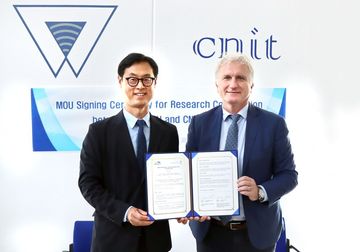
Korea Automotive Research Institute Signs MOU with Italy National Institute for Wireless Communications
The Korea Automotive Research Institute will sign an MOU with Italy's National Institute for Wireless Communications and launch joint research on next-generation mobility technologies based on 6G, V2X, and connected vehicles. The two organizations will conduct research to apply advanced wireless communication technologies to vehicles and discover international joint projects to advance next-generation connected vehicle technology development.
2026.10.12by 배종인 기자











