


Last year, electric and hydrogen vehicles in the public sector tripled compared to the previous year.
 Published2022.06.02 11:57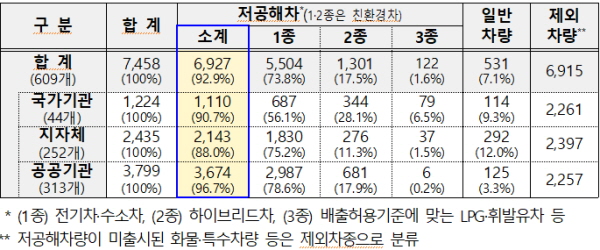
▲2021 Low-Emission Vehicle Purchase and Lease Performance (Unit: Vehicles), (Image Source: Ministry of Environment)
Public sector disclosure of low-emission vehicle purchase and lease performance
The Ministry of Environment and the Ministry of Trade, Industry and Energy announced their 2021 purchase performance and 2022 purchase plans for low-emission and eco-friendly vehicles in the public sector.
Low-emission vehicles include electric and hydrogen vehicles (zero-emission vehicles), hybrid vehicles, and liquefied petroleum gas (LPG) and gasoline vehicles that meet low-emission vehicle emission standards. Eco-friendly vehicles are categorized as electric vehicles, hydrogen vehicles, and hybrid vehicles.
According to the Clean Air Conservation Act and the Act on Promotion of Development and Distribution of Environmentally Friendly Automobiles, national agencies, local governments, and public institutions must purchase or lease a certain percentage of new vehicles as low-emission vehicles (eco-friendly vehicles) and zero-emission vehicles.
The 'Air Quality Conservation Act' requires that 100% of new vehicles be purchased as low-emission vehicles, and that the proportion of zero-emission vehicles (electric and hydrogen vehicles) be at least 80%.
The Ministry of Environment and the Ministry of Trade, Industry and Energy operate an integrated public sector mandatory purchase and lease system and have been jointly disclosing annual performance results since last year.
government investigationAccording to the report, 609 institutions subject to mandatory purchase and lease in 2021 purchased or leased a total of 7,458 new vehicles, of which 5,504 vehicles, or 73.8%, were confirmed to be zero-emission vehicles.
This is an increase of about three times in just one year compared to 1,806 units in 2020.
Low-emission vehicles, including zero-emission vehicles (electric and hydrogen vehicles), accounted for 6,927 units, or more than 90% of the total 7,458 vehicles, a 14.3% increase compared to 6,060 units in 2020.
In particular, eco-friendly vehicles accounted for 6,805 of the 6,927 units, a 23.9% increase compared to 5,494 units in 2020.
The number of organizations operating electric and hydrogen vehicles as their chief vehicles has increased by about three times from 39 in 2020 to 120.
When examined by institution, among the 609 institutions subject to mandatory purchase and lease, 510 institutions achieved the mandatory ratio of low-emission vehicles (including zero-emission vehicles) in 2021, a 20.9% increase compared to 422 institutions in 2020. The achievement rate also improved from 69.3% in 2020 to 83.7% in 2021.
The Ministry of Environment plans to impose fines of up to 3 million won on 74 local governments and public institutions out of the 99 institutions that failed to meet their mandatory ratios, in accordance with the Clean Air Conservation Act.
Meanwhile, the Ministry of Environment investigated the total vehicle purchase and lease plans of 769 organizations subject to the mandatory purchase and lease system this year, and found that the total was 6,538 vehicles.
Among these, low-emission vehicles accounted for 96.2% (6,290 units) and zero-emission vehicles accounted for 84.2% (5,510 units), indicating that the entire public sector is actively participating in the mandatory purchase and lease system.
To ensure that the goals are met without any setbacks, the Ministry of Environment and the Ministry of Trade, Industry and Energy will request supplementary measures from the 55 organizations that submitted plans that fall short of the mandatory ratio, and will review their performance on a quarterly basis.
Furthermore, to accelerate the transition to electric and hydrogen vehicles in the public sector, we plan to actively consider increasing the mandatory purchase ratio for electric and hydrogen vehicles from the current 80%. To this end, we plan to begin revising the Enforcement Decree of the Clean Air Conservation Act and the Enforcement Decree of the Eco-Friendly Vehicle Act in the second half of this year.
Park Yeon-jae, the Ministry of Environment's Air Quality Policy Director, said, "We actively informed relevant organizations and requested their participation to expand the mandatory purchase and lease system, and as a result, the 2021 performance significantly improved compared to the previous year." He added, "We will also accelerate the private sector's transition to zero-emission vehicles through measures such as the low-emission vehicle distribution target system and the '2030 Zero-Emission Vehicle Transition 100 Movement.'"
Comments
Related news
.jpg)
[International Electric Vehicle Expo] Organizing Committee Chairman Kim Dae-hwan: "National and local governments must proactively pursue electric vehicle policies."
"If policies and systems that can clearly present a vision for expanding electric vehicle adoption are established, the era of carbon neutrality could arrive much faster than anticipated."
2022.05.04by 성유창 기자
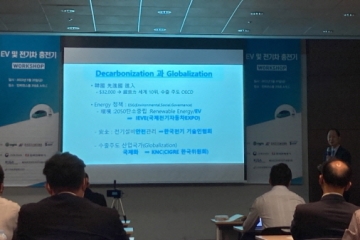
[EV/EV Charger Workshop] KEPCO Accelerates Expansion of Electric Vehicle Charging Infrastructure
According to expert opinion, in response to climate change measures, domestic transportation sector carbon emissions reached 98 million tons in 2018, and following carbon emission reduction measures to lower this to 61 million tons by 2030 (a 37.8% reduction), there is active movement toward expanding the supply of eco-friendly vehicles and corresponding infrastructure expansion.
2022.05.24by 성유창 기자
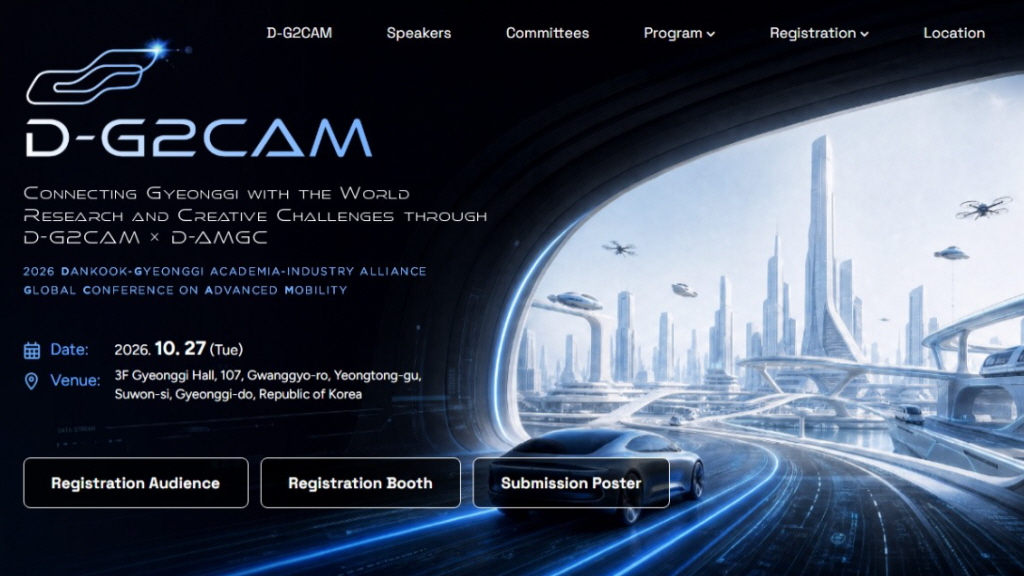
GAIA-Festa 2026, Autonomous Driving, AI, and Aerospace Experts Gather…Discussing Global Cooperation in the 'Silicon Intelligence Era'
GAIA-Festa 2026, which will be held in Suwon on October 27, is an industry-academia-research exchange event that explores the present and future of future mobility and AI technology through the global conference D-G2CAM 2026 and the international contest D-AMGC 2026. Domestic and international experts will share the latest research in autonomous driving, 5G/6G mobility, space technology, and data protection fields, while university students will showcase robots and physical AI prototypes that they have independently developed. Additionally, through poster presentations, corporate exhibitions, international cooperation meetings, and signing ceremonies, a platform will be established to connect the research capabilities and industrial needs of the Gyeonggi region with a global cooperation network.
2026.10.13by 배종인 기자
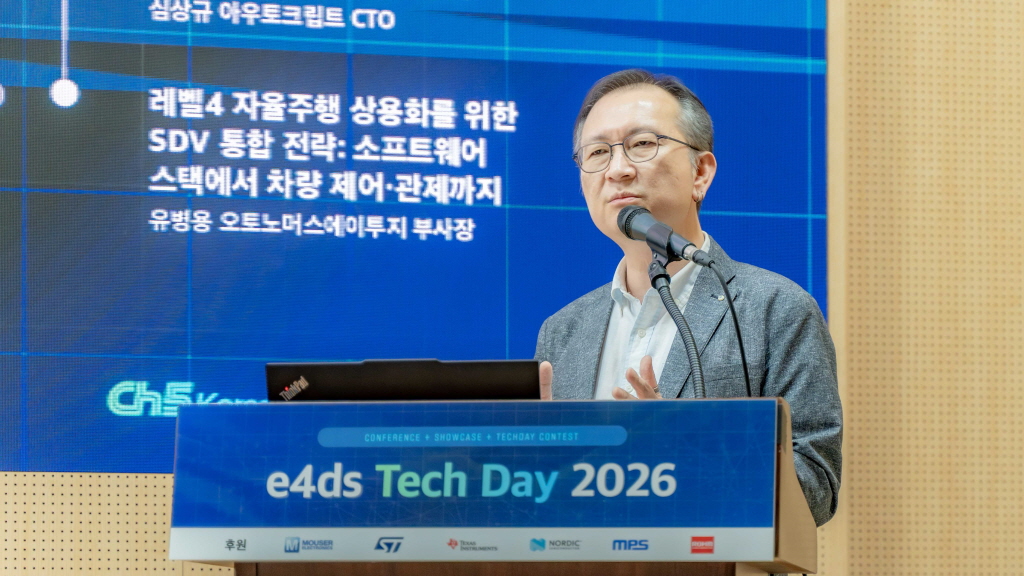
[e4ds Tech Day 2026 ⑨] Sim Sang-gyu, Autocrypt CTO: "In the Physical AI Era, Automotive Security Must Extend Beyond the Vehicle"
At e4ds Tech Day 2026, Sim Sang-gyu, CTO of Autocrypt, explained automotive cybersecurity strategies in the era of Physical AI and SDV (Software-Defined Vehicle). Automobiles are evolving as part of an ecosystem connected to AI, cloud, chargers, IoT, and robots, and he emphasized that the scope of security must expand beyond the vehicle interior to the entire connected environment. In particular, AI model tampering, adversarial attacks, OTA updates, and EV charger hacking were identified as major threats. He explained that response measures require zero trust, AI model integrity protection, intrusion detection, Security by Design and Default, and full lifecycle security management, and that proactive security system establishment beyond regulatory compliance is critical for securing future mobility competitiveness.
2026.10.12by 배종인 기자

Practical HIL Construction Strategy for Automotive and Off-Highway Controller Validation
As vehicle E/E architecture transitions to zonal structures and shifts to software-defined vehicles (SDV), the number of controllers (ECUs) requiring validation and software complexity are surging dramatically. Meanwhile, real vehicle testing cannot provide repeated verification under identical conditions and entails lead time and safety concerns. This white paper explains the principles of HIL (Hardware-in-the-Loop) validation and the structure of the NI platform composed of PXI, SLSC, and VeriStand, and through two actual implementation cases—Camera Record & Replay HIL for In-Cabin Monitoring Controller (ICMU) and Forklift Controller (VCU) HILS—describes how controller-level regression testing becomes possible. Additionally, it explicitly states application boundaries and limitations, such as lack of A2B support.
2026.10.12by 편집부











