



Korea's electric vehicle and battery market share plummets; policy support needs to be strengthened.
 Published2022.06.08 10:07
中 BEV 글로벌 수출시장 점유율 전년 比 9.5%p ↑
국경제인연합회(이하 전경련)는 ITC Trade Map 세계 무역통계를 기초로 연평균 20% 이상 성장하고 있는 글로벌 배터리전기차(BEV), 리튬이온(Li-ion)배터리 산업의 지형 변화와 한국의 과제를 8일 발표했다.
ITC trade map에 따르면 2021년 기준 배터리전기차 세계 5대 수출국의 세계 수출시장 점유율은 2020년 대비 중국이 9.5%p, 독일이 3.8%p 각각 상승한 반면, 한국과 벨기에, 미국은 각각 0.8%p, 2.1%p, 8.5%p 감소했다.
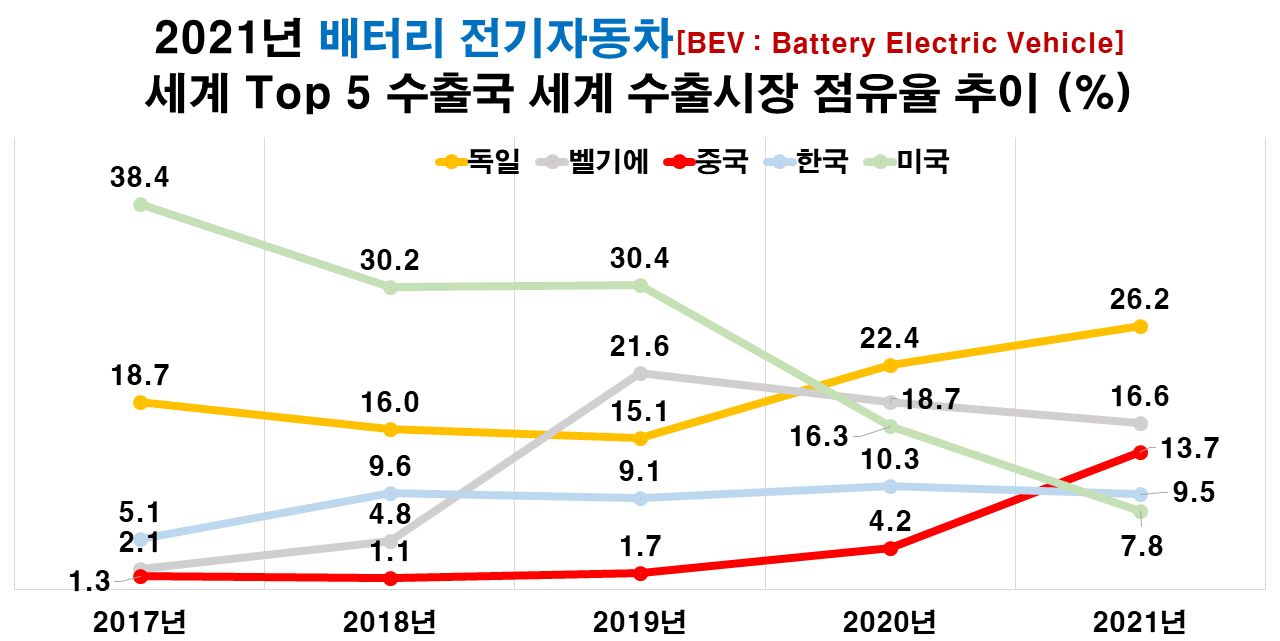
▲2021년 BEV 세계 5대 수출국 세계 수출시장 점유율 추이. (그림 출처: 전경련)
지난해 중국의 배터리전기차 세계 수출시장 점유율이 10% 가까이 상승한 것은 테슬라 상하이공장을 포함한 상하이자동차, BYD, NIO 등 중국 기업의 세계 최대 수입시장인 EU로의 수출이 전년대비 513.9%나 증가한 데 따른 것이다.
그 결과 중국의 EU 배터리 전기차 수입시장 점유율 2020년 4.2%에서 2021년 15.9%로 11.7%p 수직 상승했다.
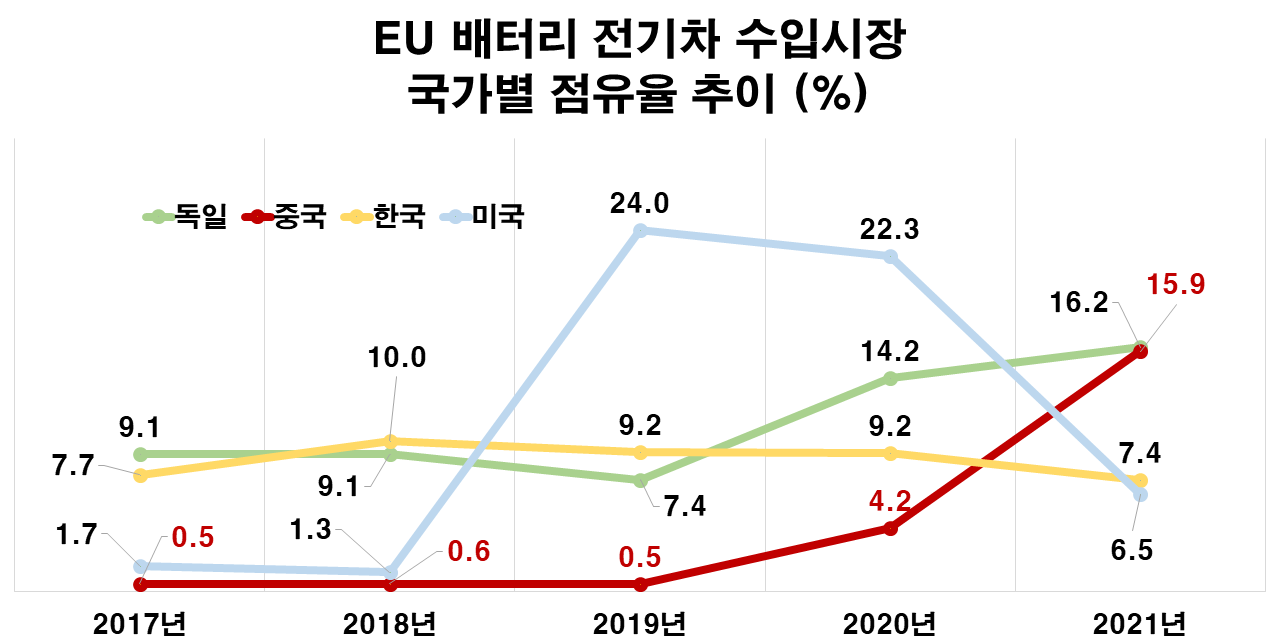
▲EU BEV 수입시장 국가별 점유율 추이. (그림 출처: 전경련)
반면 한국은 점유율이 2020년 9.2%에서 지난해 7.4%로 1.8%p 감소했고, 미국은 2020년 22.3%에서 6.5%로 급감했다.
EU 배터리 전기차 국가별 수입액 변화를 살펴보면 △중국은 2020년 7.9억유로에서 48.5억달러로 513.9% 증가했고 △독일은 26.7억유로에서 49.3억유로로 84.6% 증가 △한국은 17.3억유로에서 22.6억유로로 30.6% 증가한 반면 △미국은 41.9억유로에서 19.7억유로로 53% 감소했다.
중국은 전기차, 스마트폰 등에 들어가는 리튬이온 배터리 글로벌 시장 점령도 넘보고 있다.
리튬이온 배터리의 2021년 기준 세계 5대 수출국의 세계 수출시장 점유율은 2020년 대비 △중국이 2.9%p △폴란드가 1.8%p △독일이 1.2%p △헝가리가 0.3%p 각각 상승한 반면 △한국은 2.0%p 줄었다.
.png)
▲2021년 리튬이온 배터리 세계 5대 수출국 세계 수출시장 점유율 추이. (그림 출처: 전경련)
지난해 리튬이온 배터리 5대 수출국의 수출실적을 살펴보면 △중국은 2020년 159.4억달러에서 지난해 249.6억달러로 56.6% 증가 △폴란드는 46억달러에서 78억달러로 69.6% 증가 △독일은 34.5억달러에서 58.2억달러로 68.7% 증가 △한국은 48.8억달러에서 57.6억달러로 18% 증가 △헝가리는 27.4억달러에서 41.4억달러로 51.1% 증가했다.
특히 CATL, BYD, CALB 등 중국 기업들의 리튬이온 배터리를 포함한 출하량 기준 전기차 배터리 세계시장 점유율은 2020년 38.4%에서 지난해 48.7%로 10.3%p 증가했다.
반면 LG에너지솔루션, 삼성SDI, SK ON의 점유율은 2020년 34.7%에서 지난해 30.4%로 4.3%p 감소했다.
파나소닉 등 일본 기업도 2020년 18.4%에서 지난해 12.2%로 6.2%p 감소했다.
다만 중국은 수출보다 내수 비중이 높아 중국 시장을 제외한 세계 전기차 배터리 시장에서 한국산의 점유율은 2020년 52.4%에서 지난해 57%로 4.6%p 증가하며 세계 1위를 지켰다.
김봉만 전경련 국제본부장은 “중국은 풍부한 배터리 원자재 매장량과 중국 정부의 자국 배터리 기업에 대한 정책자금 지원을 통해 세계 1위 배터리 전기차 강국으로 자리매김했다”고 평가하면서 “신정부는 지난해부터 배터리 공급망을 재구축하고 있는 미국과 한·미 전기차·배터리 협력을 강화해야 한다”고 강조했다.
그는 이어 “2022년 4월 국내 기업이 니켈 등 대규모 광물 확보 및 배터리셀 생산을 위한 인도네시아 전기차 배터리 공장을 착공한데 이어, 5월 중국 배터리 양극재 업체와 공동으로 국내에 양극재 합작사를 설립하는 등 인도네시아, 중국과 같은 신흥국과 협력을 통한 시장지배력 확보를 추진하고 있다”며 “새 정부는 국내 관련 인프라 확충과 함께 기업의 신흥시장 공략을 위한 정책지원도 강화해야 한다”고 말했다.
Comments
Related news
Samsung SDI and Stellantis to Invest $2.5 Billion in Battery Factory in Indiana, USA
Samsung SDI and Stellantis announced that they have selected Kokomo, Indiana as the site for their first U.S. joint venture for electric vehicle battery cells and modules, and will invest more than $2.5 billion.
2022.05.27by 성유창 기자
.jpg)
Korean battery makers' global market share to decrease in 2022, excluding SK On
From January to April 2022, China showed strong performance in the global electric vehicle (EV, PHEV, HEV) battery installation rankings, while South Korea's three companies also made it into the top 10.
2022.06.02by 성유창 기자
LG Energy Solution and University of Münster Join Hands for Next-Generation Battery Research
LG Energy Solution is actively moving forward to secure next-generation battery foundational technologies by establishing joint research centers with domestic and international universities and research institutions.
2022.06.07by 성유창 기자
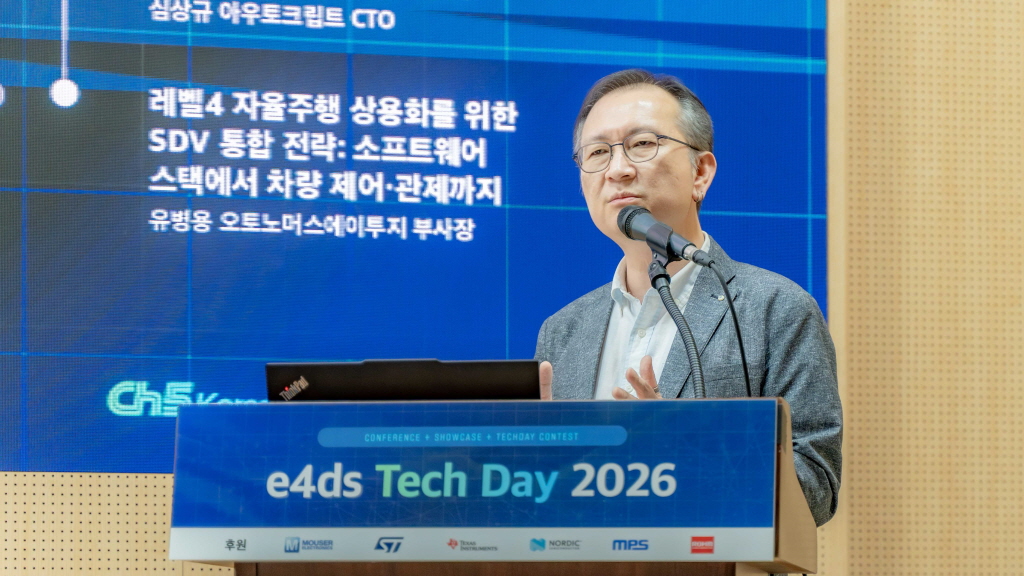
[e4ds Tech Day 2026 ⑨] Sim Sang-gyu, Autocrypt CTO: "In the Physical AI Era, Automotive Security Must Extend Beyond the Vehicle"
At e4ds Tech Day 2026, Sim Sang-gyu, CTO of Autocrypt, explained automotive cybersecurity strategies in the era of Physical AI and SDV (Software-Defined Vehicle). Automobiles are evolving as part of an ecosystem connected to AI, cloud, chargers, IoT, and robots, and he emphasized that the scope of security must expand beyond the vehicle interior to the entire connected environment. In particular, AI model tampering, adversarial attacks, OTA updates, and EV charger hacking were identified as major threats. He explained that response measures require zero trust, AI model integrity protection, intrusion detection, Security by Design and Default, and full lifecycle security management, and that proactive security system establishment beyond regulatory compliance is critical for securing future mobility competitiveness.
2026.10.12by 배종인 기자
Practical HIL Construction Strategy for Automotive and Off-Highway Controller Validation
As vehicle E/E architecture transitions to zonal structures and shifts to software-defined vehicles (SDV), the number of controllers (ECUs) requiring validation and software complexity are surging dramatically. Meanwhile, real vehicle testing cannot provide repeated verification under identical conditions and entails lead time and safety concerns. This white paper explains the principles of HIL (Hardware-in-the-Loop) validation and the structure of the NI platform composed of PXI, SLSC, and VeriStand, and through two actual implementation cases—Camera Record & Replay HIL for In-Cabin Monitoring Controller (ICMU) and Forklift Controller (VCU) HILS—describes how controller-level regression testing becomes possible. Additionally, it explicitly states application boundaries and limitations, such as lack of A2B support.
2026.10.12by 편집부











