


Chinese enterprises need a growth system; inter-company collaboration leads to mutual prosperity
 Published2022.06.14 15:24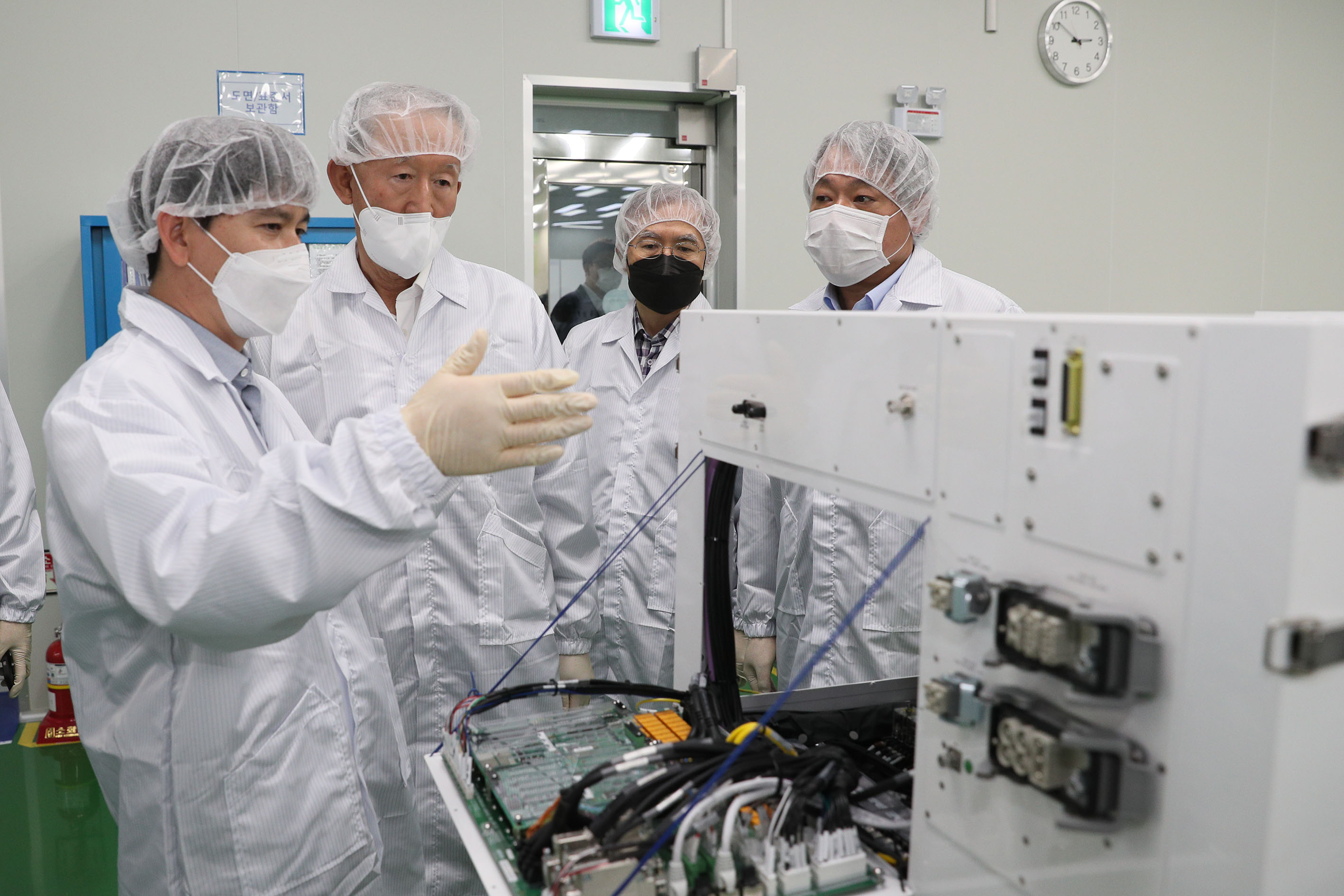
▲On the 13th, Huh Chang-soo, Chairman of the Korea Business Council for Sustainable Development, visited TOS Inc.'s manufacturing facility in Osan, Gyeonggi Province (Photo-Korea Business Council for Sustainable Development)
"Through IPO preparation, I came to understand the company's capabilities. By identifying the company's strengths and weaknesses, including technological prowess and management practices, and supplementing what was lacking, it became an opportunity to transform into a completely new company."
On the 13th, Kim Yong-gyu, CEO of TOS Inc., a semiconductor inspection equipment manufacturer based in Osan, Gyeonggi Province, made this statement. Through support from a management advisory panel for IPO preparation, the company has developed the capabilities to grow into a global enterprise.
■ SME Growth Requires System Building and Inter-Company Collaboration
The management advisory panel project, which the Korea Business Council for Sustainable Development (hereinafter "KBCSD") is promoting as part of its mutual growth initiative, is expanding its footprint by supporting SMEs in resolving management challenges and strengthening competitiveness.
Huh Chang-soo, Chairman of KBCSD, stated, "As companies grow, system building becomes essential. If SMEs utilize large companies' know-how like a bible, they will be able to build their capabilities," and emphasized, "Mutual growth is ultimately something that 'companies' do. The KBCSD Management Doctor System, where large enterprises, SMEs, and management advisory panels collaborate to support company growth, is a model case of mutual prosperity."
TOS Inc., supported by KBCSD, is a company that develops, manufactures, and supplies semiconductor and display equipment components. Meeting technological exception requirements and enhancing enterprise value, it is targeting a KOSDAQ listing in 2024. TOS Inc. holds patents for original technology in ultra-high-speed multi-channel plasma sensing devices and has achievements such as being the first in the world to develop sensing modules used in semiconductor ALD (Atomic Layer Deposition) processes.
CEO Kim Yong-gyu of TOS observed many technology companies growing into mid-sized enterprises through public offerings in recent years and, with confidence that the company's technological capabilities would enable an IPO, applied for the KBCSD Management Doctor System together with strategic partner SEMES.
Advisory Member Jo Yeon-gu assessed that there would be no obstacles to TOS's listing around 2024 given that it meets the exception requirements. However, he noted that while meeting requirements is fundamental for an IPO, it is more important to establish systems befitting a listed company to have enterprise value properly evaluated, and advised that internal and external indicators need further improvement. This is because while groundwork for an IPO is important, without performance backing it up, it is futile.
Accordingly, TOS has converted its financial statements from general business accounting standards to Korean-choice International Financial Reporting Standards (K-IFRS) and undergone accounting audit by external auditors. The company has been strengthening its foundation by upgrading the previously used ERP program (SAP), implementing daily settlement, and establishing a cost management system.
Revenue has also increased by 50.3% compared to the previous year, and operating profit margins have improved, showcasing both external growth and revenue generation simultaneously and raising expectations for IPO promotion.
CEO Kim Yong-gyu stated, "SMEs have weak human composition, and when CEOs concentrate on resolving current issues, there is insufficient time to contemplate future plans," and added, "Thanks to support from KBCSD and SEMES, we were able to overcome the limitations of SMEs and prepare for the future."
■ SEMES: Mutual Cooperation Keywords—Trust, Opportunity, Success
TOS experienced a quality accident in equipment that went into mass production in 2017, and as a result, faced difficulties with operating profits turning negative in 2019.
Facing crisis, TOS raised funds by selling buildings and invested in recovery using retained earnings. To preemptively prevent human errors occurring from manual processes in each stage, the company developed and introduced test equipment. Additionally, it expanded quality-related personnel and implemented salary increases to prevent existing employees from leaving.
SEMES' support was decisive in overcoming the crisis. Although SEMES could have changed its supplier following the quality accident, it decided to trust them further. SEMES, prioritizing quality management as its primary value, provided education and technical guidance to CEO Kim, who devoted management efforts to quality management, and supported the acquisition of Quality Management System Certification (ISO 9001).
TOS ultimately recovered order volumes in 2020, escaped losses, and succeeded in its turnaround. Reflecting on that time, CEO Kim stated, "I always had confidence in technology, but as a manager, I painfully experienced how important it is to oversee all aspects of management beyond technology, including quality and personnel," and expressed gratitude, saying, "Thanks to SEMES' commitment to mutual cooperation and collaboration, we were able to succeed in our turnaround."
Meanwhile, the KBCSD Management Advisory Panel, which launched in 2004 with the participation of 40 former CEOs and executives from major groups including Samsung, Hyundai Motor, LG, and SK, has provided advisory services to 11,151 companies in 23,462 cases (′04~′21). The KBCSD Management Doctor System has involved 75 large enterprises and 771 partner companies over the past 15 years (′07~′21).
The KBCSD SME Cooperation Center will strengthen the Management Doctor Program from 2022 onward to build a new mutual growth collaboration model. In addition to providing mid- to long-term advisory services, it plans to support education and consulting to promote ESG management among partner companies. Additionally, the center is planning partner company training in collaboration with large enterprises to address current issues such as the Occupational Safety and Health Act and the Serious Accident Punishment Act.

Comments
Related news
FKI: “Digital Tax Should Be Limited to Revenues Over $20 Billion”
The Federation of Korean Industries (Chairman Huh Chang-soo) asserted that the digital tax should be limited to digital service companies with annual sales exceeding $20 billion.
2021.06.09by 배종인 기자
Launch of Materials, Components, and Equipment Leading Enterprises Council
A platform has been established to promote exchange among materials, components, and equipment leading enterprises and to foster a healthy ecosystem in the materials, components, and equipment industry through the advancement of technology exchange, consultation, and collaboration related to core strategic technologies.
2022.04.06by 배종인 기자
Nvidia invests $5 billion in Intel
NVIDIA and Intel, leaders in global AI computing technology, are now forging ahead in providing cutting-edge solutions through NVLink-based architecture integration. NVIDIA and Intel have officially announced a strategic partnership and stated that they will jointly develop customized data center and personal computing products to accelerate diverse applications and workloads ranging from hyperscale to enterprise and consumer markets, thereby laying the foundation for the next generation computing era.
2025.09.22by 배종인 기자
.jpg)
Applied Materials Launches Environmental Protection Campaign to Mark World Cleanup Day
Applied Materials Korea (CEO Park Kwang-seon) is carrying out environmental cleanup activities with employees and their families around the Dongtan Sinricheon area on the occasion of World Cleanup Day, evolving into a company that engages with the local community beyond technological innovation.
2025.09.22by 명세환 기자
.jpg)
The combination of electrical and electronic technologies like AI, semiconductors, and electric vehicles with renewable energy will determine industrial competitiveness.
Professor Lim Chun-taek from Gwangju Institute of Science and Technology (GIST) stated in his keynote speech at the '2025 e4ds Tech Day' on the 9th, "Global energy investment is already shifting from fossil fuels to renewable energy, and the trend of electrification combined with electrical and electronic technologies is changing the industrial landscape."
2025.09.12by 배종인 기자











