



[Metaverse Expo] “Metaverse, the Key is Cloud Security”
 Published2022.06.17 10:43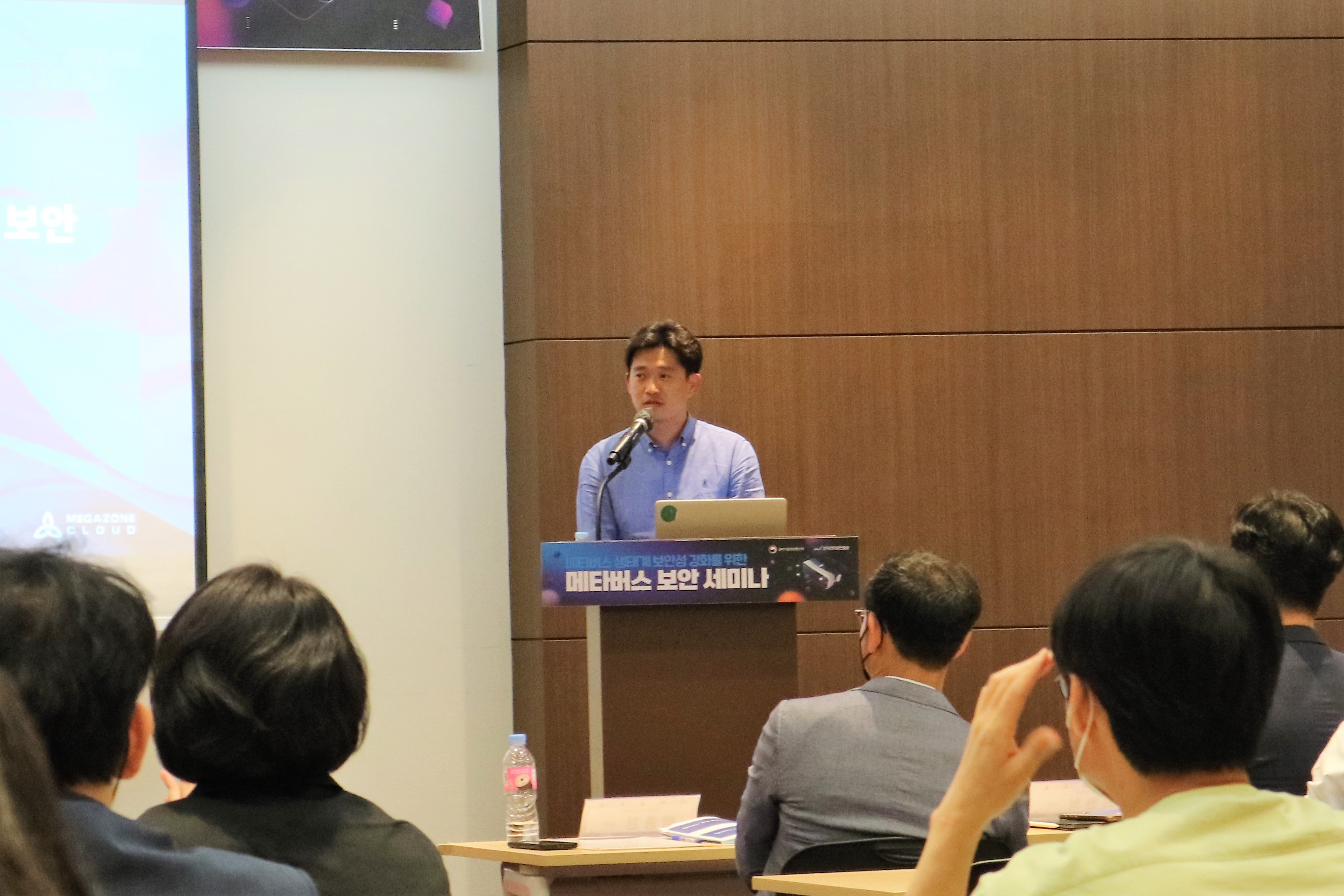
▲Megazone Cloud Team Leader Kim Jin-ho giving a presentation
Team Leader Kim Jin-ho: “Security is a priority that cannot be compromised”
Beyond digital security, metaverse security is an issue that must be addressed from the early stages of technological development and market formation, and is gradually emerging as an urgent problem.
According to market research firm Gartner, 30% of organizations worldwide are expected to have a metaverse environment by 2026. Most cloud security incidents are due to configuration errors or user mistakes, and it is predicted that by 2025, at least 99% of cloud security failures will be the fault of users, not cloud providers.
On the 14th, the Korea Internet & Security Agency (KISA) held a metaverse security seminar. This event, which was designed to strengthen the security of the metaverse ecosystem, included sessions on cloud security, metaverse security framework, digital asset security, and metaverse distribution and payment platform security.
At the seminar held that day, MegaZone Cloud Team Leader Kim Jin-ho presented on the topic of cloud security, focusing on AWS.
When it comes to cloud security incidents, cloud providers are stating a shared responsibility model. AWS's area of responsibility is accidents related to facilities such as ▲network ▲hardware ▲software that run cloud services, and the user's area of responsibility is ▲operating system management such as updates and security patches ▲firewall configuration management ▲data management ▲asset classification and use of IAM tools that grant appropriate permissions, etc.
In the Azure cloud, the scope of responsibility between the provider and the user varies depending on SaaS, PaaS, IaaS, and on-premises. Team Leader Kim explained that the security manager must be aware of this and take action.
Team Leader Kim introduced the '5-EPICs', which are five core security areas that can be used to build cloud security: Identity & Access Management (IM), Detective Controls, Infrastructure Protection, Data Protection, and Breach Response. This is a security creation model that leverages numerous experiences and best practices in a cloud environment.
Looking at the response model by attack target, in the infrastructure and system sector, there is △IM for platform and system protection, △infrastructure protection against DDoS and web vulnerability attacks, and △detection control that enables rapid detection and response to authority theft or infrastructure attacks.
Team Leader Kim explained that in the network sector, the key solutions to respond to system hacking and client vulnerability attacks that target vulnerabilities in transmission and reception networks are infrastructure protection and data protection.
In order to respond to virtual asset theft and illegal copying, data falsification and leakage in the data sector, it is argued that data encryption and data rights management are the main priorities, and this corresponds to data protection and IM.
Finally, in the service sector, he judged that the areas of detection control and breach incident response are key cloud security areas to prevent non-application of security patches and leakage of personal information.
“While engineering priorities may vary depending on business decisions in workload design, security must not be compromised by other principles and priorities,” Kim emphasized.

Comments
Related news
[Semiconductor Digital Forum] Data Explosion Driven by Metaverse and AI: The Solution Ultimately Comes from Semiconductors
Data volume is increasing exponentially. This is because technological advancements in AI, autonomous driving, metaverse, and cloud computing are driving the need to process an enormous amount of data. Humanity, having entered the era of AI and big data, is generating vast amounts of data such that the data created in just one or two days now exceeds the cumulative data accumulated throughout previous eras.
2022.04.26by 명세환 기자
[Smart Tech Korea] AI, Metaverse, and Robotics: Cutting-Edge Technology Trends at a Glance
The 11th Smart Tech Korea will be held at COEX from the 8th (Wednesday) to the 10th (Friday).
2022.06.09by 김예지 기자

[Metaverse Expo] AR and VR: Driving the Metaverse, a New Digital Continent
"The metaverse market has the potential to grow to as much as $5 trillion (approximately 6,400 trillion Korean won) by 2030," stated McKinsey, a global consulting firm, in a newly released report titled "Creating Value in the Metaverse" on the 16th. The report assessed that e-commerce at $2.6 trillion will be the largest sector comprising the global economy, followed by virtual learning at $270 billion, advertising at $206 billion, and gaming at $125 billion.
2022.06.16by 명세환 기자
.png)
Databricks Unveils Open AI Security Monitoring 'Lakewatch'
Databricks entered the security market on March 24 by unveiling LakeWatch, an open-source agentic SIEM. The core functionality of this product is to integrate and analyze security, IT, and business data in a single environment to support AI-based threat detection and investigation. The company explained that it reduces the limitations of existing security operations centers, which have had to forgo some data due to high cost structures, and enables large-scale data analysis and automation based on open formats and ecosystems. LakeWatch is currently offered as a private preview, with Adobe and Dropbox mentioned as early customers. Databricks also announced an expanded partnership with Anthropic as well as the acquisition of Antimatter and SiftD.ai.
2026.03.26by 배종인 기자
Kaspersky Unveils Revamped 'NEXT' Combining SOC Integrated Management and AI Analytics
As enterprises increase demand for integrated management and automation in the construction and operation of Security Operations Centers (SOC), Kaspersky has disclosed updates to its B2B security product suite 'Kaspersky Next'. This update expands EPP, EDR, XDR, and SIEM integration through a single console based on OSMP, incorporates AI capabilities such as DLL hijacking detection and suspicious account takeover behavior identification, and includes integration with generative AI assistant tool KIRA. The company stated that in large-scale deployment environments, EDR Expert can reduce resource requirements by up to 30%, and XDR Expert by up to 60%.
2026.03.25by 배종인 기자











