


Major US automakers and battery manufacturers launch alliance, targeting South Korea and China.
 Published2022.06.24 14:42
전경련 "한·미 전기차·배터리 협력 강화해야"
과학기술정보통신부의 ‘과학기술&ICT 정책·기술 동향’에 따르면 지난 5월 GM·포드·파나소닉·테슬라 등 완성차 업체와 폼에너지·앨버말코퍼레이션(Albemarle Corporation) 등 배터리 업체는 전기차와 배터리의 대규모 공급망 구축을 위한 ‘미국 배터리 독립연합(The Coalition for American Battery Independence, 이하 CABI)’을 발족했다.
CABI는 배터리 원자재와 제조 능력은 에너지와 기후 안보를 위해 매우 중요하다는데 의견을 같이하며 리튬을 비롯한 배터리 원자재 확보에서 처리·정제, 부품 및 배터리 팩 제조에 이르는 모든 과정에서 공급망을 확보해 경쟁력을 제고하겠다는 전략을 추진한다.
연합은 전기차·배터리 산업과 관련해 미국 정부의 정책지원과 의회의 세제지원 요청할 예정이며 필요하다면 ‘국방물자조달법(Defense Production Act)’ 적용을 받는 방안도 고려 중인 것으로 알려졌다.
국방물자조달법은 미국 대통령이 국가 안보를 위해 민간기업에 정부계약을 우선 이행하거나 주요 물품 생산을 확대하도록 주문할 수 있게 한 법령이다.
주로 군수물자를 원활하게 생산하기 위해 만들어진 법이었지만, CABI는 개정을 통해 정치·경제적 상황에서도 발효 가능하다는 점을 공략할 것으로 전해진다.
CABI 출범은 글로벌 전기차·배터리 시장경쟁에서 한국·중국에 크게 밀리고 있다는 위기감에서 비롯된 것으로 분석된다.
Global EV Outlook 2022 보고서에 따르면 세계 전기차 배터리의 76%가 중국에서 생산되고 있으며, 전기차 역시 54%가 중국에서 제조된다.
반면 미국에서 생산되는 전기차용 배터리는 세계 7%에 그쳤으며 전기차 생산량도 10% 남짓한 수준으로 원자재 관련 통계에서는 모두 3% 미만으로 조사됐다.
미국은 현재 글로벌 1위 전기차 제조업체인 테슬라를 앞세워 전기차 제조부문에서는 존재감을 발휘하고 있으나 전기차 핵심부품인 배터리 관련 산업에서 영향력은 미미하다.
실제 테슬라와 미국 내 BIG 3(GM·포드·스텔란티스) 완성차업체들이 모두 미국 기업이 아닌 한·중·일 업체들로부터 배터리를 공급받고 있는 상황이다.
일본 파나소닉을 중심으로 한국의 LG에너지솔루션과 중국 CATL 등이 테슬라에 배터리 공급한다.
금년 1분기 전기차용 배터리 시장에서는 중국 CATL이 35% 점유율로 1위를 차지했으며 지난 22일 기아 니로 차량에도 배터리를 공급한다고 밝힌 바 있다. LG에너지솔루션은 15.9%, SK온은 6.6%, 삼성SDI은 3.8% 순으로 뒤를 이었다.
한국 기업도 현재에 만족하면 안 된다는 목소리도 있다.
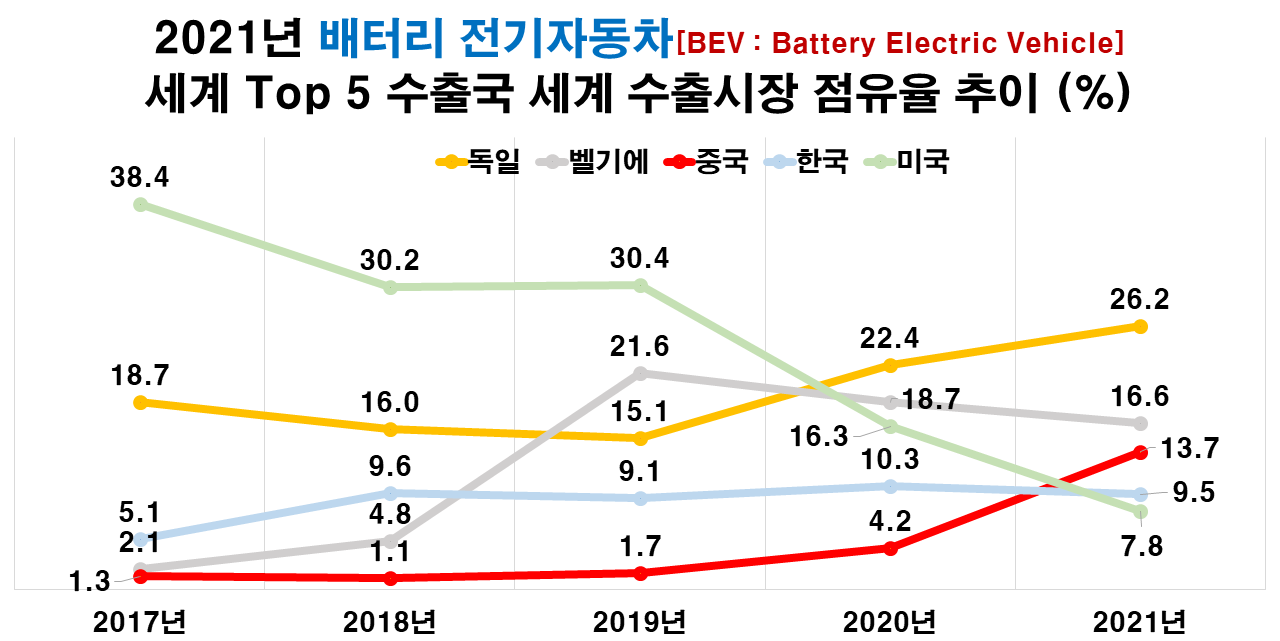
▲2021년 BEV 세계 5대 수출국 세계 수출시장 점유율 추이. (그림 출처: 전경련)
ITC trade map에 따르면 2021년 기준 배터리전기차 세계 5대 수출국의 세계 수출시장 점유율은 2020년 대비 중국이 9.5%p, 독일이 3.8%p 각각 상승한 반면, 한국, 벨기에와 미국은 각각 0.8%p, 2.1%p, 8.5%p 감소했다.
LG에너지솔루션, 삼성SDI, SK ON의 점유율은 2020년 34.7%에서 지난해 30.4%로 4.3%p 감소했다.
김봉만 전경련 국제본부장은 “중국은 풍부한 배터리 원자재 매장량과 중국 정부의 자국 배터리 기업에 대한 정책자금 지원을 통해 세계 1위 배터리 전기차 강국으로 자리매김했다”고 평가하면서 “신정부는 지난해부터 배터리 공급망을 재구축하고 있는 미국과 한·미 전기차·배터리 협력을 강화해야 한다”고 강조했다.
Comments
Related news
LG Energy Solution and University of Münster Join Hands for Next-Generation Battery Research
LG Energy Solution is actively moving forward to secure next-generation battery foundational technologies by establishing joint research centers with domestic and international universities and research institutions.
2022.06.07by 성유창 기자
.png)
Korea's electric vehicle and battery market share plummets; policy support needs to be strengthened.
As China and Germany's extraordinary advances in the BEV and lithium-ion battery industries become increasingly remarkable, experts have suggested that policy support should be strengthened alongside domestic infrastructure expansion to capture emerging markets.
2022.06.08by 성유창 기자
Infineon Launches High-Resolution 3D Image Sensor for Automotive Applications
Infineon supports all types of services requiring authentication, such as payment, battery charging, and personal data access, through reliable secure facial authentication via its 3D image sensor.
2022.06.21by 성유창 기자
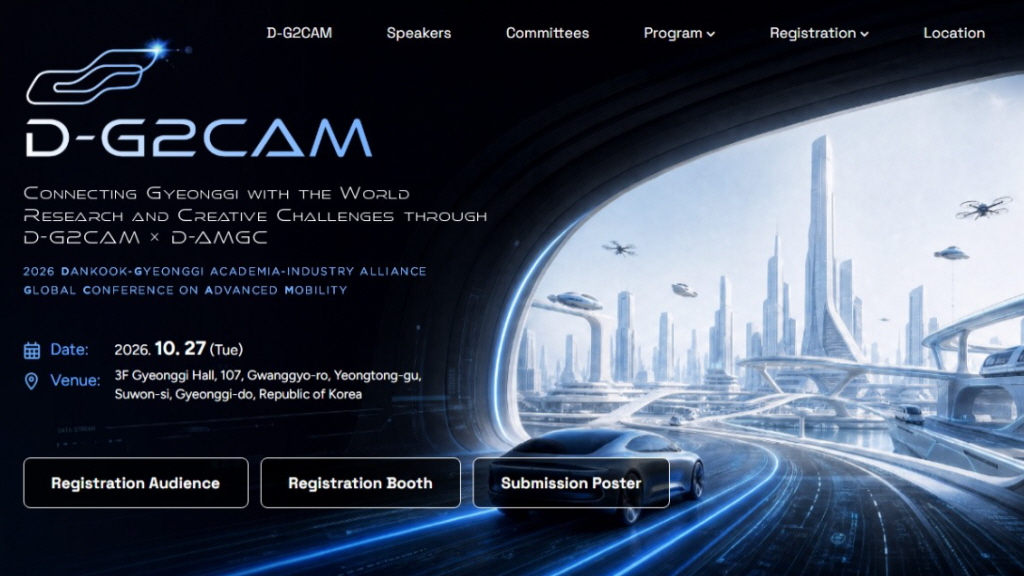
GAIA-Festa 2026, Autonomous Driving, AI, and Aerospace Experts Gather…Discussing Global Cooperation in the 'Silicon Intelligence Era'
GAIA-Festa 2026, which will be held in Suwon on October 27, is an industry-academia-research exchange event that explores the present and future of future mobility and AI technology through the global conference D-G2CAM 2026 and the international contest D-AMGC 2026. Domestic and international experts will share the latest research in autonomous driving, 5G/6G mobility, space technology, and data protection fields, while university students will showcase robots and physical AI prototypes that they have independently developed. Additionally, through poster presentations, corporate exhibitions, international cooperation meetings, and signing ceremonies, a platform will be established to connect the research capabilities and industrial needs of the Gyeonggi region with a global cooperation network.
2026.10.13by 배종인 기자
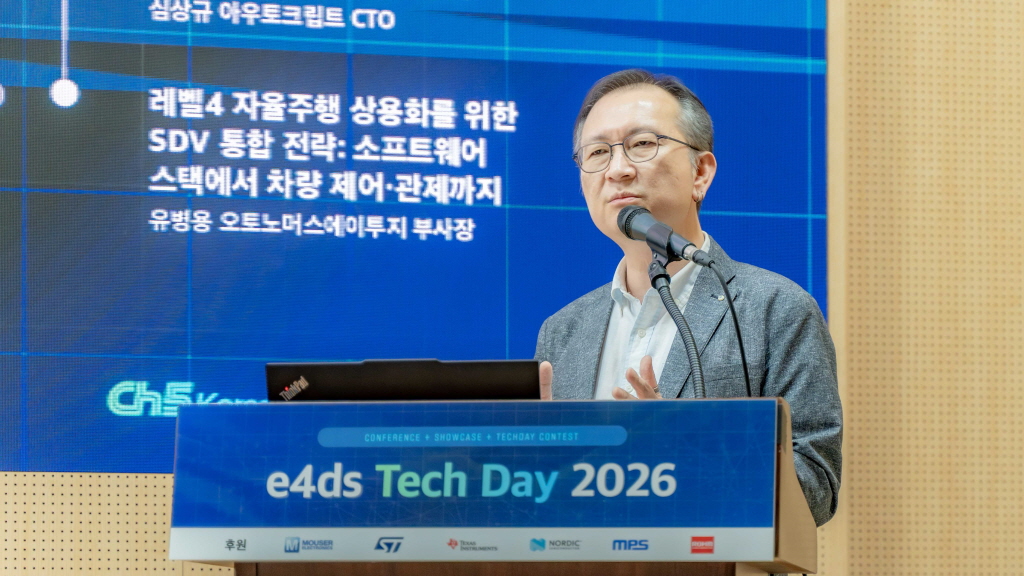
[e4ds Tech Day 2026 ⑨] Sim Sang-gyu, Autocrypt CTO: "In the Physical AI Era, Automotive Security Must Extend Beyond the Vehicle"
At e4ds Tech Day 2026, Sim Sang-gyu, CTO of Autocrypt, explained automotive cybersecurity strategies in the era of Physical AI and SDV (Software-Defined Vehicle). Automobiles are evolving as part of an ecosystem connected to AI, cloud, chargers, IoT, and robots, and he emphasized that the scope of security must expand beyond the vehicle interior to the entire connected environment. In particular, AI model tampering, adversarial attacks, OTA updates, and EV charger hacking were identified as major threats. He explained that response measures require zero trust, AI model integrity protection, intrusion detection, Security by Design and Default, and full lifecycle security management, and that proactive security system establishment beyond regulatory compliance is critical for securing future mobility competitiveness.
2026.10.12by 배종인 기자











