


KERI, “Lightning Accidents Concentrated in Summer; Avoid Sharp and Tall Objects”
 Published2022.06.27 15:15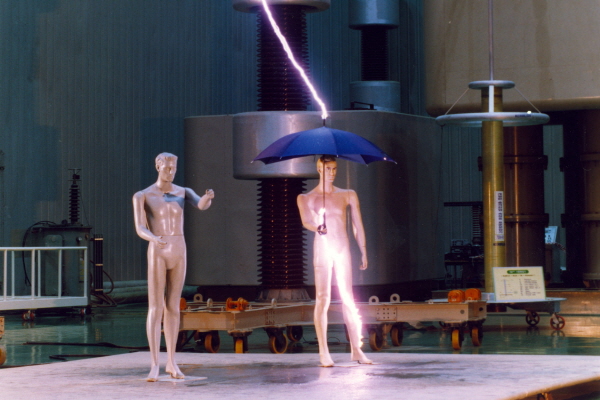
71.5% of lightning accidents occur during the summer; avoid sharp and tall objects.
The Korea Electrotechnology Research Institute (KERI, Acting President Kim Nam-kyun), a government-funded research institute under the National Science and Technology Research Council of the Ministry of Science and ICT, announced "Public Action Guidelines for Preventing Lightning Strike Risks" on the 27th in anticipation of the summer rainy season.
Lightning is a type of electrical discharge in which electric charges in a thunderstorm cloud fall to the ground and discharge. It travels at about one-tenth the speed of light, and the voltage reaches over 100 million volts. Furthermore, the temperature in the path of a lightning strike reaches 27,000 degrees, which is four times hotter than the surface of the sun. Generally, when a person is struck by lightning, they suffer a tremendous electrical shock; approximately 80% die instantly, while only about 20% survive after treatment.
Lightning strikes are increasing globally due to recent climate change. According to the Korea Meteorological Administration, 124,447 lightning strikes were recorded in South Korea alone last year. This represents an increase of approximately 51% compared to 82,651 in 2020 and is about 8% higher than the average of the past 10 years (116,000). By period, 71.5% of all lightning strikes were concentrated between June and August.
If lightning is expected or occurs, you should avoid going outside as much as possible. If you are engaged in outdoor activities, you should stay as far away as possible from tall and pointed structures (trees, streetlights, utility poles, etc.) and refrain from holding umbrellas, fishing rods, golf clubs, etc. above your head. In past experiments conducted by the KERI Electrical Environment Research Center and High Voltage Test Laboratory simulating a day with lightning, the results showed that lightning struck more frequently on mannequins positioned higher above the ground or holding umbrellas above their heads.
Therefore, do not hold long, pointed items high; instead, fold them or lay them flat. If you are outdoors, move quickly into a nearby building. However, if you must move while thunderclouds are approaching, it is best to lower your body as much as possible, keep only one foot on the ground, or run with short strides.
If you are driving, stop your vehicle in a safe place and do not get out. It is safer to remain inside the car, as lightning striking a vehicle bypasses the non-conductive interior, passes instantaneously through the exterior, and is absorbed directly into the ground via the tires. Additionally, you should close the windows and doors and avoid contact with metal parts connected to the outside, as well as with devices such as the radio.
The lightning prevention methods revealed by KERI are as follows. For more details, please refer to the 'Lightning Safety Guidebook', 'Video on How to Avoid Lightning', etc., on the research institute's website (www.keri.re.kr) and YouTube channel.
Check the weather forecast for outdoor activities, and if lightning is expected, postpone the plan or identify a suitable shelter within the travel range.
▷ If you must move during a thunderstorm, move away from areas such as embankments or pastures and walk or run with short strides, keeping only one foot on the ground.
Even if the rain stops or the thunder subsides, do not move hastily; wait at least 30 minutes after the last thunder before moving.
Do not use items that are metallic or long and pointed and can cause lightning strikes, such as umbrellas, fishing rods, and golf clubs; instead, fold them or lay them down.
Avoid riding open-roofed cars, motorcycles, bicycles, tractors, golf carts, combines, etc.
In the case of partially open shelters such as barns without lightning protection, wooden or stone huts, or bus stops, take refuge in a crouched position in the center, as far away from the walls as possible.
If you are driving, stop in a safe place and do not get out of the vehicle. Close the windows and doors, and avoid contact with metal parts connected to the outside or items such as radios as much as possible. If you must drive, drive slowly and with great caution.
Lightning can strike anywhere, but it is most likely to reach tall objects such as trees or flagpoles. Standing alone is particularly dangerous, so stay at least 10 meters away from branches or trunks.
▷ Move away from metal fences, steel towers, streetlights, etc., and avoid gathering in groups.
▷ If many people are gathered together, do not come into contact with each other, maintain a distance of at least 1 meter, and find a low, hollow place to evacuate to.
In open spaces such as open fields, sit with your legs together, hands covering your ears, and your head as close to the ground as possible.
When taking refuge in the mountains, caves under rocks protruding from cliffs or the lower parts of rock walls are relatively safer than rock walls, cracks, crevices, or protruding parts.
Staying at the edge of the forest is dangerous, and it is more effective to move to the center inside the forest.
When camping outdoors, do not install metal wires between the tent and the camper van, and in the event of a lightning strike, stay at least 1 meter away from metal tent supports or the camper van.
▷ Unplug the camper from the parking space to disconnect all power lines, and remove external antennas, etc.

Comments
Related news
.jpg)
KERI Breaks Ground on e-Nanomaterial Chemical/Wet Process Platform
A large-scale infrastructure is being established to promote research and development activities and realize technological independence in the field of advanced electrical new materials and components to accelerate the era of advanced E-mobility and future smart electronic devices.
2022.04.26by 배종인 기자
KERI Develops Fire Prediction Technology Based on Lithium-ion Battery Thermal Management
A research team from the Korea Electrotechnology Research Institute and Daegu Gyeongbuk Institute of Science and Technology has developed technology capable of predicting battery fires by analyzing approximately 1.7 million time-series data points obtained from over 1,000 experiments conducted under various charge and discharge conditions.
2022.05.09by 성유창 기자
The Korea Electric Power Corporation recognizes Vice President Kim Nam-gyun for his contributions to the development of SiC.
Kim Nam-kyun, Vice President of Research at the Korea Electrotechnology Research Institute (KERI), was recognized for his contributions to advancing the Korea Institute of Electrical and Electronic Material Engineers through the promotion of SiC power semiconductor technology.
2022.06.24by 배종인 기자
Schneider Aims for Building Energy Savings and Operational Stability with Next-Generation HVAC Drives
Schneider Electric has unveiled its next-generation HVAC drive product line 'Altivar HVAC'. The new product line's key features center on enhanced energy savings, system operational stability, and building management system integration. The products are divided into 'ATH200' for OEM and small equipment applications, and 'ATH600' for environments requiring continuous operation and advanced control. The company plans to expand the application scope from commercial buildings to facilities where HVAC system stability is critical, such as hospitals, airports, and data centers. The announcement includes over 30% energy savings, operation from -10°C to +60°C, Modbus and BACnet support, and compatibility with low global warming potential refrigerants.
2026.03.26by 명세환 기자

Ecolab Expands AI Data Center Cooling Business Through Acquisition of CoolIT
Ecolab has agreed to acquire CoolIT Systems, a liquid cooling company for AI data centers, for approximately $4.75 billion. The transaction is expected to close by Q3 2026, subject to regulatory approvals. CoolIT has been supplying direct-to-chip cooling-based coolant distribution units, cold plates, and manifolds, serving hyperscale data centers and colocation operators as customers. This acquisition is a measure to address the high-heat and high-density server environments created by AI proliferation. Ecolab plans to combine its water management and digital monitoring capabilities with CoolIT's hardware technology to expand its data center cooling business.
2026.03.26by 명세환 기자











