


[Feature] EV Crisis, A Clever Strategy for a Reversal
 Published2022.07.08 16:00
Fires and Charging Cost Increases Weaken EV Buying Sentiment
Domestic Battery Industry Aims for Rebound Through Overseas Investment
Strengthening government policy resources… Joint response in the supply chain is essential
[Editor's Note] Last year, domestic electric vehicle (EV) sales reached 100,681 units, marking a steep growth trend with a 115% increase compared to 2020. However, doubts regarding EV safety have intensified following a series of fatal accidents caused by EV fires both domestically and internationally in 2022. Furthermore, the global battery market share of Samsung SDI and LG Energy Solution—excluding SK ON—has declined, weakening the standing of domestic EV-related companies. In response, industry insiders have argued that the government must expand support and companies must strengthen cooperation with overseas firms to secure the future EV market. Accordingly, this publication has summarized recent EV issues and expert opinions.
■ Creating anxiety over electric vehicle fire accidents
On the 4th of last month, a fatal accident occurred on the Busan-Namhae Expressway due to a fire that broke out immediately after a collision involving an Ioniq 5. It was an accident in which sparks from the battery ignited immediately after the collision, leading to a massive fire before the occupant and passenger could escape, resulting in the deaths of both.
Netizens' anxiety persists, with comments such as "Electric cars do not give you a chance to escape if an accident occurs" and "It is not the time to buy an electric car yet."
The phenomenon where the temperature rose to 800 degrees immediately after the accident is a 'battery thermal runaway' caused by the battery pack being damaged by external impact.
This phenomenon has also occurred in electric vehicle accidents overseas, making it a major international issue as firefighters research effective methods for fire suppression.
It is reported that it took 7 hours to completely extinguish the Tesla Model S fire and used 100,000 liters of water. This is said to be the amount of water used in an American household for about two years.
Due to the time and water required for firefighting, a solution involving submerging entire cars in water tanks—a method used in the suppression of the Namhae Expressway fire—is emerging. The Fire Department announced that it is considering introducing mobile water tank vehicles used in Germany.
Along with this, technical solutions are also required to fundamentally ensure electric vehicles are safe from fire, such as equipping them with battery safety devices and installing fire safety sensors to cut off the power supply in dangerous situations.
■ Termination of special discount on charging fees
On the 28th of last month, the Ministry of Environment and the Ministry of Trade, Industry and Energy announced that the special discount system for electric vehicle charging fees would end on July 1.
This system was introduced in 2017 to expand the supply of electric vehicles and provides discounts on the 'basic fee' paid each time an electric vehicle is charged and the 'usage fee' charged per unit of charging capacity (1 kWh).
From the year of introduction in 2017 until the first half of 2020, the discount rate was 50%, and the charging fee per kWh was 292.9 won. From July 1, 2022, when the special discount ends, you will have to pay an additional 20.2 won to 313.1 won.
Based on the Ioniq 5, fully charging from 0% costs 24,230 won, which is 1,560 won more expensive than the existing 22,670 won.
With the fuel cost adjustment rate applied to electricity rates in the third quarter also scheduled to increase from 0 won per kWh to 5 won per kWh, voices of dissatisfaction are emerging among electric vehicle drivers.
President Yoon Suk-yeol had pledged to maintain the system for five years, but it is understood that breaking the promise was inevitable due to a combination of various reasons, including KEPCO's debt of 30 trillion won and global inflation.
Instead, the government is reportedly considering measures such as discounts on late-night slow charging rates to reduce the burden on consumers, while ending the special discount on electric vehicle charging fees.
■ Battery Price Increases, Intensifying Global Competition
Rising battery prices are also dealing a blow to the electric vehicle industry.
An industry official stated that it is very difficult to make a profit as the price of electric vehicle batteries has risen by 1.2 million won.
Competition in the electric vehicle battery market is also fierce.
Last May, the Korea Automobile Manufacturers Association (KAMA) expressed concern, stating, “The Korean industry is facing issues with parts supply and production disruptions due to a shortage of raw materials.” In particular, they noted, “China monopolizes most key raw materials for electric vehicles, accounting for 58% of global processed lithium production and 35% of nickel production, while Korea has a high dependence on China for raw materials, including 35% for rare earth elements and 88% for materials and components. Therefore, if the prices of parts or raw materials rise in the era of electric vehicles, the industry could face a crisis.”
In fact, according to the ITC trade map, the better as of 2021Compared to 2020, the global export market share of the world's top five electric vehicle exporting countries increased by 9.5%p for China and 3.8%p for Germany, while it decreased by 0.8%p, 2.1%p, and 8.5%p for South Korea, Belgium, and the United States, respectively.
The combined market share of LG Energy Solution, Samsung SDI, and SK ON fell by 4.3 percentage points from 34.7% in 2020 to 30.4% last year.
Last May, automakers such as GM, Ford, Panasonic, and Tesla, along with battery manufacturers such as Form Energy and Albemarle Corporation, launched the Coalition for American Battery Independence (CABI) to build a large-scale supply chain for electric vehicles and batteries.
The launch of CABI is analyzed to have stemmed from a sense of crisis over falling significantly behind Korea and China in the global electric vehicle and battery market competition.
Domestic battery-related companies have also begun to make moves.
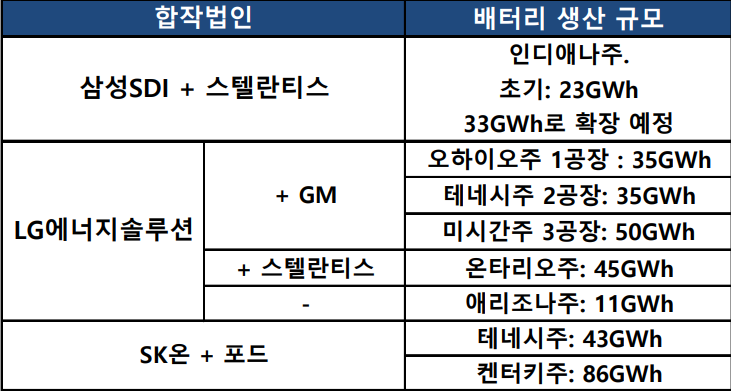
The joint venture is scheduled to begin construction at the end of 2022 and start full-scale operations in the first quarter of 2025.
It is expected to start producing electric vehicle battery cells and modules at an initial annual scale of 23 GWh and expand to 33 GWh, with investment also projected to increase to $3.1 billion.
LG Energy Solution It announced that it is reviewing plans to independently establish a battery factory worth 1.7 trillion won in the United States, but emphasized that there is no need to interpret this negatively.
LG Energy Solution, which plans to review the timing and scale of its projection due to increased investment costs caused by inflation, is putting on hold its plan to target mass production in the second half of 2024.
On the other hand, Ultium Cells, a joint venture with GM currently under construction, plans to proceed with investment and construction of joint venture plants as scheduled, including the second plant in Tennessee (35 GWh) and the third plant in Michigan (50 GWh).
SK On has partnered with Ford.
The two companies plan to jointly produce batteries through their joint venture, Blue Oval SK.
Blue Oval SK's Tennessee plant will be built on 4.7 million square meters with electric vehicle and battery production plants, while the Kentucky plant site spans 1.9 million square meters.
According to the industry, the Tennessee plant has a capacity of 43 GWh, and the Kentucky plant has 86 GWh.
■ Urgent Need to Strengthen International Cooperation and Policy Support
In the face of these global market challenges, experts unanimously agree that joint responses to supply chains, external cooperation, and government policy support are urgently needed.
During regular consultations held with the European Automobile Manufacturers Association in Belgium last May, the Korea Automobile Manufacturers Association expressed concern, stating, “China monopolizes most key raw materials for electric vehicles, accounting for 58% of global processed lithium production and 35% of nickel production, while Korea has a high dependence on China for raw materials, including 35% for rare earth elements and 88% for materials and components. Therefore, if the prices of parts or raw materials rise in the era of electric vehicles, the industry could face a crisis.”
He added, “The Korean industry faces parts supply and production due to raw material shortages "We are facing disruption issues," they stated, suggesting that "joint response regarding the supply chain in the electric vehicle era is necessary."
Kim Bong-man, head of the International Division at the Federation of Korean Industries, assessed that “China has established itself as the world’s leading battery electric vehicle powerhouse through its abundant reserves of battery raw materials and the Chinese government’s policy funding support for domestic battery companies,” and emphasized that “the new government must strengthen Korea-U.S. cooperation on electric vehicles and batteries with the United States, which has been rebuilding its battery supply chain since last year.”
He continued, “In April 2022, domestic companies broke ground on an electric vehicle battery factory in Indonesia to secure large-scale minerals such as nickel and produce battery cells, followed by the establishment of a joint venture for cathode materials in Korea with a Chinese battery cathode material company in May. They are pursuing market dominance through cooperation with emerging countries such as Indonesia and China.” He added, “The new government must expand related domestic infrastructure and strengthen policy support for companies to target emerging markets.”
Comments
Related news
[Planning] Semiconductors, the Key to Green Energy①
We have organized a venue to examine semiconductor technology that conserves energy by improving power efficiency in renewable energy generation, energy transmission, and consumption.
2022.05.16by 배종인 기자
[Planning] Semiconductors, the Key to Green Energy②-Semiconductors, Positioned as Key to Energy Production, Transmission, and Consumption
We have arranged a session to examine semiconductor technologies that conserve energy by improving power efficiency in renewable energy production, energy transmission, and energy consumption.
2022.05.23by 배종인 기자
.jpg)
[Planning] Biden's Visit to Korea: Heightened China Risk vs. K-Semiconductor Leap
US President Joe Biden visited South Korea and made Samsung's semiconductor manufacturing plant in Pyeongtaek his first stop. This scene symbolically reflects the elevated international standing of the semiconductor industry. As the importance of technology and economic security in national security grows, there is heightened interest in what changes the domestic semiconductor industry, positioned at the center of US friend-shoring, will face following this visit.
2022.05.24by 명세환 기자
[Planning] AIoT: Creating a Truly "Smart" World (1)
AI (Artificial Intelligence) is a computing technology that learns like the human brain and solves problems, while IoT (Internet of Things) is a technology that connects objects equipped with sensors through internet communication capabilities.
2022.06.27by 김예지 기자
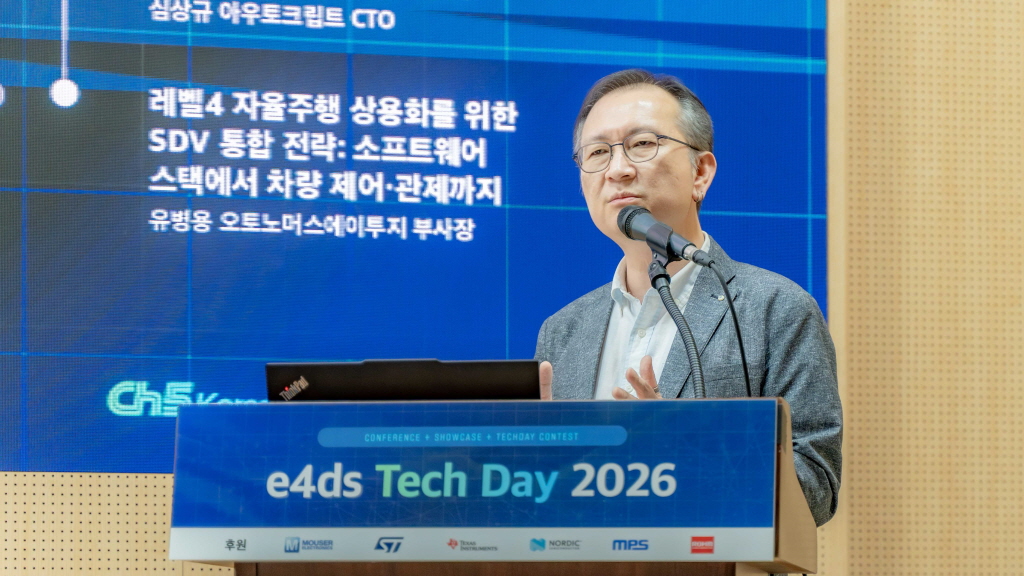
[e4ds Tech Day 2026 ⑨] Sim Sang-gyu, Autocrypt CTO: "In the Physical AI Era, Automotive Security Must Extend Beyond the Vehicle"
At e4ds Tech Day 2026, Sim Sang-gyu, CTO of Autocrypt, explained automotive cybersecurity strategies in the era of Physical AI and SDV (Software-Defined Vehicle). Automobiles are evolving as part of an ecosystem connected to AI, cloud, chargers, IoT, and robots, and he emphasized that the scope of security must expand beyond the vehicle interior to the entire connected environment. In particular, AI model tampering, adversarial attacks, OTA updates, and EV charger hacking were identified as major threats. He explained that response measures require zero trust, AI model integrity protection, intrusion detection, Security by Design and Default, and full lifecycle security management, and that proactive security system establishment beyond regulatory compliance is critical for securing future mobility competitiveness.
2026.10.12by 배종인 기자











