


342 Industry Leaders Offer Recommendations to Government..."Semiconductor Shortage and Carbon Neutrality Response Required"
 Published2022.07.19 08:06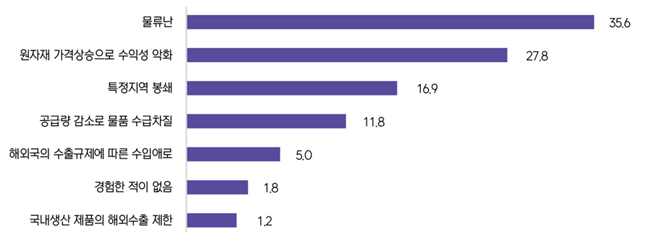
▲According to a survey by the Korea Trade Association, more than 8 out of 10 domestic export companies have experienced exposure to global supply chain crises. (Source: Korea Trade Association)
Rising exchange rates and raw material prices, supply chain disruptions, and the need to expand carbon-neutral infrastructure present numerous crises facing the domestic industry. In the domestic industry where manufacturing and import-export are core, voices from the field are calling for institutional improvements needed to resolve semiconductor supply instability and expand renewable energy infrastructure for domestic small and medium-sized enterprises.
The Korea Trade Association announced on the 19th that it delivered a policy recommendation report titled "Voices from the Export Field for the New Government" containing opinions from 342 CEOs of small and medium-sized trading companies nationwide to the Ministry of Trade, Industry and Energy.
According to the report, in particular, supply instability in general-purpose semiconductors is causing disruptions to finished product production in other industries. Company A, which manufactures semiconductor equipment, stated, "Even when ordering materials from global MCU (microcontroller unit) manufacturers at prices 30 times higher than before the pandemic, we receive only about 10% of the required quantity, and we can only obtain this after six months, causing difficulties in semiconductor equipment production."
Industry representatives emphasized with one voice, "As export environments are expected to worsen due to difficulties in sourcing raw and subsidiary materials and logistics challenges, rapid government support is needed in supply chains, logistics, marketing, business environment, and carbon neutrality response."
The Trade Association suggested regarding industry difficulties in sourcing raw and subsidiary materials, "It is necessary for the government to provide incentives to large companies so they can contribute to stabilizing raw and subsidiary material supply for small and medium-sized enterprises by leveraging their own networks." Additionally, it recommended expanding the VAT deferral system for imported raw materials for export and the application of import tariff quotas to ease the cost burden on trading companies.
The strengthening of carbon-neutral requirements by global large enterprises participating in RE100 toward companies in their supply chains was also identified as a major challenge. Automotive parts company B stated, "Finished vehicle manufacturers are requesting greenhouse gas reduction plans including renewable energy use, but not only is it difficult to secure renewable energy sources, but it is also challenging to measure enterprise-wide greenhouse gas emissions." In response, the association recommended that the government establish a foundation for quantitatively measuring carbon emissions and supplement systems to improve accessibility to renewable energy for small and medium-sized enterprises.
Additionally, the association also recommended "expansion of airline operations" and "exemption from negative confirmation submission upon return from overseas business trips" for the trading industry that needs to actively conduct face-to-face marketing activities after COVID-19, as well as "expanded budget support for logistics costs" and "establishment of a government-wide logistics control tower" to address logistics challenges.
Kim Byung-yoo, head of the Member Services Division at the Trade Association, stated, "We plan to conduct in-depth discussions with the Ministry of Industry to reflect the industry difficulties and recommendations contained in this report," adding, "We will continue to do our best to continuously receive trade-related regulations and difficulties through the regulatory reform task force (TF) and work to resolve them."

Comments
Related news

94.9% of Domestic Companies Have Experienced Supply Chain Crises... Strengthening Semiconductor Capabilities Is Essential
[Editor's Note] As the global supply chain crisis has intensified due to the COVID-19 pandemic, geopolitical risks, and U.S.-China tensions, domestic companies continue to maintain heightened levels of tension in production and trade, facing logistics shortages, soaring raw material prices, and disruptions in the supply of key materials. With the global supply chain crisis entering a prolonged phase, semiconductor and electronics-related companies are experiencing considerable difficulties.
2022.05.03by 명세환 기자
“CF series gas, must prepare for supply restrictions”
CF-series gases used in semiconductor etching may face usage restrictions due to their high global warming potential, and it has been suggested that preparations are necessary to address potential supply constraints.
2022.05.20by 배종인 기자
.jpg)
Global device shipments are down… "Hopeful for the 5G phone boom"
The global device market faces headwinds from geopolitical upheaval, high inflation, currency fluctuations, and supply chain disruptions, with forecasts pointing to a direct impact on declining shipment volumes. Meanwhile, the emergence of a 5G smartphone supercycle is creating optimism about future market prospects.
2022.07.04by 명세환 기자

Intel Unveils Next-Generation 'Core Ultra Series 3' and vPro Platform for Enterprise PCs
Intel has officially unveiled the "Intel Core Ultra Series 3" for next-generation enterprise PCs and the latest vPro platform, addressing a wide range of demands from enterprise notebooks to high-performance workstations.
2026.03.26by 배종인 기자

ROHM Launches ESD Protection Diode Compatible with High-Speed Interfaces of 10Gbps or Higher
Semiconductor specialist ROHM has developed the 'RESDxVx series' of ESD (electrostatic discharge) protection diodes capable of responding to next-generation high-speed data communication environments exceeding 10Gbps, simultaneously enhancing both signal quality maintenance required in high-speed interfaces and IC protection performance.
2026.03.26by 배종인 기자











