


Lee Jeong-hwan, President of the Korea Institute of Materials Science, emphasizes response to the weaponization of rare earths.
 Published2022.07.20 14:15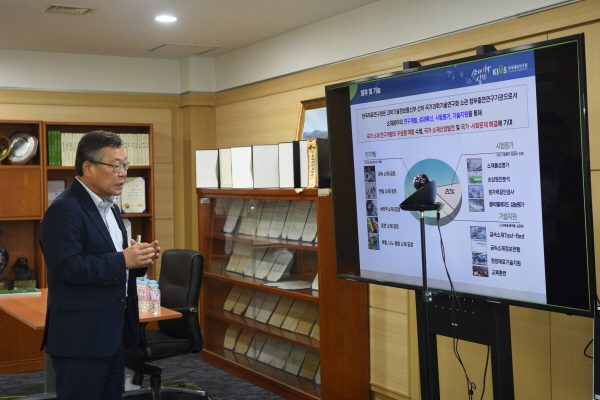
▲ Director Lee Jeong-hwan of the Institute of Materials Science giving a lecture at an online seminar
Lee Jeong-hwan, President of the Korea Institute of Materials Science, shared his expertise on preemptive response measures to the global rare earth industry crisis.
The Korea Institute of Materials Science announced that on the 19th, President Lee Jeong-hwan gave a lecture at a seminar of the public-private joint supply chain monitoring council in China, held online via Zoom.
The topic of this lecture was 'Rare Metals Value Chain and Market Trends,' and he introduced the types of rare metals and value chain analysis, their utilization and supply and demand status, as well as China's policy direction and response strategies for major issues.
The lecture was conducted for officials from Korean government agencies and local investment companies in Chengdu and Chongqing, which are among the major mineral production (processing) hubs in China.
The purpose was to invite experts from the Korea Institute of Materials Science to provide an opportunity to learn about institutional trends, the rare metals value chain, and market trends online.
Rare metals refer to metallic elements that are present in small quantities within the Earth's crust or are difficult to produce or extract, and which currently have industrial demand and are expected to see increased demand in the future.
Although there are no globally unified standards, approximately 30 types are classified internally based on the industrial characteristics of each country, and Korea is currently selecting and managing 35 types and 56 rare metals.
We are currently in a time when the hegemonic rivalry between the United States and China is intensifying, and both countries are reorganizing supply chains for strategically important national security items.
In particular, as rare metals and key materials are being utilized as strategic weapons in international disputes, such as Japan's export restrictions and China's embargo on Japanese rare earths, the threat of weaponizing rare earth resources is steadily increasing.
During the lecture, Lee Jung-hwan, President of the Korea Institute of Materials Science, emphasized, “China is exerting immense influence on the global rare earth industry based on political objectives and industrial policy goals,” adding, “Korea also needs to actively respond to this and prepare solutions in political, industrial, and economic aspects.”

Comments
Related news
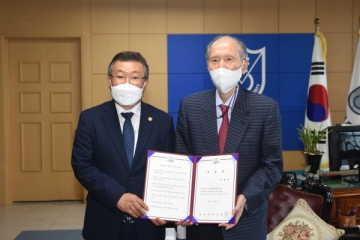
Lee Jeong-hwan, Director of the Materials Research Institute, Appointed Professor Emeritus at Kyungnam University
The director of Korea Institute of Materials Science (KIMS), Lee Jung-hwan, a government-funded research institute under the Ministry of Science and ICT, has been appointed as an endowed chair professor in the Department of Advanced Materials Engineering at Kyungnam University.
2021.10.01by 배종인 기자
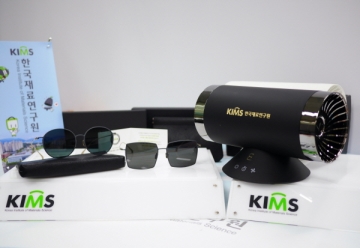
KIMS Listens to Public Voices on Achievements
The Korea Institute of Materials Science (KIMS, Director Lee Jung-hwan) will select citizen experience groups to allow the public to experience outcomes produced through research results directly developed by the institute, and will have the opportunity to listen to their feedback.
2022.07.04by 배종인 기자
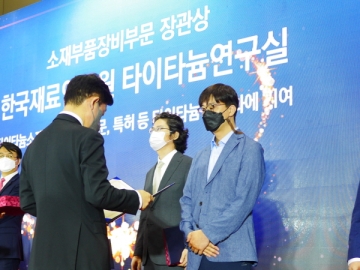
Materials Research Institute, Titanium Material Self-Sufficiency Contribution Recognized
The Korea Institute of Materials Science (KIMS), a government-funded research institute under the Ministry of Science and ICT, has been recognized for its contributions to achieving domestic self-sufficiency in titanium (Ti) materials.
2022.07.07by 배종인 기자

Schneider Aims for Building Energy Savings and Operational Stability with Next-Generation HVAC Drives
Schneider Electric has unveiled its next-generation HVAC drive product line 'Altivar HVAC'. The new product line's key features center on enhanced energy savings, system operational stability, and building management system integration. The products are divided into 'ATH200' for OEM and small equipment applications, and 'ATH600' for environments requiring continuous operation and advanced control. The company plans to expand the application scope from commercial buildings to facilities where HVAC system stability is critical, such as hospitals, airports, and data centers. The announcement includes over 30% energy savings, operation from -10°C to +60°C, Modbus and BACnet support, and compatibility with low global warming potential refrigerants.
2026.03.26by 명세환 기자

Ecolab Expands AI Data Center Cooling Business Through Acquisition of CoolIT
Ecolab has agreed to acquire CoolIT Systems, a liquid cooling company for AI data centers, for approximately $4.75 billion. The transaction is expected to close by Q3 2026, subject to regulatory approvals. CoolIT has been supplying direct-to-chip cooling-based coolant distribution units, cold plates, and manifolds, serving hyperscale data centers and colocation operators as customers. This acquisition is a measure to address the high-heat and high-density server environments created by AI proliferation. Ecolab plans to combine its water management and digital monitoring capabilities with CoolIT's hardware technology to expand its data center cooling business.
2026.03.26by 명세환 기자











