



KERI succeeds in low-temperature production of all-solid-state batteries
 Published2022.07.20 14:26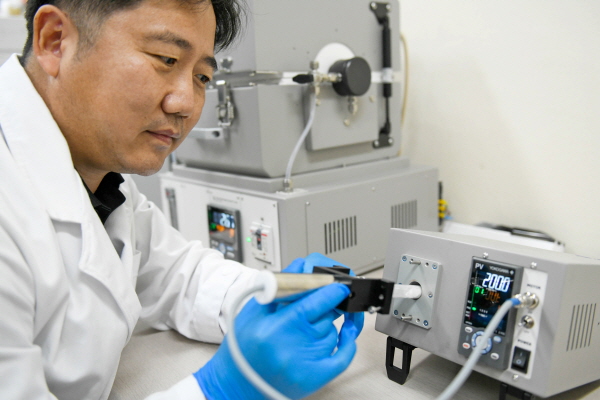
Dr. Ha Yun-cheol of the Korea Electrotechnology Research Institute is manufacturing a solid electrolyte at a low crystallization temperature of 200°C or lower.
Preparing for commercialization through corporate technology transfer
The Korea Electrotechnology Research Institute (KERI, Acting President Kim Nam-kyun) is expected to make a significant contribution to the future commercialization of all-solid-state batteries by lowering the heat treatment temperature for the manufacture and application of all-solid-state battery electrolytes to below 200℃ and solving the problems of ion conductivity loss and interfacial resistance.
The Korea Electrotechnology Research Institute announced on the 18th that the 'low-temperature sintered solid electrolyte powder manufacturing and sheeting technology' developed by Dr. Ha Yun-cheol's team at the Next-Generation Battery Research Center has been transferred to a specialized company.
All-solid-state batteries are next-generation batteries that replace the liquid 'electrolyte' responsible for transferring ions between the anode and cathode with a solid. Because they utilize non-flammable solids, they eliminate the risk of fire and do not require separate cooling systems. This makes them a promising next-generation technology that can be applied in various ways depending on the intended purpose, such as increasing battery capacity, miniaturization, and diversifying battery forms.
For all-solid-state batteries, effective production of the solid electrolyte is important, but above all, because the electrolyte is solid, interfacial contact with other materials is extremely important during the stage of making electrodes or membranes (separators). While interfacial contact can be improved through heat treatments such as sintering, the problem is that some battery materials, such as binders, are susceptible to high temperatures.
In particular, even solid electrolytes well-formed at high temperatures (generally above 500°C) had to be ground into very fine particles to be mixed with other materials (binders, conductive materials, active materials, etc.), which often led to a loss of ion conductivity. Even after mixing, interfacial resistance issues arose due to limited heat treatment. We faced a dilemma where raising the temperature raised concerns about material damage, while lowering it resulted in a decline in the quality of the final product.
KERI’s achievement in overcoming these difficulties is a technology that can manufacture high-quality solid electrolytes at low temperatures without damage and apply them optimally to electrode plates and membranes.
Dr. Ha Yun-cheol's team was able to develop a solid electrolyte manufacturing technology that has ion conductivity equivalent to that of the conventional method (heat treatment at 500°C or higher) even at a low crystallization temperature of 200°C or lower, based on their self-developed intermediate rewetting milling process.
The ability to lower the heat treatment temperature to below 200℃ leads to the development of a new electrode (or membrane) manufacturing process. Unlike the existing process (preparation of solid electrolyte through high-temperature heat treatment, grinding, mixing, and sheeting), which generates significant interfacial resistance, the KERI process allows for the creation of an electrode by mixing the solid electrolyte with various materials (binder, conductive material, active material, etc.) and sheeting it, and then finishing the process with a single heat treatment.
These wet milling processes and low-temperature sintering methods allow the size (particle size) of the solid electrolyte to be appropriately controlled and adjusted according to the user's application purpose (for electrode manufacturing, membrane manufacturing, etc.), and also lower the interfacial resistance between solid materials. The effect of reducing energy costs in the manufacturing process is also significant.
The research institute's achievements were recognized for their high technological capabilities and transferred to Hana Technology Co., Ltd. (CEO Oh Tae-bong), a company specializing in secondary battery equipment. Hana Technology is a specialized equipment manufacturer capable of turnkey production for the entire secondary battery process and has recently been expanding its business into the materials industry. Through this, the company aims to contribute to the rapid commercialization of all-solid-state batteries by securing both core material technology and manufacturing equipment technology. Based on this technology transfer from KERI, Hana Technology plans to complete the technology for mass production of 'solid electrolyte sheet manufacturing equipment' and 'solid electrolyte materials for sheets' for all-solid-state batteries by the end of 2023.
Dr. Ha Yun-cheol of KERI stated, “Our technology is a highly complete and practical achievement in that it goes beyond the perspective of simply improving the ion conductivity of solid electrolytes or mass production, and takes into account electrode or membrane processes as well,” adding, “We will continue to make sustained efforts to develop material, electrode plate, and cell process technologies for the commercialization of high-performance and safe all-solid-state batteries in fields such as energy storage systems (ESS) and electric vehicles.”

Comments
Related news
KERI Successfully Transfers Core Solid-State Battery Technology
The Korea Electrotechnology Research Institute (KERI, Director Myung Sung-ho) has successfully transferred its core solid-state battery technology, which has garnered significant attention as a world-first achievement, with full-scale mass production now anticipated.
2021.10.26by 배종인 기자
KERI Solves Challenges in All-Solid State Battery Commercialization
The Korea Electrotechnology Research Institute (KERI, President Myung Sung-ho) has developed a technology capable of resolving various issues including lithium loss, interfacial side reactions, and internal short circuits—key challenges in commercializing solid-state batteries—thereby further enhancing the prospects for future commercialization of solid-state batteries.
2021.11.08by 배종인 기자

KERI Develops Fire Prediction Technology Based on Lithium-ion Battery Thermal Management
A research team from the Korea Electrotechnology Research Institute and Daegu Gyeongbuk Institute of Science and Technology has developed technology capable of predicting battery fires by analyzing approximately 1.7 million time-series data points obtained from over 1,000 experiments conducted under various charge and discharge conditions.
2022.05.09by 성유창 기자
Schneider Aims for Building Energy Savings and Operational Stability with Next-Generation HVAC Drives
Schneider Electric has unveiled its next-generation HVAC drive product line 'Altivar HVAC'. The new product line's key features center on enhanced energy savings, system operational stability, and building management system integration. The products are divided into 'ATH200' for OEM and small equipment applications, and 'ATH600' for environments requiring continuous operation and advanced control. The company plans to expand the application scope from commercial buildings to facilities where HVAC system stability is critical, such as hospitals, airports, and data centers. The announcement includes over 30% energy savings, operation from -10°C to +60°C, Modbus and BACnet support, and compatibility with low global warming potential refrigerants.
2026.03.26by 명세환 기자
Ecolab Expands AI Data Center Cooling Business Through Acquisition of CoolIT
Ecolab has agreed to acquire CoolIT Systems, a liquid cooling company for AI data centers, for approximately $4.75 billion. The transaction is expected to close by Q3 2026, subject to regulatory approvals. CoolIT has been supplying direct-to-chip cooling-based coolant distribution units, cold plates, and manifolds, serving hyperscale data centers and colocation operators as customers. This acquisition is a measure to address the high-heat and high-density server environments created by AI proliferation. Ecolab plans to combine its water management and digital monitoring capabilities with CoolIT's hardware technology to expand its data center cooling business.
2026.03.26by 명세환 기자











