



Gartner, “Device ‘Cold Wave’”
 Published2022.07.25 16:31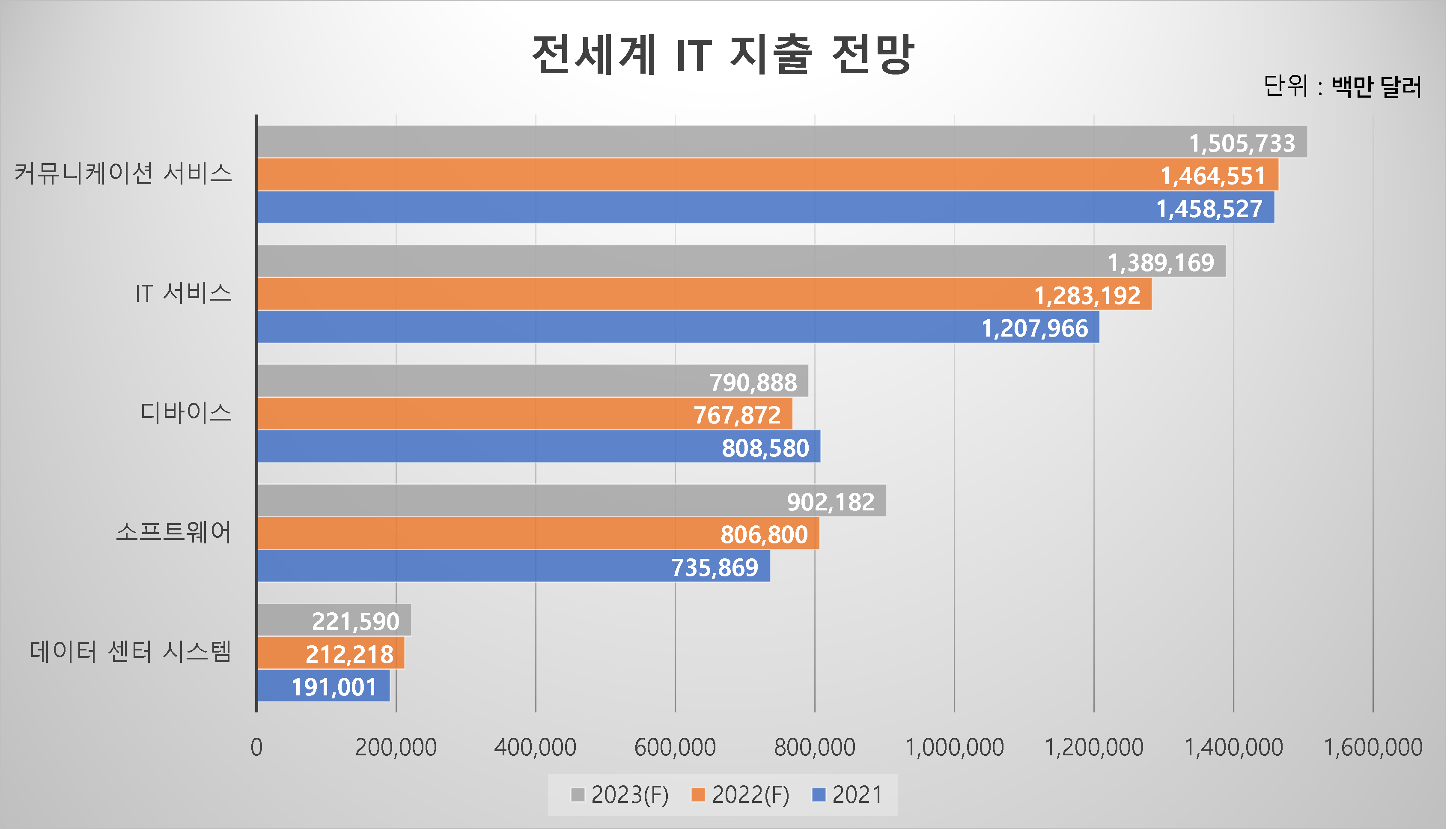
▲전세계 IT 지출 전망 (자료-가트너, 그래픽-e4ds)
디바이스 부문은 역성장, 국내 시장 비슷한 흐름
코로나 팬데믹이 전세계를 휩쓴 이후 IT제품군에서 소비 호황을 맞이했다. 더불어 4K·8K 등 고품질 콘텐츠 및 AI·자율주행·커넥티드카·클라우드 서비스 등 IT 기술이 발달함에 따라 관련 IT 지출이 역대급 성장을 기록한 지난해를 보냈다. 올해는 지난해 비해 침체된 호황기를 보내고 있으며 디바이스 부문에선 찬바람이 불고 있어 글로벌 시장 변화와 국내 산업 흐름에 긴장감이 고조되고 있다.
■ 디바이스 역성장 속 지출 강세 부문은?
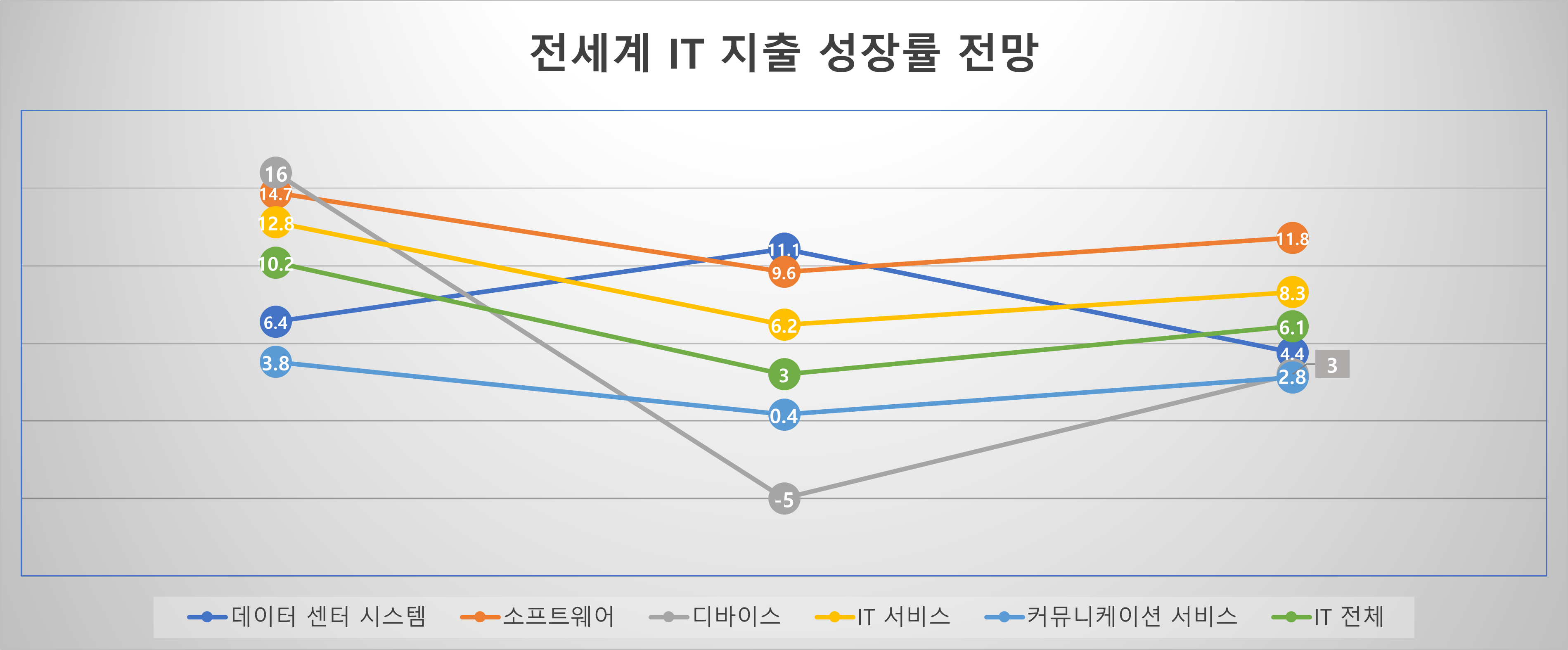
▲전세계 IT 지출 성장률 전망 (자료-가트너)
데이터 센터 시스템에 대한 지출은 2022년 11.1% 증가해 모든 부문에서 가장 높은 성장률을 나타낼 것으로 내다봤다. 클라우드 컨설팅, 구축 및 관리 서비스는 지난해 2,170억 달러에서 2022년 2,550억 달러 규모로 성장해 올해 IT서비스 부문을 6.2%로 끌어올릴 것으로 추정했다.
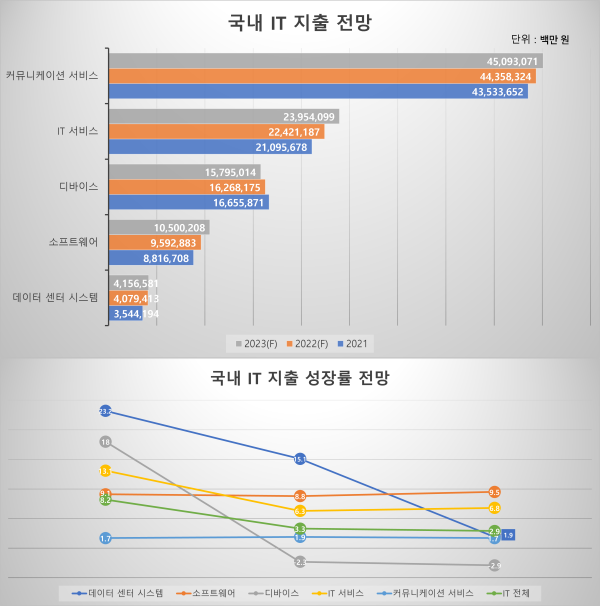
▲ 국내 IT 지출/성장률 전망 (자료-가트너)
국내 데이터 센터 시스템은 지난해 23.2% 성장하며 올해도 15.1% 지출이 확대돼 호황기가 이어지고 있는 반면 2023년 성장률이 1.9%에 불과해 성장폭이 크게 둔화될 것으로 예상됐다. 소프트웨어 부문은 매해 완만한 성장세를 보였다.
또한, 전세계 소프트웨어에 대한 지출은 2022년에 9.6% 증가한 8,068억달러에 이어 2023년에는 11.8% 증가한 9,021억달러에 이를 것으로 추정했다.
인플레이션 상황에 대해 우려하는 존 데이비드 러브록 가트너 리서치 부사장은 “세계 모든 중앙은행이 물가 상승에 대한 대책 마련에 주력하고 있지만 인플레이션은 2023년 말에나 감소할 것”이라고 말했다.
반면에 러브록 부사장은 “인플레이션과 환율에서 나타나는 현재 수준의 변동성은 2022년 CIO들의 투자 계획을 방해하지 않으리라 예상된다”며, “단기적으로 투자하지 않는 기업은 중기적으로 뒤처질 가능성이 높으며, 장기적으로는 존재하지 않을 위험이 있다”고 주장했다.
러시아의 우크라이나 침공으로 인해 물가 상승 및 유통 불확실성 상황이 악화됨에 따라 CIO들과 기업들은 IT 소유 모델에서 서비스 기반 모델로 대거 전환하는 추세이다.
이에, 가트너는 클라우드 부문에 대한 지출이 2021년에는 18.4%, 2022년에는 22.1% 성장할 것이라고 전망했다. 나아가 가트너는 클라우드 서비스에 대한 수요가 IT서비스 산업을 재편하고 있을 뿐만 아니라, 하이퍼스케일러(hyperscaler)가 데이터 센터를 구축함에 따라 2022년에는 서버에 대한 지출 또한 16.6% 증가할 것으로 전망했다.
■ IT 인력 부족 현상이 IT 지출에 미치는 영향
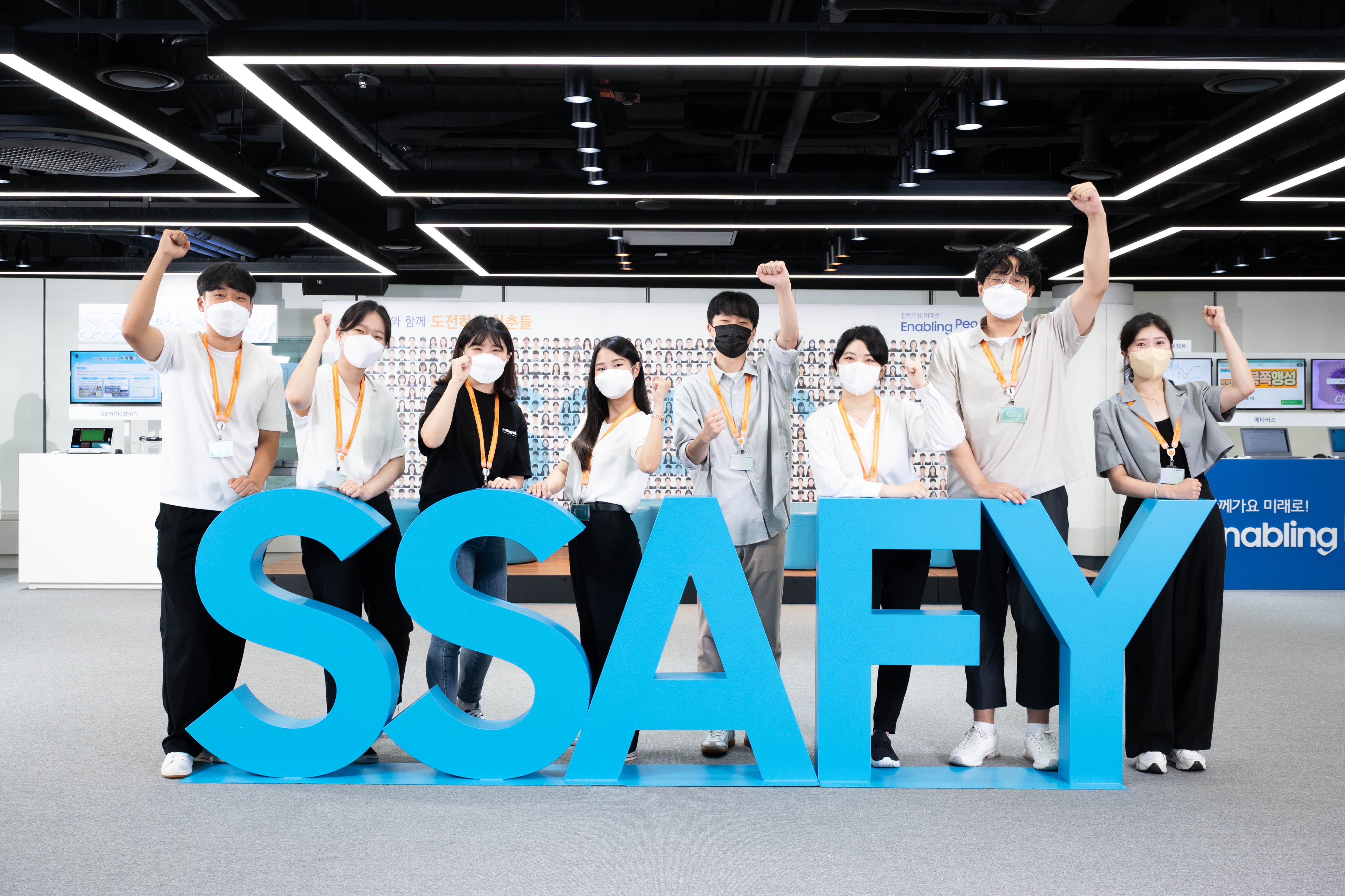
▲'SSAFY'는 삼성이 운영하는 CSR 프로그램으로 국내 IT 생태계 저변을 확대하고 청년 취업 경쟁력을 높이기 위해 소프트웨어 및 IT 개발 커리큘럼을 교육하고 있다. 현재까지 3,678명이 수료했고, 이 가운데 2,770명이 취업한 것으로 전해진다. (사진-삼성전자)
전세계가 겪고 있는 핵심 IT 기술 부족 현상은 2023년 말까지 해소될 것으로 예상된다. 이는 디지털 전환을 완료하려는 기업들의 추진력이 둔화되는 시점에 기존 직원의 역량 향상과 재훈련이 영향을 미칠 것으로 보인다.
가트너는 CIO(Chief Information Officer)들이 빠른 시일 내에 증가하는 IT 수요와 감소하는 IT 인력 수준 사이에서 균형을 맞추기 위해 조치를 취해야 한다고 강조했다.
IT 인력 시장의 규모가 지속적으로 줄어들면서 인재 유치와 유지가 어려워지고 있다. 가트너가 2022년 1분기에 약 18,000명의 직원들을 대상으로 한 글로벌 노동 시장 설문조사에 따르면, 보상이 IT 인재 유치 및 유지의 1위 요인인 것으로 나타났다.
기술 서비스 제공업체는 경쟁력 있는 급여를 제공하기 위해 IT 서비스 가격을 인상하고 있다. 이것이 2023년까지 소프트웨어 및 IT 서비스의 지출 증가에 영향을 미칠 것으로 전망된다고 가트너는 분석했다.
IT서비스 부문에 대한 지출 증가는 지난해 12.8% 성장률에 비해 다소 둔화된 6.2%의 2022년 성장 전망을 보이고 있으나 2023년엔 이보다 증가한 8.3%의 성장률로 약 1조3800억원에 달할 것으로 전망된다.
러브록 부사장은 “CIO들은 숙련된 IT 직원의 부재를 보완하기 위해 더 많은 IT 서비스를 사용하고 있다”며, “낮은 수준의 기술을 필요로 하는 작업은 직원들의 근무 시간을 줄이기 위해 관리형 서비스 회사에 외주를 맡기는 경향이 있는 반면, 많은 기업에서 얻을 수 없는 고급 기술을 요구하는 중요한 전략 작업은 외부 컨설턴트에서 점차 수행 비중이 높아질 것”이라고 밝혔다.

Comments
Related news
2022 Server Shipments May Be Slightly Downgraded
Under the impact of the pandemic, the global server market has experienced rapid growth over the past two years, with an anticipated annual server shipment growth rate of 5%, while excess orders are being adjusted and shipment volumes may see a slight downward revision.
2022.06.29by 명세환 기자
.jpg)
Global device shipments are down… "Hopeful for the 5G phone boom"
The global device market faces headwinds from geopolitical upheaval, high inflation, currency fluctuations, and supply chain disruptions, with forecasts pointing to a direct impact on declining shipment volumes. Meanwhile, the emergence of a 5G smartphone supercycle is creating optimism about future market prospects.
2022.07.04by 명세환 기자

342 Industry Leaders Offer Recommendations to Government..."Semiconductor Shortage and Carbon Neutrality Response Required"
Rising exchange rates and raw material prices, supply chain disruptions, and the need to expand carbon-neutral infrastructure present numerous crises facing the domestic industry. In the domestic industry where manufacturing and import-export are core, voices from the field are calling for institutional improvements needed to resolve semiconductor supply instability and expand renewable energy infrastructure for domestic small and medium-sized enterprises.
2022.07.19by 명세환 기자
ESP32 Development Environment Selection and GPS Application Implementation
The ESP32 is a microcontroller that integrates Wi-Fi, Bluetooth, 12-bit ADC, capacitive touch, PWM, DAC, and UART in a single SoC. However, the abundance of features does not by itself solve the designer's problems. The real challenges lie in selecting the appropriate development environment, determining which pins can be used and which must be avoided, and converting raw data from modules into usable information. This document addresses ESP32 peripheral constraints (ADC2 and Wi-Fi coexistence limitation, UART1 occupancy, ADC non-linear regions), the trade-offs between Arduino IDE and ESP-IDF, and the process from connecting NEO-6M/NEO-M8N GPS modules to UART2, parsing NMEA sentences, and visualizing routes in Google Earth, all organized based on documented references.
2026.10.12by 편집부
MIPI CSI-2, DSI-2, C-PHY, D-PHY Test Solution Technical White Paper
The MIPI interface adopts a burst mode that transitions between low-power (LP) and high-speed (HS) states for low-power consumption, and in return, strict timing rules are imposed on state transitions. Additionally, the high-speed section operates as a packet-based protocol with headers, ECC, and CRC, so verification engineers must handle waveforms and protocols simultaneously. Traditional configurations combining general-purpose oscilloscopes and AWGs reveal limitations in setup complexity, measurement uncertainty, and lack of reproducibility when faced with these requirements. This white paper, based on webinar materials, organizes the structure of this problem and describes how the SV5C-DPTXCPTX generator for receiver testing and SV5C-DPRXCPRX analyzer for transmitter testing integrate state transition testing, stressed eye testing, and protocol analysis into a single bench, along with their application boundaries.
2026.10.12by 편집부











