


Electric vehicle rapid charging rates to increase starting next month
 Published2022.08.01 14:10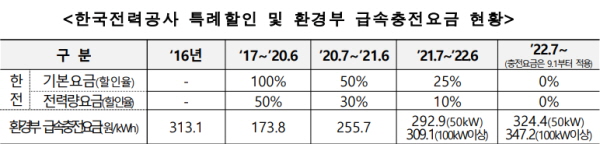
292.9 won/kWh for 50kW → 324.4 won/kWh
309.1 won/kWh for 100kW → 347.2 won/kWh
Starting September 1, the Ministry of Environment will lower the charging rates for public rapid chargers from the current 292.9 won/kWh* (50kW) and 309.1 won/kWh (over 100kW) to 324.4 won/kWh (50kW) and 347.2 won/kWh (over 100kW).
The Ministry of Environment has been adjusting the charging rates for public rapid chargers in operation in accordance with the Korea Electric Power Corporation's special discounts on electric vehicle charging rates and the gradual reduction of discount rates.
Since June of this year, the Ministry of Environment has been operating a joint task force (TF) on charging fees with related organizations such as the Ministry of Trade, Industry and Energy and Korea Electric Power Corporation, as well as relevant experts, and has been discussing the appropriate level of public rapid charging fees through meetings and other means.
After these discussions, it was decided that the public rapid charger rates would reflect half of the impact of the end of the special discount and the increase in electricity rates.
With this measure, the fuel cost of electric vehicles will increase by approximately KRW 2,200 (KRW 6.2/km) from the current KRW 20,503 to KRW 22,708 for a single full charge using a 50kW rapid charger for an electric vehicle equipped with a 70kWh battery.
The charging fee that has been realized this time is reflected in the payment system, and charging fee information signs are attached. It will be applied from September 1st after a preparation period.
Meanwhile, the Ministry of Environment and the Ministry of Trade, Industry and Energy have decided to improve the electricity rate system and reduce the rate of reduction in electric vehicle purchase subsidies to reduce the burden on electric vehicle users and charging service providers.
Korea Electric Power Corporation (KEPCO) plans to review measures such as changing the basic fee calculation method for some chargers from the current contract power method to a maximum demand power method, reflecting opinions from the field that the basic fee burden for charging facilities is high.
The Ministry of Environment has continued to reduce subsidies for electric vehicle purchases, but plans to ease the burden on new buyers by easing the rate of subsidy reduction next year compared to previous years to ensure that there are no disruptions to the spread of electric vehicles.
Comments
Related news
[Feature] EV Crisis, A Clever Strategy for a Reversal
An industry official argued that the government should expand its support to secure future EV market share, and that companies should also strengthen cooperation with overseas partners.
2022.07.08by 성유창 기자
.jpg)
The Ioniq 6 goes 100km further than the Ioniq 5
Hyundai Motor has unveiled the Ioniq 6, a mid-size sedan electric vehicle that succeeds the Ioniq 5.
2022.07.15by 성유창 기자

[Mybe②] Mybe, "We will overcome the shortage of Chinese parts supply and secure market competitiveness"
Kim Jong-bae, CEO of MyDrive, stated that while the company had set a delivery target of 1,000 units for 2022, component procurement itself was not proceeding smoothly due to China's lockdown measures.
2022.07.20by 성유창 기자
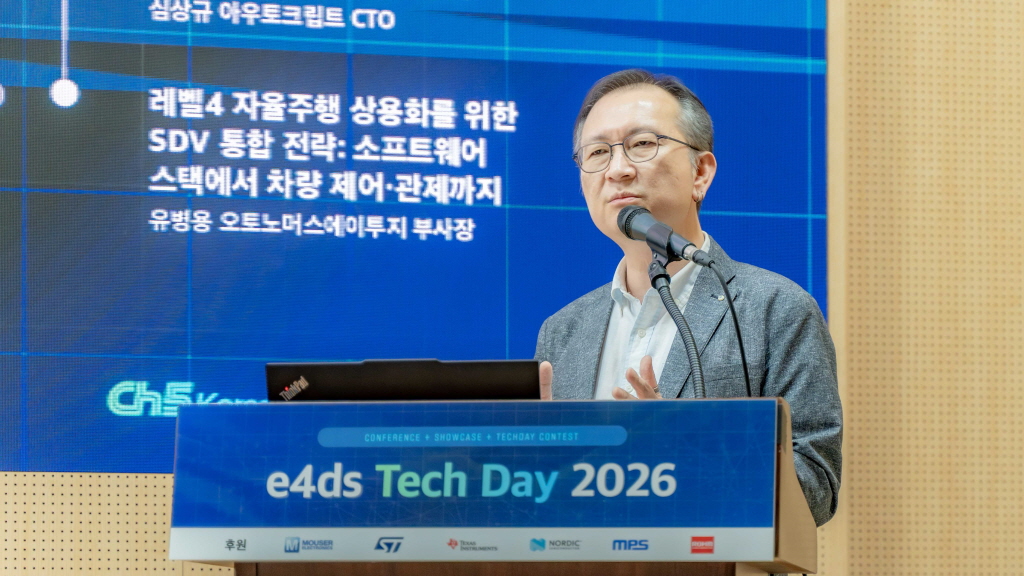
[e4ds Tech Day 2026 ⑨] Sim Sang-gyu, Autocrypt CTO: "In the Physical AI Era, Automotive Security Must Extend Beyond the Vehicle"
At e4ds Tech Day 2026, Sim Sang-gyu, CTO of Autocrypt, explained automotive cybersecurity strategies in the era of Physical AI and SDV (Software-Defined Vehicle). Automobiles are evolving as part of an ecosystem connected to AI, cloud, chargers, IoT, and robots, and he emphasized that the scope of security must expand beyond the vehicle interior to the entire connected environment. In particular, AI model tampering, adversarial attacks, OTA updates, and EV charger hacking were identified as major threats. He explained that response measures require zero trust, AI model integrity protection, intrusion detection, Security by Design and Default, and full lifecycle security management, and that proactive security system establishment beyond regulatory compliance is critical for securing future mobility competitiveness.
2026.10.12by 배종인 기자

Practical HIL Construction Strategy for Automotive and Off-Highway Controller Validation
As vehicle E/E architecture transitions to zonal structures and shifts to software-defined vehicles (SDV), the number of controllers (ECUs) requiring validation and software complexity are surging dramatically. Meanwhile, real vehicle testing cannot provide repeated verification under identical conditions and entails lead time and safety concerns. This white paper explains the principles of HIL (Hardware-in-the-Loop) validation and the structure of the NI platform composed of PXI, SLSC, and VeriStand, and through two actual implementation cases—Camera Record & Replay HIL for In-Cabin Monitoring Controller (ICMU) and Forklift Controller (VCU) HILS—describes how controller-level regression testing becomes possible. Additionally, it explicitly states application boundaries and limitations, such as lack of A2B support.
2026.10.12by 편집부











