


Samsung SDI Achieves Record Quarterly Revenue and Operating Profit
 Published2022.08.03 14:58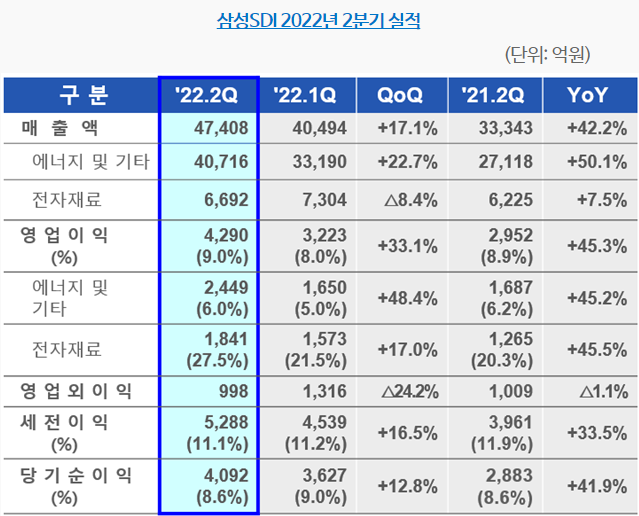
▲ Samsung SDI Q2 2022 Operating Results (Source: Samsung SDI)
Q2 2022 Revenue 4.7408 trillion won · Operating profit 429 billion won
Growth expected in the second half of the year centered on medium-to-large batteries and high value-added products
Samsung SDI announced its business results for the second quarter of 2022 on the 29th, stating that it recorded sales of 4.7408 trillion won, an operating profit of 429 billion won, and a net profit of 409.2 billion won in the second quarter.
Sales increased by 17.1% and operating profit increased by 33.1% compared to the previous quarter, marking all-time highs for both sales and operating profit, and it is the first time that operating profit has exceeded 400 billion won.
Looking at the business divisions, sales in the energy sector increased by 22.7% and operating profit by 48.4% compared to the previous quarter.
Compared to the previous quarter, sales of medium and large batteries increased, and profitability also improved.
Sales of high-value products such as Gen.5 for automotive batteries expanded amidst robust demand growth, and for ESS batteries, revenue increased due to expanded sales for power use, and profitability also improved by reflecting the increase in raw material costs in the selling price.
In the case of small batteries, sales increased and profitability improved, centered on cylindrical batteries. Sales of cylindrical batteries grew, driven by demand for electric vehicles and high-output power tools, while sales of pouch-type batteries declined due to slowing demand for IT products and pent-up demand for new products in the second half of the year.
Sales in the electronic materials division amounted to 669.2 billion won, up 7.5% from the same period last year but down 8.4% from the previous quarter. Operating profit was 184.1 billion won, up 45.5% from the same period last year and 17.0% from the previous quarter.
The electronic materials division enhanced profitability compared to the previous quarter through the expansion of high-value-added products. Sales of OLED materials increased as supply to new platforms commenced, while sales of semiconductor materials remained at the same level as the previous quarter. The polarizing film division maintained profitability by expanding sales centered on products differentiated from competitors.
Sales of medium and large batteries are expected to continue in the second half of this year, driven by high value-added products.
With the operation of the second factory in Hungary, sales of Gen.5 batteries for automotive batteries are set to begin in earnest, and plans are underway to continue securing orders for next-generation platforms. Sales of ESS batteries are expected to expand due to the increased demand for renewable energy driven by high oil prices and expanded eco-friendly policies, as well as the launch of new power ESS products.
Sales growth for small batteries is projected to be driven by the mobility sector. Sales of cylindrical batteries for mobility applications, such as electric vehicles and electric bicycles, are expected to expand. A 46-pi (Φ, diameter 46mm) line is also being built to support new electric vehicle projects.
In the second half of the year, the electronic materials sector expects to expand sales, centered on OLED and semiconductor materials.
Samsung SDI explained, “We are expanding sales of OLED materials to major customers and pursuing entry into next-generation platforms. For semiconductor materials, we plan to expand sales through the timely launch of new products, and for polarizing films, we intend to respond to the decrease in downstream demand by diversifying our customer base.”
Comments
Related news
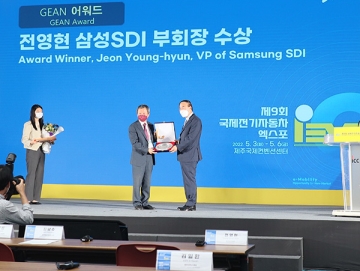
[International Electric Vehicle Expo] Samsung SDI: "Achieving Electric Vehicle Battery Efficiency Through Appropriate Mechanisms"
At the opening ceremony of the '9th International Electric Vehicle Expo (IEVE)', Vice Chairman Jeon Young-hyun received the World Electric Vehicle Association Award, and Vice President Jang Rae-hyuk, head of the Development Division of the Medium and Large Battery Business Unit, delivered the keynote speech.
2022.05.06by 김예지 기자
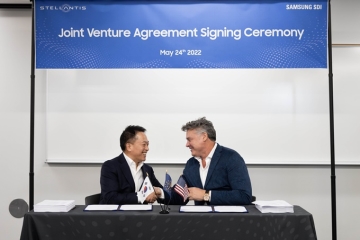
Samsung SDI and Stellantis to Invest $2.5 Billion in Battery Factory in Indiana, USA
Samsung SDI and Stellantis announced that they have selected Kokomo, Indiana as the site for their first U.S. joint venture for electric vehicle battery cells and modules, and will invest more than $2.5 billion.
2022.05.27by 성유창 기자

[e4ds Tech Day 2026 ⑨] Sim Sang-gyu, Autocrypt CTO: "In the Physical AI Era, Automotive Security Must Extend Beyond the Vehicle"
At e4ds Tech Day 2026, Sim Sang-gyu, CTO of Autocrypt, explained automotive cybersecurity strategies in the era of Physical AI and SDV (Software-Defined Vehicle). Automobiles are evolving as part of an ecosystem connected to AI, cloud, chargers, IoT, and robots, and he emphasized that the scope of security must expand beyond the vehicle interior to the entire connected environment. In particular, AI model tampering, adversarial attacks, OTA updates, and EV charger hacking were identified as major threats. He explained that response measures require zero trust, AI model integrity protection, intrusion detection, Security by Design and Default, and full lifecycle security management, and that proactive security system establishment beyond regulatory compliance is critical for securing future mobility competitiveness.
2026.10.12by 배종인 기자
Practical HIL Construction Strategy for Automotive and Off-Highway Controller Validation
As vehicle E/E architecture transitions to zonal structures and shifts to software-defined vehicles (SDV), the number of controllers (ECUs) requiring validation and software complexity are surging dramatically. Meanwhile, real vehicle testing cannot provide repeated verification under identical conditions and entails lead time and safety concerns. This white paper explains the principles of HIL (Hardware-in-the-Loop) validation and the structure of the NI platform composed of PXI, SLSC, and VeriStand, and through two actual implementation cases—Camera Record & Replay HIL for In-Cabin Monitoring Controller (ICMU) and Forklift Controller (VCU) HILS—describes how controller-level regression testing becomes possible. Additionally, it explicitly states application boundaries and limitations, such as lack of A2B support.
2026.10.12by 편집부
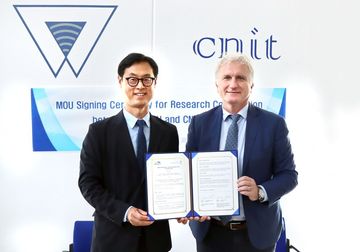
Korea Automotive Research Institute Signs MOU with Italy National Institute for Wireless Communications
The Korea Automotive Research Institute will sign an MOU with Italy's National Institute for Wireless Communications and launch joint research on next-generation mobility technologies based on 6G, V2X, and connected vehicles. The two organizations will conduct research to apply advanced wireless communication technologies to vehicles and discover international joint projects to advance next-generation connected vehicle technology development.
2026.10.12by 배종인 기자











