


Ministry of SMEs and Startups to Support R&D of Promising Fields such as Secondary Batteries and Future Vehicles with 19.4 Billion Won
 Published2022.08.04 10:37
글로벌 경쟁력 확보 위해 과제당 5~6원씩 최대 2년 지원
중소벤처기업부(이하 중기부)는 ‘중소기업 기술혁신개발사업’을 통해 지원할 이차전지, 첨단로봇, 미래차 등 미래 유망분야 154개 과제를 선정했다고 4일 밝혔다.
‘중소기업 기술혁신개발사업’은 매출액 20억원 이상의 중소기업 중 4차 산업혁명과 디지털전환 시대를 선도할 우수한 기술력을 보유한 중소기업을 지원하는 사업이다.
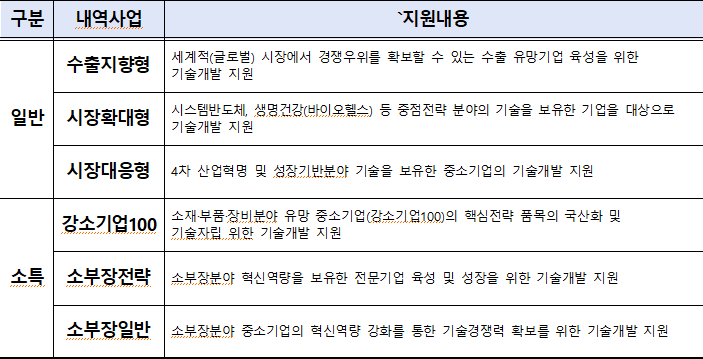
▲기술개발혁신사업 지원내용 (출처: 중기부)
이번 공모는 4월 11일(월)부터 4월 25일(월)까지 2주간 총 1,548개 과제가 접수됐으며 10:1의 높은 경쟁률 가운데 비대면 평가방식을 적용해 최종 154개 과제(총 194억원)를 선정했다.
선정된 과제들은 최대 2년간 5~6억원을 지원할 예정이다.
이차전지 분야에서는 △활성화 공정용 충·방전 장비 △소재 가공용 정밀 레이저 가공기 △박막 표면처리용 롤투롤(Roll to Roll) 장비 등 제조장비 △폐배터리 소재 재활용기술 △전해액 첨가제 합성기술 △고순도 양극안정제 공정기술과 같은 소재·공정개발 관련 총 8개 과제가 선정됐다.
첨단로봇 분야에서는 로봇산업의 고도화와 첨단제조기술 확보를 위해 △제조업 작업자 지원 협동로봇 △관로 안전점검용 이동로봇 등 제조 첨단로봇과 △다기능 복합 물류 관리 로봇 △AI 기반 사물 부착형 이동로봇 등 서비스 로봇 개발을 위한 7개 과제가 선정됐다.
미래차 분야에서는 △전기차용 인버터 전류 센서 △레이더 센서 사후정비 기술 등 감지기(센서)관련 과제 △전기차 모터용 축전압 저감 장치 △다기능 주거용 전기차 충전기 등 보급·기반(인프라) 관련 7개 과제가 선정됐다.
중기부는 선정된 과제를 대상으로 8월 중 신속히 협약을 체결해 과제 수행을 위한 연구비를 빠르게 지원할 계획이며, 선정된 중소기업을 대상으로 연구개발 수행계획, 연구비 계상 및 집행, 연구윤리 등 과제 수행을 위한 기본지침 안내도 병행할 계획이다.
윤석배 중기부 기술개발과장은 “국내 중소·벤처기업들이 세계적인(글로벌) 시장에서 독보적 기술 경쟁력을 갖출 수 있도록 지속적으로 지원할 계획”이라며 ”이차전지, 첨단로봇 등 미래 유망분야에서 잠재력 있는 중소‧벤처기업들도 적극 발굴해 육성할 것“이라고 말했다.
Comments
Related news

The Ministry of SMEs and Startups will provide 200 million won to each of the "100 Small Business Startups."
The Ministry of SMEs and Startups (hereinafter referred to as the Ministry) announced on the 8th that it will recruit 20 innovative startups to secure advanced manufacturing capabilities in the materials, parts, and equipment sectors and create new markets, with applications accepted through the 29th of the same month.
2022.03.07by 성유창 기자
Samsung Electronics and the Ministry of SMEs and Startups (MSS) are partnering to develop the system semiconductor ecosystem, hosting the Fabless Challenge.
Samsung Electronics and the Ministry of SMEs and Startups have joined forces to build a domestic system semiconductor ecosystem aimed at revitalizing the domestic fabless ecosystem.
2022.07.27by 명세환 기자
Nvidia invests $5 billion in Intel
NVIDIA and Intel, leaders in global AI computing technology, are now forging ahead in providing cutting-edge solutions through NVLink-based architecture integration. NVIDIA and Intel have officially announced a strategic partnership and stated that they will jointly develop customized data center and personal computing products to accelerate diverse applications and workloads ranging from hyperscale to enterprise and consumer markets, thereby laying the foundation for the next generation computing era.
2025.09.22by 배종인 기자
.jpg)
Applied Materials Launches Environmental Protection Campaign to Mark World Cleanup Day
Applied Materials Korea (CEO Park Kwang-seon) is carrying out environmental cleanup activities with employees and their families around the Dongtan Sinricheon area on the occasion of World Cleanup Day, evolving into a company that engages with the local community beyond technological innovation.
2025.09.22by 명세환 기자
.jpg)
The combination of electrical and electronic technologies like AI, semiconductors, and electric vehicles with renewable energy will determine industrial competitiveness.
Professor Lim Chun-taek from Gwangju Institute of Science and Technology (GIST) stated in his keynote speech at the '2025 e4ds Tech Day' on the 9th, "Global energy investment is already shifting from fossil fuels to renewable energy, and the trend of electrification combined with electrical and electronic technologies is changing the industrial landscape."
2025.09.12by 배종인 기자











