



Full Inspection of Waste Batteries Expected to Save Time and Costs
 Published2022.08.11 10:02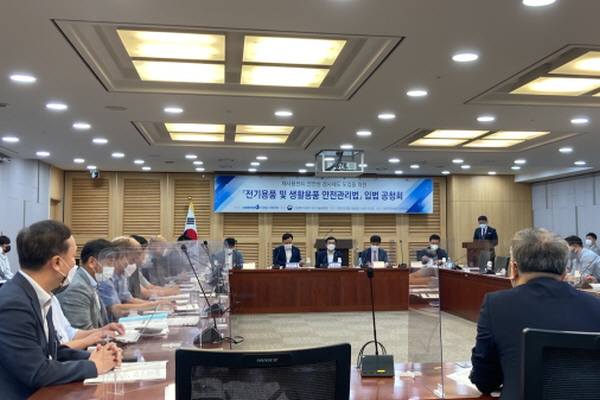
Over 80% Reduction in Time and Cost Compared to Existing Inspections
Businesses with experts can conduct full inspections themselves
The legislative public hearing on the 'Electrical Appliances and Household Goods Safety Management Act' for the introduction of a safety inspection system for reusable batteries was held to hear opinions from institutions and companies regarding the amendment of the bills proposed by Representative Lee Jang-seop last January.
By 2030, there are 80,000 waste batteries, with a scale of 21 trillion won, and the annual average growth is expected to reach 8.2%.
According to SNE Research, the total sales volume of electric vehicles and hybrid electric vehicles in the first half of 2022 was approximately 4,285,000 units, a 63% increase compared to the same period last year.
The number of waste batteries generated in 2022 is projected to increase exponentially to 9,155 for electric vehicles compared to only 12 in 2017, and hybrid electric vehicles are also expected to more than double to 74,988 compared to 3,657 in 2017.
Waste batteries collected domestically are reused for ESS, etc., or disposed of after recovering key materials such as lithium.
The industry aims to secure global competitiveness, not stopping at the domestic level. It was stated that relevant laws must be amended promptly for this to happen.
Kim Yu-tak, head of the Korea Battery Industry Association, stated, “The cumulative capacity of recyclable electric vehicle batteries worldwide is expected to increase to 1 TWh by 2030,” and argued that we must move quickly to secure the global market.
Park Sun-kyu, a manager at SK ON, stated, “There was business uncertainty due to the absence of a safety inspection system to evaluate reusable batteries.” “Currently, the evaluation period for recycled battery modules alone is three months,” he said, adding, “I hope that with the legislation of the inspection system, the projects that have been conducted as demonstration projects will be commercialized in earnest.”
Jang Hyuk-jo, Head of the Electrical and Telecommunications Product Safety Division at the Korean Agency for Technology and Standards, stated, “As the adoption of electric vehicles expands, the continuous generation of waste batteries is expected, necessitating an inspection system to enhance their utilization.” He added, “To reduce the inspection burden, we will allow businesses equipped with specialized personnel to conduct inspections themselves.”
Representative Yoon Kwan-seok continued by emphasizing the necessity of a full inspection, stating, “Approximately 80% of waste batteries can be recycled or reused,” but added, “However, because the quality of individual waste batteries varies and the risk of accidents is high, all products must be inspected.”
To this end, the plan is to introduce a new 'full inspection system' suitable for used products, rather than the safety certification (sample inspection by model) under current laws.
Compared to existing methods that require massive costs and time, full inspection can reduce costs and time by more than 80%.
Manager Jang stated, “We will conduct guidance and supervision of safety inspection agencies, including verifying the appropriateness of inspection work even after the fact,” adding, “We are insured to compensate for damages caused by defects in waste batteries.”
The scale of liability insurance is 1 billion won for property damage and 150 million won for bodily injury, and the annual insurance premium is estimated at 12 million won.
Inspection methods are also becoming more advanced.
KTL will complete the development of a software inspection technique utilizing driving history information embedded in batteries within this year.
While existing module testing took 40 hours, software testing techniques [test so]This time can be drastically reduced from 80 minutes to 30 minutes per person.
Operation history information includes the number of charge/discharge cycles, remaining capacity, battery voltage, and battery failure history.
Many things were said during the Q&A session as well.
When asked about the fact that business could not be conducted due to a lack of battery supply for a year, Manager Jang replied that the reason was that it had not been long since the full-scale rollout of electric vehicles began.
It was reported that in order to revitalize the supply and demand of waste batteries, a process will be established for private sector purchasing rather than the Ministry of Environment's bidding method.
Comments
Related news
Infineon Launches High-Resolution 3D Image Sensor for Automotive Applications
Infineon supports all types of services requiring authentication, such as payment, battery charging, and personal data access, through reliable secure facial authentication via its 3D image sensor.
2022.06.21by 성유창 기자
Major US automakers and battery manufacturers launch alliance, targeting South Korea and China.
US automakers and battery manufacturers are joining forces to catch up with South Korea and China, which have secured competitive advantages in the electric vehicle and battery markets, as they make a full-scale push forward.
2022.06.24by 성유창 기자

[e4ds Tech Day 2026 ⑨] Sim Sang-gyu, Autocrypt CTO: "In the Physical AI Era, Automotive Security Must Extend Beyond the Vehicle"
At e4ds Tech Day 2026, Sim Sang-gyu, CTO of Autocrypt, explained automotive cybersecurity strategies in the era of Physical AI and SDV (Software-Defined Vehicle). Automobiles are evolving as part of an ecosystem connected to AI, cloud, chargers, IoT, and robots, and he emphasized that the scope of security must expand beyond the vehicle interior to the entire connected environment. In particular, AI model tampering, adversarial attacks, OTA updates, and EV charger hacking were identified as major threats. He explained that response measures require zero trust, AI model integrity protection, intrusion detection, Security by Design and Default, and full lifecycle security management, and that proactive security system establishment beyond regulatory compliance is critical for securing future mobility competitiveness.
2026.10.12by 배종인 기자

Practical HIL Construction Strategy for Automotive and Off-Highway Controller Validation
As vehicle E/E architecture transitions to zonal structures and shifts to software-defined vehicles (SDV), the number of controllers (ECUs) requiring validation and software complexity are surging dramatically. Meanwhile, real vehicle testing cannot provide repeated verification under identical conditions and entails lead time and safety concerns. This white paper explains the principles of HIL (Hardware-in-the-Loop) validation and the structure of the NI platform composed of PXI, SLSC, and VeriStand, and through two actual implementation cases—Camera Record & Replay HIL for In-Cabin Monitoring Controller (ICMU) and Forklift Controller (VCU) HILS—describes how controller-level regression testing becomes possible. Additionally, it explicitly states application boundaries and limitations, such as lack of A2B support.
2026.10.12by 편집부
Korea Automotive Research Institute Signs MOU with Italy National Institute for Wireless Communications
The Korea Automotive Research Institute will sign an MOU with Italy's National Institute for Wireless Communications and launch joint research on next-generation mobility technologies based on 6G, V2X, and connected vehicles. The two organizations will conduct research to apply advanced wireless communication technologies to vehicles and discover international joint projects to advance next-generation connected vehicle technology development.
2026.10.12by 배종인 기자











