


The Ministry of Trade, Industry and Energy announced efforts to minimize the burden on the industry from the US semiconductor support law.
 Published2022.08.29 14:12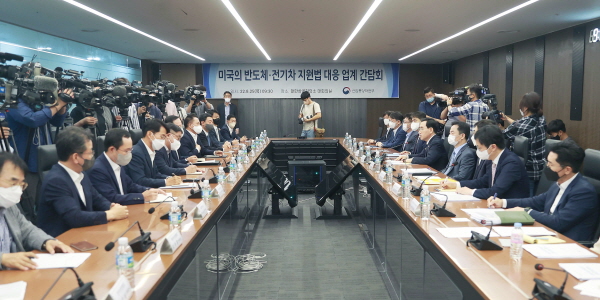
The Ministry of Trade, Industry and Energy announced that it will work to minimize the burden on the Korean semiconductor industry due to the "guardrail" provisions of the U.S. Semiconductor Support Act.
On the 25th, the Ministry of Trade, Industry and Energy held a meeting with the semiconductor, automobile, and battery industries in the Korea Chamber of Commerce and Industry conference room to discuss response measures related to the semiconductor support law and inflation reduction law passed in the United States.
Regarding semiconductors, under the Semiconductor Support Act, companies making new semiconductor-related investments in the U.S. can receive financial support (USD 52.7 billion from 2022 to 2026) and a 25% investment tax credit. However, companies receiving incentives will face some restrictions on new investments in China and other countries of concern for the next 10 years under the so-called "guardrail" provisions.
However, exceptions to the guardrail are also recognized, such as the exclusion of general semiconductor-related equipment, such as memory, as determined by the U.S. Secretary of Commerce.
Accordingly, the Ministry of Trade, Industry and Energy plans to focus on discussions with the U.S. Department of Commerce on general semiconductor content and strive to minimize the burden on the industry. If necessary, the Ministry will actively utilize the already established Korea-U.S. semiconductor partnership dialogue and supply chain/industry dialogue channels between the Ministry of Trade, Industry and Energy and the Department of Commerce.
According to the revised electric vehicle tax credit in the Inflation Reduction Act, electric vehicles assembled in North America that meet certain battery mineral and component ratio requirements will receive support of up to $7,500 per electric vehicle.can receive.
Through this meeting, the government and industry discussed active consultations with the United States, seeking industry-level response measures, cooperation with countries in similar positions, and a One Team system between the government and the private sector. Based on this, they plan to respond in a three-dimensional manner.
Minister Lee Chang-yang said in his remarks, “Recently, the United States appears to be pursuing the promotion of advanced industries and the protection of domestic industries through measures such as the Semiconductor Support Act and the Inflation Reduction Act.” He added, “The draft of the CHIPS Act did not include guardrail text, but it was added during the congressional discussion. The Inflation Reduction Act, which includes provisions for reforming electric vehicle subsidies, was also passed without a hitch about two weeks after the bill was made public. It appears that various factors, such as domestic political factors in the United States, the search for decoupling from China, and the promotion of domestic industries, have worked in a complex manner.”
The minister also emphasized, “While our companies may receive support under this law, it also includes provisions that are burdensome to our companies, such as guardrail provisions and electric vehicle subsidy requirements. Furthermore, there are significant concerns from countries like Korea, Germany, and Japan, which are exporting electric vehicles to the U.S., so there is a need for the public and private sectors to communicate regularly, gather opinions, and prepare response measures.”
To this end, the Ministry of Trade, Industry and Energy plans to form a public-private joint response team and actively conduct outreach to the U.S. administration, Congress, and the White House as a single team, thereby pursuing a multi-faceted response.
We will closely examine the possibility of violations of international trade norms such as the WTO agreement and the Korea-US FTA, and consider ways to respond in line with similar positions of countries such as the EU. In September, Ahn Deok-geun, the head of the Trade Negotiation Headquarters, will visit the US to intensively discuss the semiconductor support law and the inflation reduction law with the US. Prior to this, director-generals of the Ministry of Trade, Industry and Energy will also visit the US in August to proceed through high-level consultations.

Comments
Related news
The Ministry of SMEs and Startups and Seoul National University will host a job fair for fabless professionals.
Fabless companies operate in the technology-based sector of the system semiconductor field, and while they demonstrate growth potential with innovative startups emerging, most remain small and medium-sized enterprises with limited revenue and operating profit. Accordingly, government agencies and relevant industry-academia-research institutions are actively working to address key challenges facing fabless companies in areas such as funding, human resources, and mutual prosperity.
2022.08.26by 명세환 기자
Semiconductor Industry Urges Swift Passage of Semiconductor Competitiveness Enhancement Act
The semiconductor industry has urged the swift passage of the Semiconductor Industry Competitiveness Enhancement Act to overcome the semiconductor crisis and secure semiconductor leadership.
2022.08.29by 배종인 기자
Fabless Industry Association: "National support for semiconductors is essential."
Domestic semiconductor fabless companies have strongly urged nationwide support.
2022.08.29by 배종인 기자

Intel Unveils Next-Generation 'Core Ultra Series 3' and vPro Platform for Enterprise PCs
Intel has officially unveiled the "Intel Core Ultra Series 3" for next-generation enterprise PCs and the latest vPro platform, addressing a wide range of demands from enterprise notebooks to high-performance workstations.
2026.03.26by 배종인 기자

ROHM Launches ESD Protection Diode Compatible with High-Speed Interfaces of 10Gbps or Higher
Semiconductor specialist ROHM has developed the 'RESDxVx series' of ESD (electrostatic discharge) protection diodes capable of responding to next-generation high-speed data communication environments exceeding 10Gbps, simultaneously enhancing both signal quality maintenance required in high-speed interfaces and IC protection performance.
2026.03.26by 배종인 기자











