


Ministry of Science and ICT, 2023 total budget 18.8 trillion won
 Published2022.09.02 10:05
Key strategic technologies including semiconductors reach 2.2 trillion won… up 13% year-on-year
The Ministry of Science and ICT (Minister Lee Jong-ho) will increase its total budget for 2023 by 13% compared to this year and focus on securing strategic technologies for a super-gap in the era of technological hegemony competition and national digital innovation.
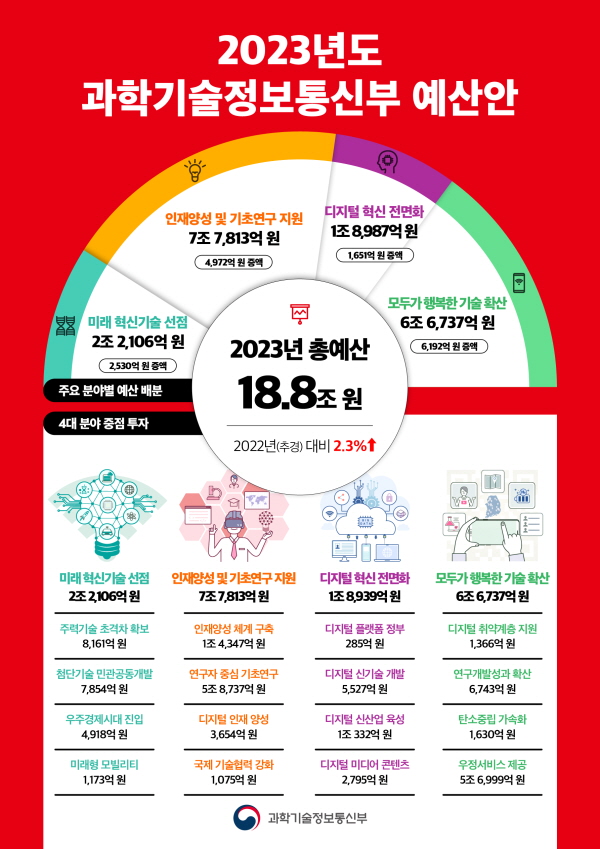
The Ministry of Science and ICT announced the 2023 budget plan on the 31st. According to this, the total amounted to 18.8 trillion won, an increase of 2.3% compared to 2022.
Key strategic technologies such as semiconductors, nuclear power, and 6G amounted to 2.2106 trillion won, an increase of 12.9% compared to the previous year.
14 billion won was allocated as a new budget for 2023 for the activation of semiconductor design verification infrastructure, and the nano and materials technology development project was increased by 14.8 billion won to 251.1 billion won.
The AI semiconductor demonstration support project budget was increased by 8.4 billion won from the previous year to 12.5 billion won.
3.1 billion won has been newly allocated for the development of innovative small modular reactor (i-SMR) technology, and 29.1 billion won for research and development of core technologies for spent nuclear fuel, an increase of 1.7 billion won compared to the previous year.
The budget for 6G core technology development was increased by 1.9 billion won to 32.7 billion won.
To secure core technologies in advanced technology fields early through industry-academia-research collaboration, the budget for building quantum computing research infrastructure was increased by 2 billion won to 12 billion won, and 3.8 billion won was newly allocated for quantum computing-based quantum gain challenge research.
A budget of 117.3 billion won has also been allocated to lead mobility innovation through the early development of future modes of transportation and unmanned vehicles.
Of these, the Autonomous Driving Technology Development Innovation Project was increased by 8.9 billion won to 37.3 billion won, and the Next-Generation Autonomous Vehicle Communication Technology Development Project was increased by 4.3 billion won to 9.6 billion won.
The budget for the development of source technology for unmanned vehicles was increased by 400 million won to 25.6 billion won, and the budget for the development of stratospheric drones for continuous disaster monitoring was increased by 8.3 billion won to 12.3 billion won.
Support for technology innovation-driven talent development and basic research was increased by 6.8% from the previous year to 7.7813 trillion won, and support for the full-scale implementation of national digital innovation was increased by 9.5% from the previous year to 1.8939 trillion won.
The sector for the "Technology Diffusion for Everyone's Happiness," aimed at enhancing digital accessibility for vulnerable groups and establishing a safe ICT infrastructure, amounted to 6.6737 trillion won, an increase of 10.2% compared to the previous year.% increased.
The 2023 budget bill and fund management plan will be submitted to the National Assembly on September 2 after approval by the Cabinet, and will be amended and finalized during the regular session through preliminary review by the standing committee, main review by the Budget and Accounts Committee, and approval by the plenary session.
Minister of Science and ICT Lee Jong-ho stated, “In this budget proposal, we have focused on securing a super-gap in strategic technology fields where we are ahead, such as reinforcing outdated and gapped equipment at semiconductor research sites, promoting the development of next-generation small modular reactors, and striving for the world’s first 6G commercialization.” He added, “We will also concentrate our capabilities on the early establishment of a government digital platform so that simple and repetitive public tasks can be automated and private and public data can be interconnected to provide services to the public.”

Comments
Related news
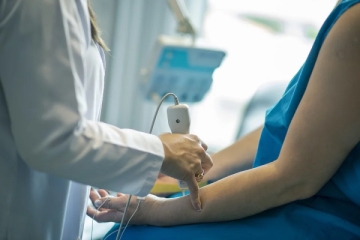
The Ministry of Science and ICT will invest 17.5 trillion won in the Korean New Deal and post-COVID response.
The Ministry of Science and ICT has finalized the 2021 budget plan totaling 17.5154 trillion won. This represents an increase of 1.2086 trillion won compared to 2020 and was expanded to support the Korean New Deal, basic and fundamental research and development, cultivation of three strategic new industries, realization of an inclusive society, and response to infectious diseases. The government R&D budget increased by 3.1823 trillion won to reach 27.4018 trillion won.
2020.12.03by 이수민 기자
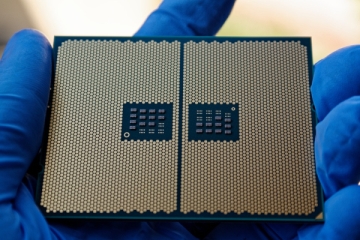
Next year's nanotechnology and materials technology development budget has been set at KRW 287.9 billion, a 25% increase over this year.
The Ministry of Science and ICT has finalized and will proceed with the implementation plan for the 2021 Nano and Materials Technology Development Project, with a total budget of 287.9 billion won. This plan accounts for approximately 70% of the ministry's 417.3 billion won budget for materials, components, and equipment support, representing an increase of approximately 25% compared to the previous year. The Ministry of Science and ICT plans to categorize similar projects into five types—future technology, core technology, commercialization, fab advancement, and research innovation—for systematic project management and to enhance convenience and predictability in the research field. The ministry will implement customized support strategies for each category.
2020.12.16by 이수민 기자
.jpg)
2022 KEIT Materials, Parts, and Equipment General Team budget: 1.0251 trillion won, 35.6% of total
The Korea Evaluation Institute of Industrial Technology (hereinafter KEIT) announced KEIT's budget by industrial sector and new project support programs at the "2022 Government R&D Project Online Multi-Ministry Briefing Session" held on the 26th.
2022.01.27by 성유창 기자
Nvidia invests $5 billion in Intel
NVIDIA and Intel, leaders in global AI computing technology, are now forging ahead in providing cutting-edge solutions through NVLink-based architecture integration. NVIDIA and Intel have officially announced a strategic partnership and stated that they will jointly develop customized data center and personal computing products to accelerate diverse applications and workloads ranging from hyperscale to enterprise and consumer markets, thereby laying the foundation for the next generation computing era.
2025.09.22by 배종인 기자
.jpg)
Applied Materials Launches Environmental Protection Campaign to Mark World Cleanup Day
Applied Materials Korea (CEO Park Kwang-seon) is carrying out environmental cleanup activities with employees and their families around the Dongtan Sinricheon area on the occasion of World Cleanup Day, evolving into a company that engages with the local community beyond technological innovation.
2025.09.22by 명세환 기자











