



Fabless Special (2) - Lee Kang-yoon, CEO of Skychips: "Planning first, developing second, and considering customer needs are essential."
 Published2022.09.06 15:06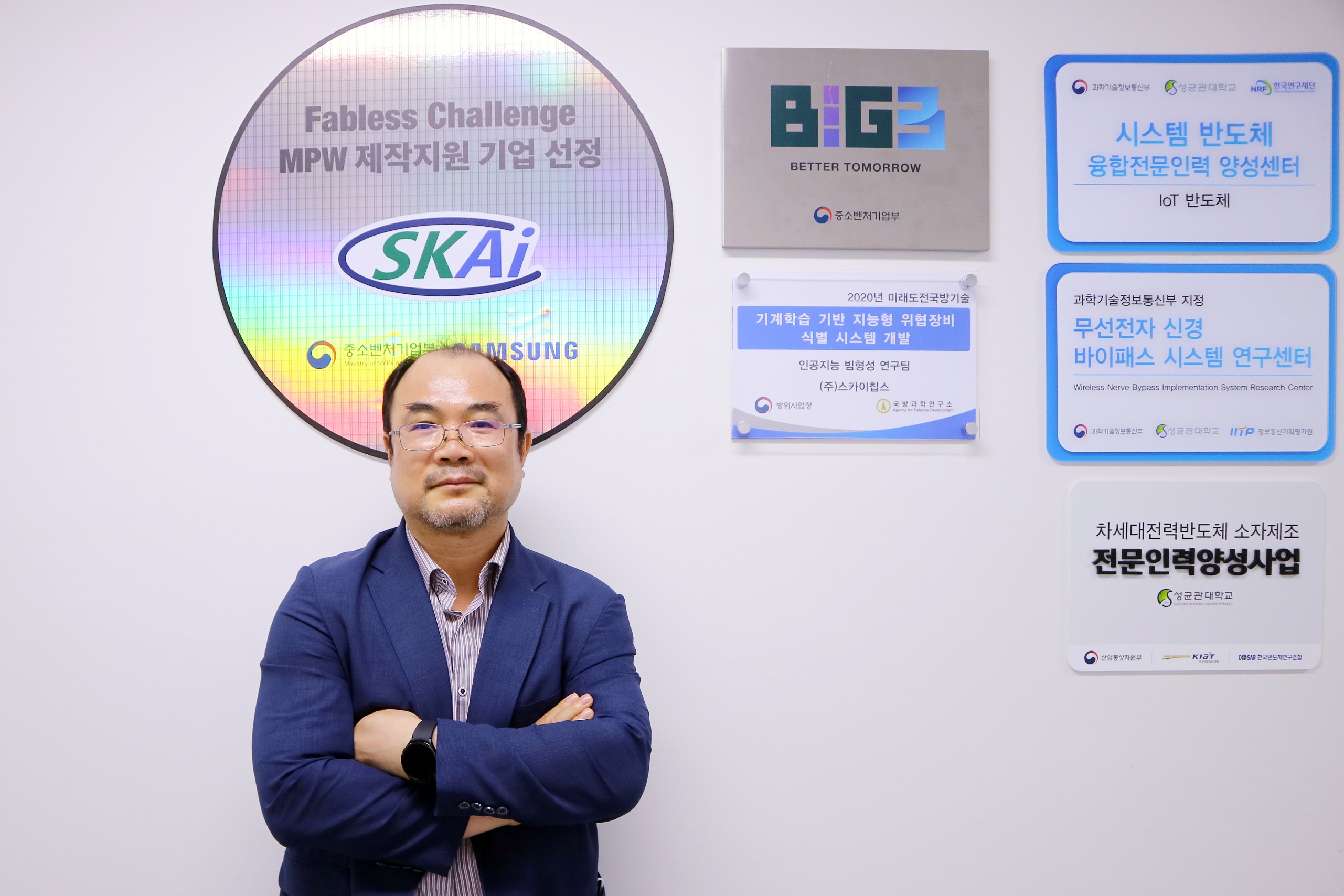
▲Lee Kang-yoon, CEO of Sky Chips
CEO Lee Kang-yoon: Lessons from his second fabless startup: "Customer needs come first."
[Editor's Note] Domestic fabless companies are struggling to blossom into global innovators amidst the harsh system semiconductor market, where they command only 1% of the global market share. Last July, the Ministry of SMEs and Startups (MSS) selected five innovative fabless companies for the Fabless Challenge. We met with the selected fabless companies, who will launch new products through Samsung Electronics Foundry, to learn about their solutions and future plans.
Skychips CEO Lee Kang-yoon, whom I met that day, founded the fabless company Skychips while serving as a professor in the Department of Electrical and Electronic Engineering at Sungkyunkwan University. With a research staff of approximately 70 and over 200 IPs, Skychips possesses design and technology development capabilities and was preparing to produce products using technologies that combine wireless communication chips with neuromorphic AI.
■ Please introduce SkyChips. What are its main solutions?
The company focuses on designing power semiconductors, including wireless charging, and also designs and manufactures low-power RF transmitters and receivers and communication transmitters and receivers.
Among the 90 employees, 70 are researchers, and they are working hard to develop intelligent ICT by applying AI functions to these products. Rather than heavy AI like Nvidia, we are focusing on designing neuromorphic AI circuits based on analog circuits.
I heard you previously founded a fabless company based in the Seoul National University Integrated Systems Laboratory. What was the semiconductor ecosystem like at the time?
It was the late 1990s, a time of a venture boom. The government encouraged venture startups even more than it does today. While significant investment was made, the semiconductor ecosystem at the time was still underdeveloped, particularly in the system semiconductor sector. As I recall, companies primarily used Taiwanese foundries, outsourcing production to TSMC or UMC.
Compared to then, things have improved significantly. Domestic system semiconductor companies have also grown significantly, and a growing sense of mutual growth has emerged. Furthermore, the increased accessibility of domestic foundry companies like Samsung Electronics has played a role.
■ Have you had any difficulties running the company?
Looking back, back then, we were focused solely on technology development, lacking a marketing or strategic planning approach. While we developed the product first and then considered where to sell it, we now take a more proactive approach: product planning first, then integrating technology accordingly. We believe that our clients' needs come first.
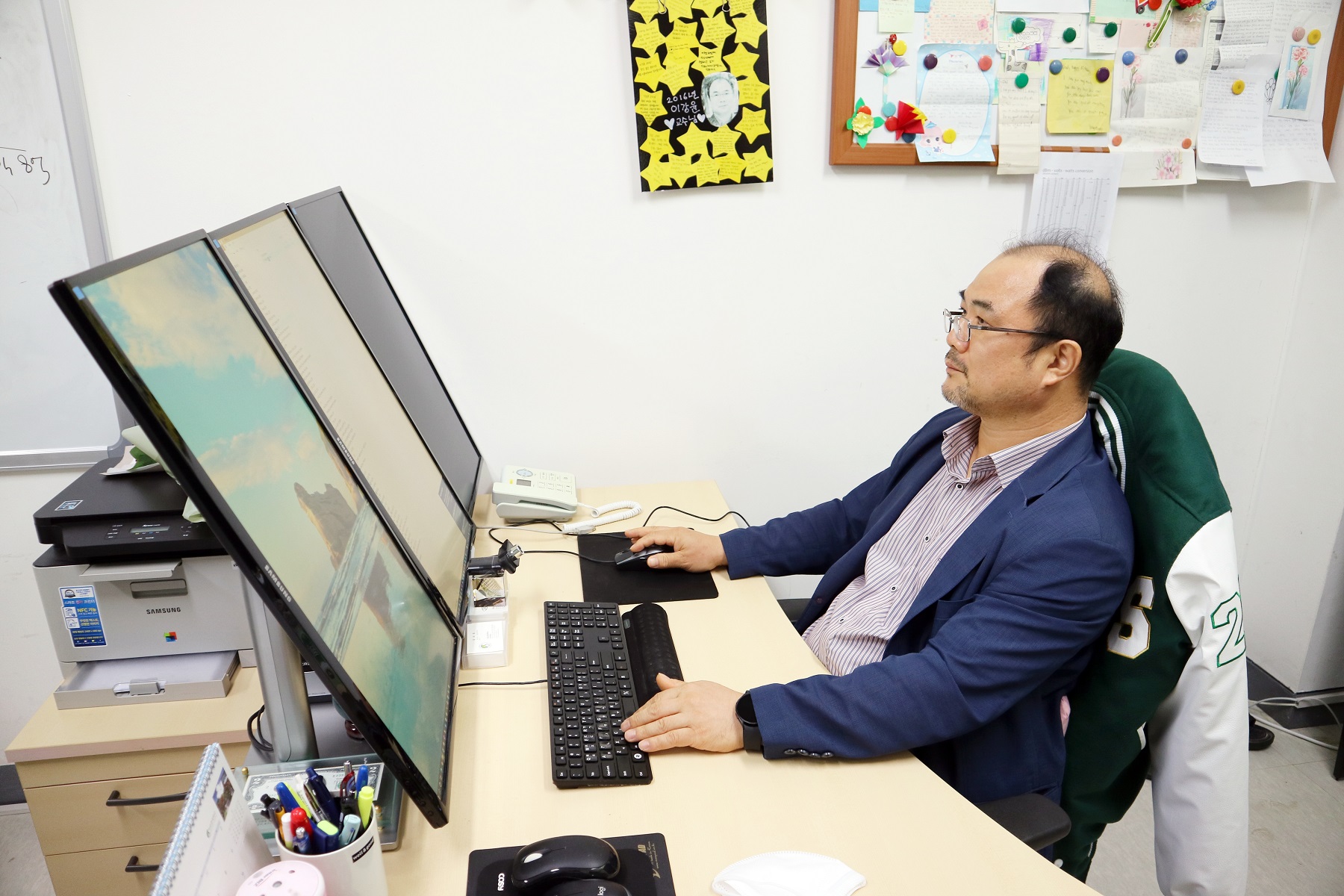
▲CEO Lee Kang-yoon at work
■ Later, you founded a fabless company based in the Sungkyunkwan University Integrated Circuit Research Lab. What motivated you?
I've done a lot of projects with companies that are at the level of mass-produced products, but once the project is finished, it stops there and ends there. Due to the nature of school labs, there is a lack of motivation to continue working on projects.
We have developed over 200 IPs in our lab, and we hold over 100 patents. With the idea of leveraging these IPs to commercialize products, we started our own business.
Furthermore, the emergence of successful startup models in the system semiconductor industry can have a positive impact on students. I wanted to create a company that provides students with a vision and dreams by providing them with success stories.
■ At the last Fabless Challenge, you presented a vision for product development using "energy harvesting" technology. Could you elaborate on this?
Energy harvesting is the technology of harvesting energy from various sources. These sources include the common light bulbs we see in everyday life. For example, solar panels in electronic calculators, which capture and convert solar energy into electricity, are a representative example.
SkyChips achieves energy harvesting through RF signals. With numerous RF signals present in a room, the key is to harness the power of technology to extract as close to 100% efficiency from these tiny energy sources. SkyChips has conducted extensive research into high-efficiency technologies.
This technology can be used in any battery-powered device, and we are focusing on developing remote controllers as our first target product line.
■ What are your future plans?
The ultra-low-power communication chip is scheduled to enter mass production around December of this year, with a launch planned for next year. The wireless charging IC is expected to undergo the customer support (CS) phase in the second half of this year and enter mass production in the first half of next year.
In the long term, we also plan to continue research in the field of biosensors. The next plan is to develop a chip that can diagnose diseases such as cancer and coronavirus using sensors.
■ What market are you targeting?
SkyChips' target market is the IoT and wearables sectors. With the rapid growth of these markets, the number of sensors installed has already surpassed the global population, and this sector is poised for high growth in the future, multiplying by several times.
Furthermore, wireless charging presents numerous opportunities in any battery-related field. This technology can be applied to a wide range of applications, including unmanned systems, smart factories, and toys. It also reduces the consumption of charging cables and discarded batteries, making it a good fit for environmental, social, and governance (ESG) considerations.
SkyChips is exploring opportunities in the multi-product manufacturing sector and believes this sector is a suitable market for fabless services.
SkyChips is growing with the goal of an IPO in 2024.
thank you

Comments
Related news

Intel Unveils Next-Generation 'Core Ultra Series 3' and vPro Platform for Enterprise PCs
Intel has officially unveiled the "Intel Core Ultra Series 3" for next-generation enterprise PCs and the latest vPro platform, addressing a wide range of demands from enterprise notebooks to high-performance workstations.
2026.03.26by 배종인 기자

ROHM Launches ESD Protection Diode Compatible with High-Speed Interfaces of 10Gbps or Higher
Semiconductor specialist ROHM has developed the 'RESDxVx series' of ESD (electrostatic discharge) protection diodes capable of responding to next-generation high-speed data communication environments exceeding 10Gbps, simultaneously enhancing both signal quality maintenance required in high-speed interfaces and IC protection performance.
2026.03.26by 배종인 기자
ST Launches 75V Drive IC Targeting 48V Industrial Motor Driving
ST Microelectronics has unveiled the 'STSPIN9P' series of 75V motor drive ICs tailored for 48V-class industrial drive system design. The new product family is characterized by half-bridge and full-bridge configurations that enable design scalability according to motor type and output conditions. Power supply circuits, protection functions, and current sensing circuits are integrated on-chip to simplify system configuration, and the devices are designed to support applications up to 500W maximum. The company plans to provide reference designs and demo boards to support development and evaluation in industrial automation, robotics, pumps, fans, lighting, and textile machinery.
2026.03.26by 배종인 기자
Nordic supports security updates for the entire lifecycle of IoT devices at a single fixed cost
Nordic Semiconductor, a global leader in low-power wireless connectivity solutions, has unveiled a single fixed-cost licensing model that delivers FOTA (Firmware Over-the-Air) and device management capabilities throughout the device lifecycle via nRF Cloud, and introduced a new firmware update solution to prepare for the enforcement of the European Union's Cyber Resilience Act (CRA).
2026.03.26by 배종인 기자
Practical Training in Low-Noise, Low-Power Circuit Design All in One Place… Training Fee Support
The "2026 Advanced Engineer Practical Masterclass" to strengthen competencies in high-sensitivity analog circuit and sensor-based system design will be held on April 16 at the e4ds Conference Center in Gasan-dong, Seoul. This program will be conducted as an offline paid hands-on training session, not online, and is targeted at engineers seeking on-site intensive learning. Texas Instruments will provide educational support for this training, allowing participation at 150,000 won, a 100,000 won discount from the original price of 250,000 won.
2026.03.26by 배종인 기자











