


EUV introduction hinders, semiconductor special gas regulation innovation
 Published2022.09.13 16:41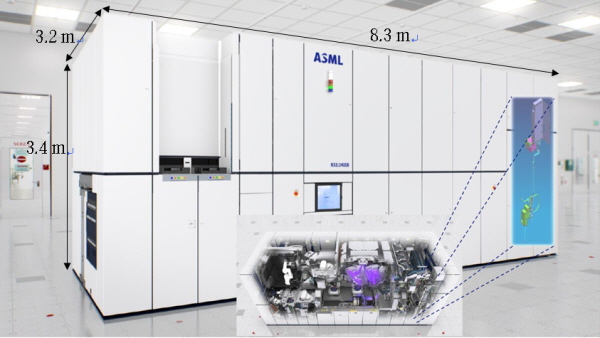
▲EUV equipment exterior
Ease of expansion of semiconductor factories, etc.
There are high expectations that the burden on companies will be alleviated as regulations related to special semiconductor gases, such as the basis for using new material piping in exposure equipment, which has been an obstacle to the introduction of cutting-edge semiconductor equipment such as EUV, are improved.
The Ministry of Trade, Industry and Energy (Minister Lee Chang-yang) announced on the 12th that in order to achieve a semiconductor superpower, it has selected 11 safety innovation tasks for high-pressure gases used in the semiconductor industry and will rationally improve them through expert review, etc.
The Ministry of Trade, Industry and Energy has been continuously discovering and improving regulations, such as extending the ‘overseas return period for high-pressure containers that have omitted inspection’ from 6 months to up to 2 years, to support the semiconductor industry and stabilize the supply and demand of imported industrial gases for semiconductor manufacturing purposes.
In particular, the 11 regulations selected this time are tasks that can further enhance the global competitiveness of the domestic semiconductor industry through regulatory improvement, and were derived through meetings and on-site visits with semiconductor-related organizations and companies.
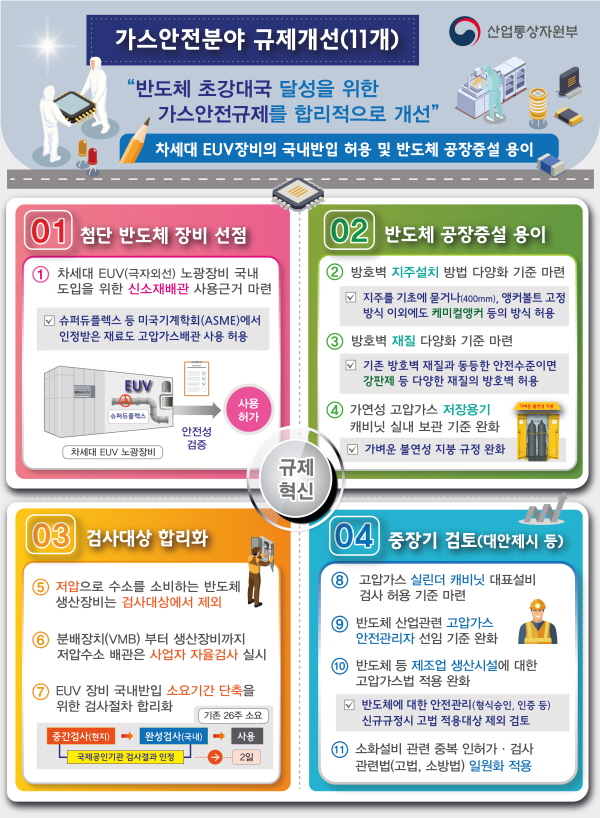
First, we will improve the standards for domestic introduction of next-generation EUV (Extreme Ultra Violet) equipment.
The next-generation EUV equipment using the current new material piping (super duplex steel) is scheduled to be developed, but since there are no regulations on the use of new material piping in the high-pressure gas laws, it is impossible to introduce it domestically. In order to secure the next-generation cutting-edge equipment, materials recognized by the American Society of Mechanical Engineers (ASME), such as super duplex steel, are being used. After reviewing the safety of the pipeline so that it can be used as a high-pressure gas pipeline, the detailed gas standards will be revised to allow its domestic introduction.
Within the EUV equipment, the gas equipment uses high-pressure gas to push liquid tin into the exposure equipment.
In addition, the plan is to allow various installation standards related to firewalls to facilitate the expansion of semiconductor factories.
In addition to methods such as burying the foundation or fixing it with anchor bolts, methods such as chemical anchors are permitted, and various materials such as steel plate are permitted for the protective wall if they have the same level of safety as the existing protective wall material. In addition, the indoor storage standards for flammable high-pressure gas storage cabinets are relaxed.
The inspection targets have also been rationalized, with semiconductor production equipment that consumes hydrogen at low pressure being excluded from the inspection target, and low-pressure hydrogen piping from distribution devices to production equipment being subject to voluntary inspection by business operators. In addition, the inspection process will be streamlined to shorten the period required to bring EUV equipment into the country.
In addition, standards for inspection of representative equipment for high-pressure gas cylinder cabinets will be established, and the standards for appointing high-pressure gas safety managers related to the semiconductor industry will be relaxed.
It was decided to ease the application of the High Pressure Gas Act to manufacturing production facilities such as semiconductors and to unify and apply laws related to duplicate permits and inspections for fire extinguishing equipment.
Vice Minister Park Il-joon said, “We will swiftly pursue the innovation regulatory tasks selected this time so that they can serve as a catalyst to promote and support the achievement of a semiconductor superpower,” and “Going forward, we will continue to discover regulatory innovation tasks that seek to balance safety and industrial development not only in the semiconductor industry but also in other industries related to energy safety, and support them to strengthen corporate competitiveness.”

Comments
Related news
Hydrogen for Semiconductors, a Key Material for Advanced EUV Technology, is Rising
Air Liquide has recently completed the first phase of construction of a 25MW water electrolysis hydrogen plant between Tainan and Hsinchu Science Park in Taiwan. The hydrogen is expected to be used exclusively for semiconductors, including by TSMC, and hydrogen consumption for semiconductors is projected to increase as advanced EUV processes become more prevalent.
2021.04.07by 배종인 기자
TSMC to Start Full-Scale EUV Production in Second Half
TSMC is ramping up production of Apple's A15 processor in the second half of the year, and it is anticipated that mass production using EUV equipment in the 5nm process will commence in earnest.
2021.07.07by 배종인 기자
.jpg)
Lee Jae-yong personally stepped forward to secure EUV.
Following Samsung Electronics Vice Chairman Lee Jae-yong's accompanying U.S. President Joe Biden's recent visit to Samsung Electronics' Pyeongtaek campus, Vice Chairman Lee has been actively engaging with global leaders, including meeting with Intel CEO Pat Gelsinger who visited Seoul to discuss cooperation plans.
2022.06.16by 명세환 기자
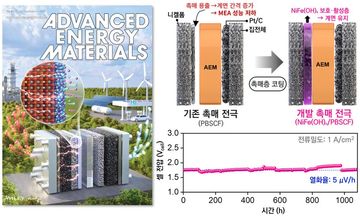
Materials Research Institute Develops Ultra-thin Coating Water Electrolysis Catalyst Technology
The Korea Institute of Materials Science has simultaneously resolved the performance and durability trade-off problem in water electrolysis catalysts by applying ultra-thin surface coating technology. Achieving 1.9 times higher performance compared to conventional catalysts while demonstrating 1,000-hour long-term stability, the institute has developed technology scalable to industrial water electrolysis systems through a simple process.
2026.10.07by 배종인 기자
Gigaphoton Develops Neon Gas Recycling System for ArF Excimer Lasers...Achieves 50% Recycling Rate
Gigaphoton announced that it has developed a gas recycling system for ArF excimer lasers and achieved a 50% neon gas recycling rate.
2026.10.02by 배종인 기자











