


Wireless charger power metering, prior development of high-frequency measurement-capable power meters is essential
 Published2022.09.21 10:19
.jpg)
Song Sang-hoon, Head of the Industrial Technology Management Corporation, is giving a presentation on the topic of 'Research on Evaluation Standards for Electric Vehicle Wireless Charger Power Measurement Accuracy'.
Charger developers must also be equipped with testing laboratory-level equipment.
It has been argued that for the wireless charging metering of electric vehicles, the prior development of power meters and reference devices capable of accurately measuring high-frequency power of the fundamental component (85 kHz) or higher is necessary.
The Korea Research Institute of Standards and Science (KRISS) held the '2022 Second Half Electromagnetic/Electromagnetic Measurement Club Workshop' at Hanwha Resort Pyeongchang from the 19th to the 20th.
On this day, Song Sang-hoon, Head of the Korea Testing Laboratory, who gave a presentation on the topic of 'Research on Evaluation Standards for Electric Vehicle Electric Vehicle Wireless Charger Metering Accuracy,' discussed the type approval and technical standards of electric vehicle wireless chargers, as well as related research content.
Director Song Sang-hoon stated that even a very small difference in electricity rates can lead to a significant increase in the costs borne by the public, explaining that this is the reason why quantitative aspects are managed by law.
It was announced that research is underway to establish type approval standards for electric vehicle wireless chargers, as there are currently no such standards.
In particular, it was stated that unlike the sine wave of typical AC electric vehicle chargers, the power metering of wireless chargers uses a non-sine wave at high frequency, generating a significant amount of noise.
In particular, the surrounding environment is so diverse that the target measurementIt was mentioned that it is difficult to handle the accuracy of.
Accordingly, it was announced that equipment with a bandwidth of 20 MHz and a maximum sampling rate of 100 ms was installed to measure high-frequency power of approximately 85 kHz.
Since there is no traceability to high-frequency power of approximately 85 kHz and no guarantee of metering accuracy, the measurement demonstration proceeded to verify the validity of the metering method by simultaneously measuring the power before and after the coil stage and comparing them relatively. The demonstration results showed that the PFC output value was the highest, and the power of the transmitting coil in the intermediate stage was the lowest. It was revealed that the rectifier section of the receiver closest to the electric vehicle actually showed higher power than the coil power of the transmitter section, which is the intermediate section.
In response to this, it was stated that, fundamentally, as the amount of switched power increases, it is difficult to accurately read high-frequency power, and therefore equipment capable of accurately measuring high-frequency power is required, along with the development of a system for this purpose.
It was mentioned that prior development of power meters (Class 1.0 or higher) and reference devices (Class 0.1 or higher) capable of accurately measuring high-frequency power of the fundamental component (85 kHz) or higher is necessary in the future.
In addition, it was mentioned that wireless charger manufacturers must also be equipped with equipment at the level of testing institutions for it to be effective, and that manufacturers are currently equipped with such facilities now that relevant laws have been implemented.
Various presentations were given at the workshop on this day.
In his presentation 'Comparison of D-Band Planar Impedance Calibration Methods and Semiconductor Device Measurement,' Dr. Gu Hyeon-ji of the Korea Research Institute of Standards and Science (KRISS) noted that measuring the permittivity of each layer in a multilayer environment is difficult, and accurate measurement is challenging because cross-sectional information is lost the moment the cross-section is cut. He then proposed a method for evaluating characteristic impedance using alternative approaches, such as the calibration comparison method.
Kang No-won, Head of the Physical Standards Division at the Korea Research Institute of Standards and Science, gave a presentation on the topic of "Domestic and International Trends in Quantum Sensors," introducing an overview of quantum sensors and quantum sensor programs in major countries, and discussing the current status of domestic research on the commercialization of quantum sensors.
Quantum sensors are devices that measure physical quantities using quantum mechanical properties such as quantum entanglement, compression, alignment, and coherence. They are expected to overcome current measurement limitations and standard quantum limits, thereby dramatically increasing sensor reduction and precision, and contribute to securing national strategic technologies, responding to competition for technological hegemony, and creating new industries.
Dr. Lee Dong-jun of the Korea Research Institute of Standards and Science presented 'Measurement Techniques for Array Antennas for Millimeter-Wave 5G Using Calibrated Microelectro-Optical Sensors,' and Jwa Sang-hoon, of Korean descentThe director of the Quantity Measurement Association introduced 'domestic and international trends in conformity assessment and KOLAS revisions'.
In addition, Kang Tae-won, a principal researcher at the Korea Research Institute of Standards and Science, gave a presentation on 'ITU-R SG5 and WRC23 Research Trends' on behalf of Han Jin-wook, a researcher at the National Radio Research Institute.
Meanwhile, the Electromagnetic Wave/Electromagnetic Measurement Club workshop was held for the first time in about three years due to COVID-19, and has been sharing the latest technologies related to electromagnetic wave measurement for over 10 years.
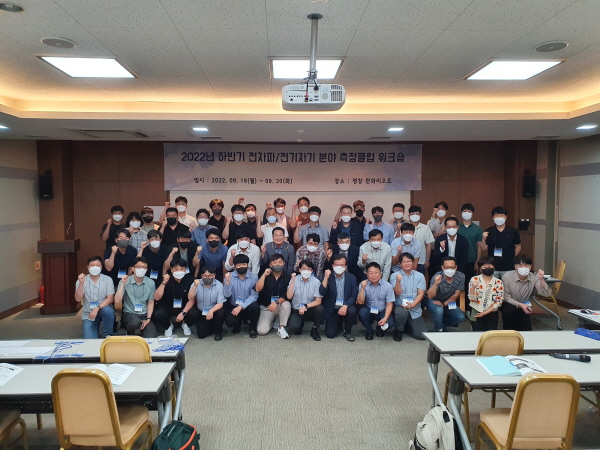
Members of the Electromagnetic Wave/Electromagnetic Measurement Club are taking a commemorative photo at the workshop.

Comments
Related news
.jpg)
“It depends on semiconductor ultra-fine material analysis technology”
As semiconductors become increasingly ultra-miniaturized beyond the capabilities of impurity analysis, opinions have been raised that overcoming this limitation requires analysis management starting from semiconductor materials.
2022.09.16by 배종인 기자
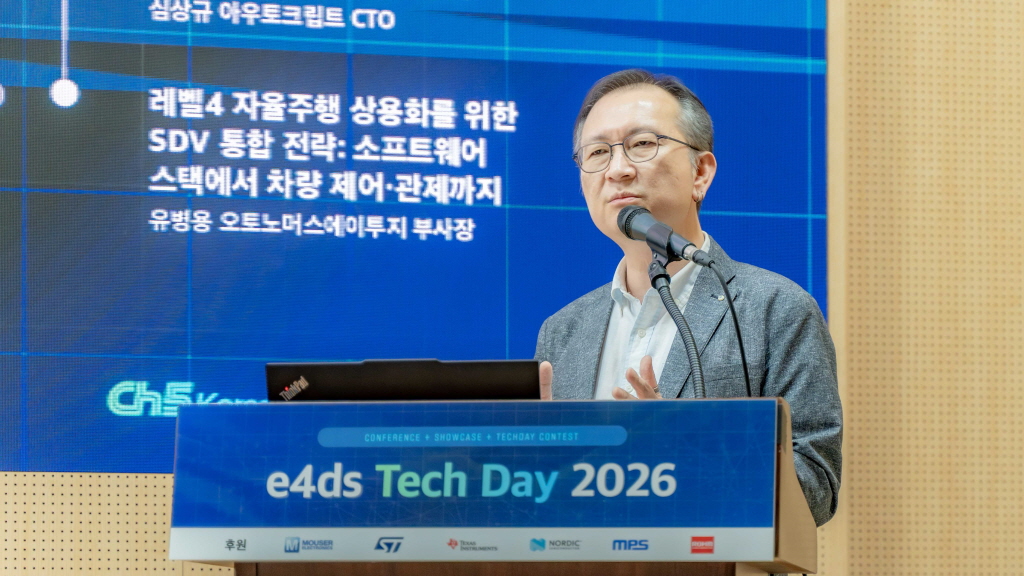
[e4ds Tech Day 2026 ⑨] Sim Sang-gyu, Autocrypt CTO: "In the Physical AI Era, Automotive Security Must Extend Beyond the Vehicle"
At e4ds Tech Day 2026, Sim Sang-gyu, CTO of Autocrypt, explained automotive cybersecurity strategies in the era of Physical AI and SDV (Software-Defined Vehicle). Automobiles are evolving as part of an ecosystem connected to AI, cloud, chargers, IoT, and robots, and he emphasized that the scope of security must expand beyond the vehicle interior to the entire connected environment. In particular, AI model tampering, adversarial attacks, OTA updates, and EV charger hacking were identified as major threats. He explained that response measures require zero trust, AI model integrity protection, intrusion detection, Security by Design and Default, and full lifecycle security management, and that proactive security system establishment beyond regulatory compliance is critical for securing future mobility competitiveness.
2026.10.12by 배종인 기자
Practical HIL Construction Strategy for Automotive and Off-Highway Controller Validation
As vehicle E/E architecture transitions to zonal structures and shifts to software-defined vehicles (SDV), the number of controllers (ECUs) requiring validation and software complexity are surging dramatically. Meanwhile, real vehicle testing cannot provide repeated verification under identical conditions and entails lead time and safety concerns. This white paper explains the principles of HIL (Hardware-in-the-Loop) validation and the structure of the NI platform composed of PXI, SLSC, and VeriStand, and through two actual implementation cases—Camera Record & Replay HIL for In-Cabin Monitoring Controller (ICMU) and Forklift Controller (VCU) HILS—describes how controller-level regression testing becomes possible. Additionally, it explicitly states application boundaries and limitations, such as lack of A2B support.
2026.10.12by 편집부
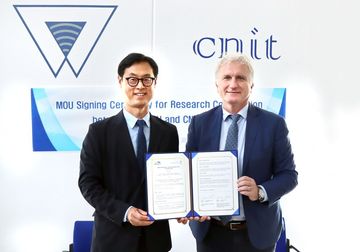
Korea Automotive Research Institute Signs MOU with Italy National Institute for Wireless Communications
The Korea Automotive Research Institute will sign an MOU with Italy's National Institute for Wireless Communications and launch joint research on next-generation mobility technologies based on 6G, V2X, and connected vehicles. The two organizations will conduct research to apply advanced wireless communication technologies to vehicles and discover international joint projects to advance next-generation connected vehicle technology development.
2026.10.12by 배종인 기자
Color Accuracy Issues in Vehicle Interior Ambient Lighting and Intelligent LED Drivers
Vehicle interior ambient lighting is spreading across all price segments, and the level of color accuracy required of lighting designers is rising accordingly. This white paper quantitatively addresses why temperature drift and individual variations of RGB LEDs cannot be corrected by standard constant-current drivers, and explains an intelligent LED driver approach that integrates an MCU, calibration data, and a LIN network interface into the driver. It covers implementation details of the LITIX Interior TLD4020-3ET currently in production, portfolio roadmap, and evaluation/development environments, and clarifies application boundaries including lack of 48V support, lack of RGBi/ISELED support, and absence of direct optical degradation diagnostics.
2026.10.08by 명세환 기자











