



CEVA PentaG-RAN Accelerates 5G Infrastructure Rollout
 Published2022.09.27 11:01
▲CEVA accelerates 5G infrastructure rollout with baseband platform IP for industry-first 5G RAN custom semiconductors (Image - CEVA)
FPGA and COTS CPU-based products have lower power and area compared to other products.
The 5G base station and wireless ASIC markets are experiencing rapid growth driven by the digital transformation that continuously demands higher cellular bandwidth at low latency. Recently, network fragmentation driven by the Open RAN initiative and mMIMO drive forms has attracted the attention of global silicon suppliers in the cellular infrastructure market opportunity.
CEVA, Inc. (NASDAQ: CEVA), a leading licensor of wireless connectivity and smart sensing technologies, today announced PentaG-RAN, the industry's first 5G baseband platform IP for application-specific integrated circuits (ASICs) targeting cellular infrastructure in both base station and radio configurations, including distributed units (DUs) and remote radio units (RRUs), from small cells to massive multiple-input, multiple-output (mMIMO).
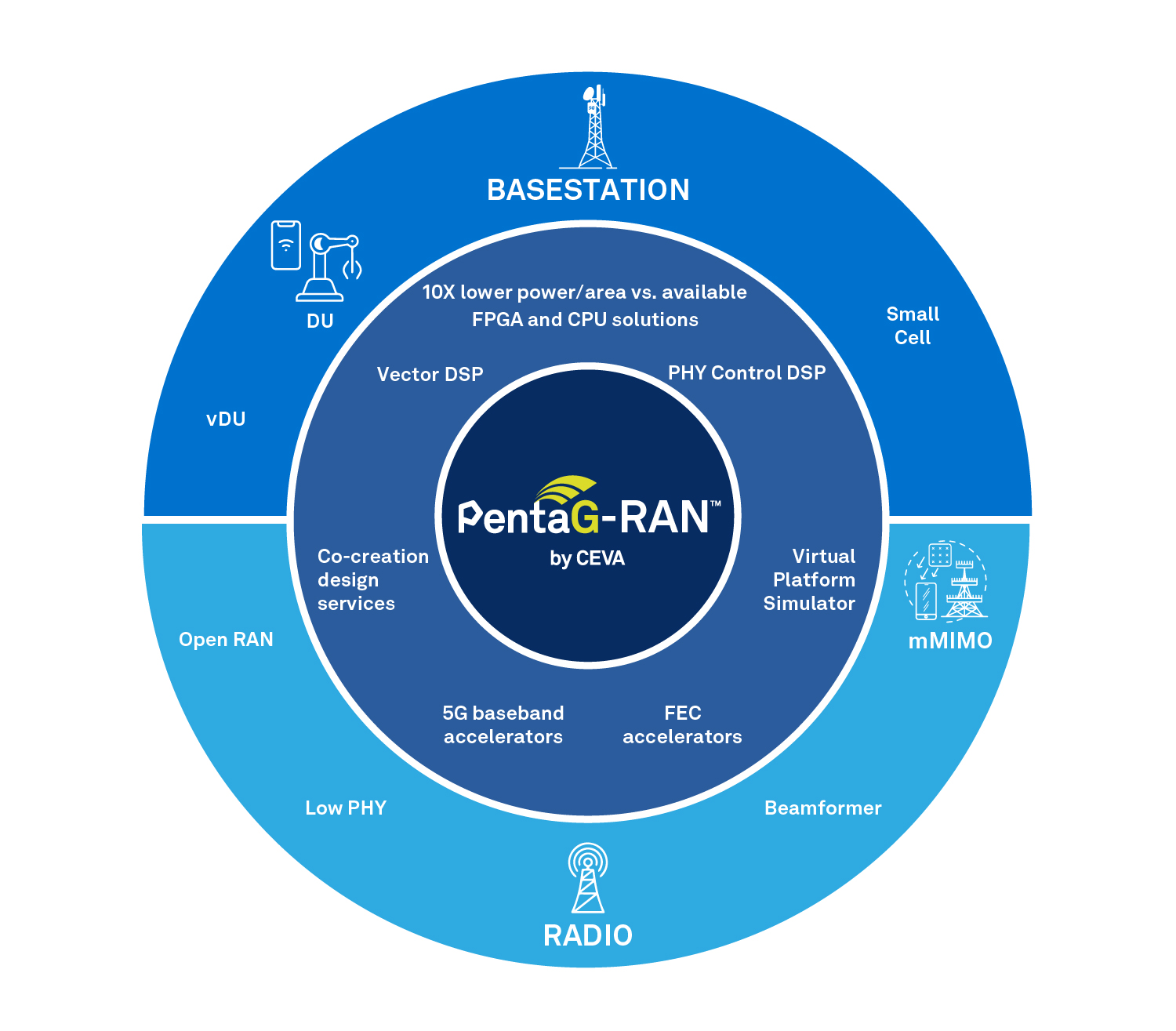
▲This heterogeneous baseband compute platform is designed to lower the barriers to entry for companies seeking to enter the open RAN (O-RAN) equipment market. (Image: CEVA)
According to ABI Research, a global technology intelligence company, shipments of 5G mobile infrastructure equipment, including mMIMO radios, O-RAN radios, small cells, and virtual basebands, are expected to grow at an average annual rate of 17% from 2022 to 2027, exceeding 23 million units per year by 2027. Current platforms are not attractive to the market because they cannot effectively scale mMIMO and support new O-RAN, creating an opportunity for new players to enter the market by exploiting this gap.
Accordingly, PentaG-RAN explained that it provides an L1 PHY (physical layer 1) solution platform with hardware/software role division by integrating a powerful vector DSP (Digital Signal Processor), a PHY control DSP, a flexible 5G hardware accelerator, and other special components required for the modem processing chain.
CEVA claims that this can deliver up to 10x power and area savings compared to available FPGA and commercial-off-the-shelf (COTS) CPU-based alternatives. To further reduce silicon design risk and accelerate ASIC design, CEVA also offers co-production services to support PentaG-RAN customers in developing their entire PHY system, from concept to complete chip design.
Guy Keshet, general manager and head of the Mobile Broadband business unit at CEVA, said: “CEVA has been at the cutting edge of DSP technology in cellular infrastructure for the past decade and is working with leading OEMs to deliver the most advanced DSP architectures deployed in 5G RAN today. The PentaG-RAN platform leverages this extensive experience to deliver a 5G chipset for next-generation mMIMO systems and a next-generation platform solution to support emerging 8-RAN use cases.”

Comments
Related news

Intel Unveils Next-Generation 'Core Ultra Series 3' and vPro Platform for Enterprise PCs
Intel has officially unveiled the "Intel Core Ultra Series 3" for next-generation enterprise PCs and the latest vPro platform, addressing a wide range of demands from enterprise notebooks to high-performance workstations.
2026.03.26by 배종인 기자

ROHM Launches ESD Protection Diode Compatible with High-Speed Interfaces of 10Gbps or Higher
Semiconductor specialist ROHM has developed the 'RESDxVx series' of ESD (electrostatic discharge) protection diodes capable of responding to next-generation high-speed data communication environments exceeding 10Gbps, simultaneously enhancing both signal quality maintenance required in high-speed interfaces and IC protection performance.
2026.03.26by 배종인 기자
ST Launches 75V Drive IC Targeting 48V Industrial Motor Driving
ST Microelectronics has unveiled the 'STSPIN9P' series of 75V motor drive ICs tailored for 48V-class industrial drive system design. The new product family is characterized by half-bridge and full-bridge configurations that enable design scalability according to motor type and output conditions. Power supply circuits, protection functions, and current sensing circuits are integrated on-chip to simplify system configuration, and the devices are designed to support applications up to 500W maximum. The company plans to provide reference designs and demo boards to support development and evaluation in industrial automation, robotics, pumps, fans, lighting, and textile machinery.
2026.03.26by 배종인 기자

Nordic supports security updates for the entire lifecycle of IoT devices at a single fixed cost
Nordic Semiconductor, a global leader in low-power wireless connectivity solutions, has unveiled a single fixed-cost licensing model that delivers FOTA (Firmware Over-the-Air) and device management capabilities throughout the device lifecycle via nRF Cloud, and introduced a new firmware update solution to prepare for the enforcement of the European Union's Cyber Resilience Act (CRA).
2026.03.26by 배종인 기자

Practical Training in Low-Noise, Low-Power Circuit Design All in One Place… Training Fee Support
The "2026 Advanced Engineer Practical Masterclass" to strengthen competencies in high-sensitivity analog circuit and sensor-based system design will be held on April 16 at the e4ds Conference Center in Gasan-dong, Seoul. This program will be conducted as an offline paid hands-on training session, not online, and is targeted at engineers seeking on-site intensive learning. Texas Instruments will provide educational support for this training, allowing participation at 150,000 won, a 100,000 won discount from the original price of 250,000 won.
2026.03.26by 배종인 기자











