



KIMS Transfers High-Sensitivity Nanoplasmonic Sensor Substrate Manufacturing Technology to Zeus
 Published2022.10.04 10:44
.jpg)
The Korea Institute of Materials Science (KIMS, President Lee Jeong-hwan), a government-funded research institute under the Ministry of Science and ICT, is taking action to respond to the Restriction of Hazardous Substances (RoHS) regulations for electrical and electronic products through the transfer of platform technology.
The Korea Institute of Materials Science announced on the 4th that it has transferred high-sensitivity nanoplasmonic sensor substrate manufacturing technology to Zeus Co., Ltd., a company specializing in the manufacture of semiconductors, displays, and robots.
The Korea Institute of Materials Science (KIMS) signed a technology commercialization agreement with Zeus Co., Ltd. regarding this and promised to transfer high-sensitivity nanoplasmonic sensor materials, rapid detection methods, and AI analysis platform technology to respond to the Restriction of Hazardous Substances (RoHS) regulations for electrical and electronic products in the future.
Based on this technology, Zeus Co., Ltd. will proceed with the commercialization of a high-sensitivity rapid hazardous substance detection platform and an AI/hardware system integrated product.
The Korea Institute of Materials Science possesses source technology that enables the direct fabrication of high-density nanostructures on low-cost polymer substrates through plasma etching technology.
In addition, we are securing the price competitiveness, process ease, and reliability of nanoplasmonic materials.
It is possible to form high-density plasmonic nanostructures on a 96-well plate without using a nanopatterning process, making it possible to rapidly inspect environmental hazardous substances with high sensitivity.
The Korea Institute of Materials Science and Engineering and Zeus Co., Ltd., through additional joint research, bio-water using nanoplasmonic materialsWe plan to develop quality detection and discrimination technologies. The platform technology, which includes high-sensitivity nanosensor materials, AI diagnostic technology, and preprocessing and analysis technologies, is expected to be applied to the diagnosis of various diseases and in vitro diagnostic technologies for healthcare.
The market for environmental hazardous substance detectors is showing rapid growth due to the expansion of eco-friendly policies.
On the other hand, Korea is currently absolutely dependent on multinational chemical analysis equipment companies, including those from Japan and the United States.
If the new optical-based rapid detection technology is commercialized based on the source material technology for nano-plasmonic sensors secured by the Korea Institute of Materials Science, it is expected to replace imported equipment in related markets and pioneer the chemical analysis market through exports.
Lee Jeong-hwan, President of the Korea Institute of Materials Science (KIMS), stated, “Responding to international environmental regulations in the electrical and electronic industry contributes significantly to strengthening the competitiveness of Korea’s leading industries and securing international credibility.” He added, “We will continue our efforts to provide foundational technologies for the transition to eco-friendly policies across the entire domestic electrical and electronic industry by alleviating the burden of analysis costs for manufacturing companies and ensuring reliability in quality control.”

Comments
Related news
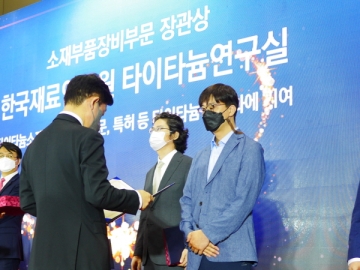
Materials Research Institute, Titanium Material Self-Sufficiency Contribution Recognized
The Korea Institute of Materials Science (KIMS), a government-funded research institute under the Ministry of Science and ICT, has been recognized for its contributions to achieving domestic self-sufficiency in titanium (Ti) materials.
2022.07.07by 배종인 기자
KIMS Accelerates the Era of Green Hydrogen Production
A domestic research team has successfully developed the nation's first long-lifespan, high-efficiency anion exchange membrane water electrolysis stack technology based on non-precious metals.
2022.08.11by 성유창 기자
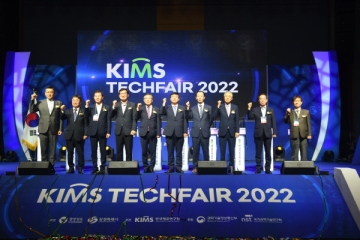
KIMS Showcases Extreme Materials Technology
The Korea Institute of Materials Science (KIMS, Director Lee Jung-hwan), a government-funded research institute under the Ministry of Science and ICT, has organized an event to showcase extreme materials technology and lay the foundation for securing leading-edge extreme materials.
2022.09.21by 배종인 기자
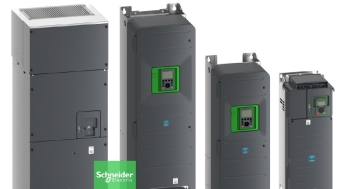
Schneider Aims for Building Energy Savings and Operational Stability with Next-Generation HVAC Drives
Schneider Electric has unveiled its next-generation HVAC drive product line 'Altivar HVAC'. The new product line's key features center on enhanced energy savings, system operational stability, and building management system integration. The products are divided into 'ATH200' for OEM and small equipment applications, and 'ATH600' for environments requiring continuous operation and advanced control. The company plans to expand the application scope from commercial buildings to facilities where HVAC system stability is critical, such as hospitals, airports, and data centers. The announcement includes over 30% energy savings, operation from -10°C to +60°C, Modbus and BACnet support, and compatibility with low global warming potential refrigerants.
2026.03.26by 명세환 기자
Ecolab Expands AI Data Center Cooling Business Through Acquisition of CoolIT
Ecolab has agreed to acquire CoolIT Systems, a liquid cooling company for AI data centers, for approximately $4.75 billion. The transaction is expected to close by Q3 2026, subject to regulatory approvals. CoolIT has been supplying direct-to-chip cooling-based coolant distribution units, cold plates, and manifolds, serving hyperscale data centers and colocation operators as customers. This acquisition is a measure to address the high-heat and high-density server environments created by AI proliferation. Ecolab plans to combine its water management and digital monitoring capabilities with CoolIT's hardware technology to expand its data center cooling business.
2026.03.26by 명세환 기자











