



KIMM Takes the Lead in Permanent Reuse of Organic Waste
 Published2022.10.04 10:57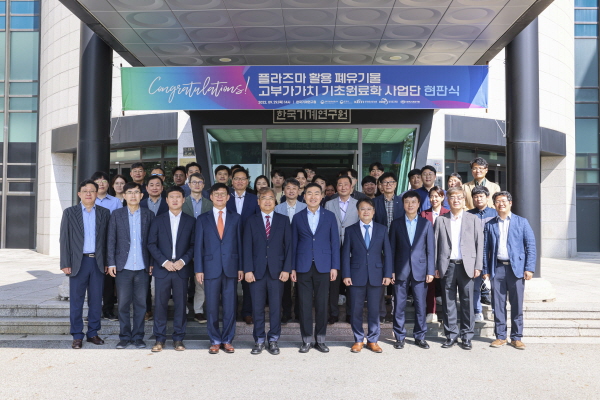
The Korea Institute of Machinery and Materials (KIMM), under the Ministry of Science and ICT (President Park Sang-jin), is advancing the dream of permanent reuse of waste organic materials, such as waste plastics.
On the 29th, the Korea Institute of Machinery and Materials (KIMM) launched the 'Plasma-based Waste Organic Material High Value-added Basic Raw Material Conversion Project Group (hereinafter the Project Group, Director Song Young-hoon)' at its headquarters in Daejeon and held a plaque unveiling ceremony.
The project team will invest a total of 27 billion won in research funds to develop technology for the permanent reuse of waste organic materials, such as waste plastics, with support from the Innovation Challenge Project promoted by the Ministry of Science and ICT (Minister Lee Jong-ho) and the Ministry of Environment (Minister Han Hwa-jin).
A total of 16 institutions are participating in the project consortium, including government-funded research institutes such as the Korea Institute of Machinery and Materials, the Korea Institute of Industrial Technology, the Korea Research Institute of Chemical Technology, and the Korea Institute of Science and Technology, as well as universities such as KAIST, Seoul National University, POSTECH, Sogang University, and Yonsei University.
The project team focuses on developing innovative technologies to resolve the problem of organic waste, such as waste plastics, that occurred in large quantities during the COVID-19 pandemic, and to achieve carbon neutrality goals that have become urgent due to the global climate crisis.
To this end, we plan to accelerate research with the goal of realizing an innovative concept that converts various types of waste organic materials, such as waste oil, waste organic solvents, and waste plastics, into ethylene, a basic raw material for plastics.
In particular, a technology has been developed that converts waste plastics into ethylene and propylene through a single process without a sorting step, enabling permanent reuse.If this happens, oil consumption could drastically decrease, and it is expected to play a leading role in responding to climate change.
Song Young-hoon, head of the project team, stated, “While converting waste plastics into fuel through incineration, pyrolysis, or gasification is difficult to achieve as a carbon-neutral solution, enabling the permanent reuse of waste plastics will not only reduce waste and petroleum consumption but also accelerate the realization of carbon neutrality.” He added, “We will strive to secure the capability for Korea to lead global carbon-neutral technology through the verification and realization of this innovative concept.”

Comments
Related news
Korea Institute of Machinery and Materials, a platform for cooperation between research institutes and special zone companies in the semiconductor industry.
As global efforts to secure semiconductor supply chains and lead in technology are intensifying, a forum for discussion has been opened to establish a semiconductor co-prosperity cooperation ecosystem between government-funded research institutes and special zone enterprises.
2022.09.02by 배종인 기자

KIMM, Thermal Energy Overview at '2022 Global Mechanical Technology Forum'
A forum has been established to examine thermal energy technology, which is a key factor in achieving carbon neutrality.
2022.09.06by 배종인 기자
.jpg)
KIMM Overview of Thermal Energy Technology for Achieving Carbon Neutrality
As the urgency of achieving carbon neutrality is being emphasized in the face of climate crisis, including global abnormal high temperatures and natural disasters, the '2022 Global Mechanical Technology Forum,' which brought together the present and future of thermal energy technology for implementing a carbon-neutral society, has successfully concluded.
2022.09.22by 배종인 기자
Schneider Aims for Building Energy Savings and Operational Stability with Next-Generation HVAC Drives
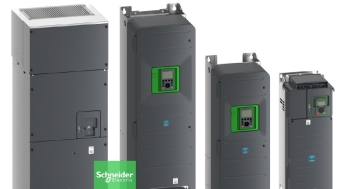
Schneider Electric has unveiled its next-generation HVAC drive product line 'Altivar HVAC'. The new product line's key features center on enhanced energy savings, system operational stability, and building management system integration. The products are divided into 'ATH200' for OEM and small equipment applications, and 'ATH600' for environments requiring continuous operation and advanced control. The company plans to expand the application scope from commercial buildings to facilities where HVAC system stability is critical, such as hospitals, airports, and data centers. The announcement includes over 30% energy savings, operation from -10°C to +60°C, Modbus and BACnet support, and compatibility with low global warming potential refrigerants.
2026.03.26by 명세환 기자
Ecolab Expands AI Data Center Cooling Business Through Acquisition of CoolIT
Ecolab has agreed to acquire CoolIT Systems, a liquid cooling company for AI data centers, for approximately $4.75 billion. The transaction is expected to close by Q3 2026, subject to regulatory approvals. CoolIT has been supplying direct-to-chip cooling-based coolant distribution units, cold plates, and manifolds, serving hyperscale data centers and colocation operators as customers. This acquisition is a measure to address the high-heat and high-density server environments created by AI proliferation. Ecolab plans to combine its water management and digital monitoring capabilities with CoolIT's hardware technology to expand its data center cooling business.
2026.03.26by 명세환 기자











