


KIMM Successfully Measures Fine Dust by Vehicle Type
 Published2022.10.07 10:03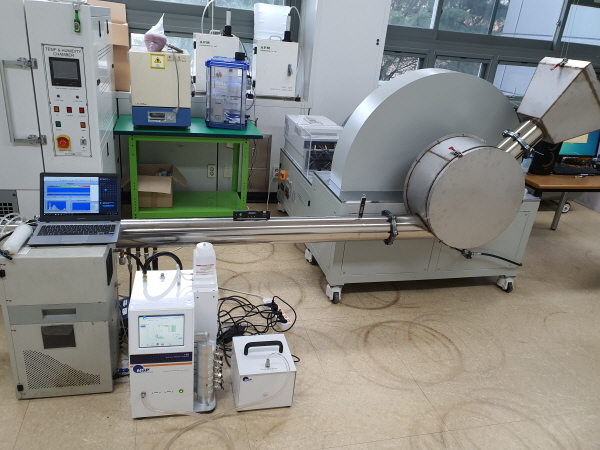
▲ Brake wear simulator used for measuring non-exhaust fine dust
The Korea Institute of Machinery and Materials (KIMM), under the Ministry of Science and ICT, has succeeded in the world's first integrated measurement of vehicle-generated fine dust, including not only engine combustion but also tire and brake wear, and is expected to be used as supporting data for future non-exhaust fine dust reduction policies.
The Korea Institute of Machinery and Materials announced that it has succeeded in comprehensively measuring fine dust generated during the operation of internal combustion and electric vehicles due to engine combustion, tire and brake wear, road wear, and road re-suspended dust.
Automobile fine dust can be classified into exhaust fine dust generated by engine combustion, etc., and non-exhaust fine dust generated when dust that has settled on the roadside or tires, brakes, roads, etc., is scattered again by the movement of vehicles.
A research team led by Dr. Lee Seok-hwan of the Mobility Power Research Laboratory at the Korea Institute of Machinery and Materials (KIMM) Carbon Neutrality Research Center conducted an integrated experimental measurement of fine dust emissions by vehicle type for domestic compact SUVs, utilizing a mobile road dust measurement vehicle along with self-developed tire wear simulators and brake wear simulators.
The measurement results for gasoline, diesel, and electric vehicles (90% regenerative braking) show PM10 (fine dust) standards of 42.3 mg/km, 43.2 mg/km, 47.7 mg/km, and P, respectively, in that order.Fine dust levels of 14.5 mg/km, 14.1 mg/km, and 13.9 mg/km were generated based on M2.5 (ultrafine dust) standards.
To date, only the amount of fine dust generated from brake wear has been studied. In the case of other non-exhaust fine dust sources, such as tire or road wear, research on measuring generation amounts or identifying phenomena has not been properly conducted. Until now, fine dust emissions have been calculated using estimates based on emission factors for each source listed in the national emission inventory.
The Korea Institute of Machinery and Materials' attempt to calculate fine dust emissions through integrated experimental measurements by vehicle type (internal combustion and electric vehicles) and emission source (exhaust and non-exhaust) is a world first. It is expected to be used as supporting data for identifying the causes of non-exhaust particulate matter generated from internal combustion engines and electric vehicles, and for supporting related environmental policies.
In the case of the latest internal combustion engine vehicles, the emission of exhaust particulate matter is low due to the development of engine combustion and aftertreatment devices, and accordingly, it has been found that more than 90% of the particulate matter generated by vehicles originates from non-exhaust particulate matter.
Of the 42.3 mg/km of fine dust generated from gasoline vehicles, road resuspension dust, road wear, and tire/brake wear were measured at 19.3 mg/km, 10.7 mg/km, and 11.3 mg/km, respectively, while the amount of fine dust generated from exhaust was only 1.0 mg/km.
In the case of electric vehicles (90% regenerative braking), it was measured that out of a total of 47.7 mg/km of fine dust, road re-suspended dust, road wear, and tire/brake wear accounted for 23.5 mg/km, 13.1 mg/km, and 10.5 mg/km, respectively.
Lee Seok-hwan, a principal researcher at the Korea Institute of Machinery and Materials (KIMM), stated, “Although electric vehicles emit no harmful exhaust gases or greenhouse gases, integrated experimental measurements have confirmed that a significant level of non-exhaust fine dust is generated.” He added, “To improve urban air quality, multifaceted measures to reduce non-exhaust fine dust must be prepared alongside policies to promote the adoption of electric vehicles.”
This study was conducted with the support of the Ministry of Science and ICT's 'Characterization of Fine Dust by Automobile Emission Source' project, and the results of this study were published in the prestigious SCI journal 'Science of the Total Environment'.

Comments
Related news
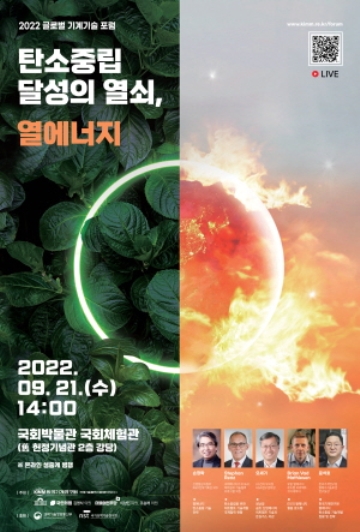
KIMM, Thermal Energy Overview at '2022 Global Mechanical Technology Forum'
A forum has been established to examine thermal energy technology, which is a key factor in achieving carbon neutrality.
2022.09.06by 배종인 기자
.jpg)
KIMM Overview of Thermal Energy Technology for Achieving Carbon Neutrality
As the urgency of achieving carbon neutrality is being emphasized in the face of climate crisis, including global abnormal high temperatures and natural disasters, the '2022 Global Mechanical Technology Forum,' which brought together the present and future of thermal energy technology for implementing a carbon-neutral society, has successfully concluded.
2022.09.22by 배종인 기자
KIMM Takes the Lead in Permanent Reuse of Organic Waste
The Korea Institute of Machinery and Materials (KIMM), under the Ministry of Science and ICT, is accelerating the realization of permanent reuse of waste organic materials such as waste plastics.
2022.10.04by 배종인 기자

[e4ds Tech Day 2026 ⑨] Sim Sang-gyu, Autocrypt CTO: "In the Physical AI Era, Automotive Security Must Extend Beyond the Vehicle"
At e4ds Tech Day 2026, Sim Sang-gyu, CTO of Autocrypt, explained automotive cybersecurity strategies in the era of Physical AI and SDV (Software-Defined Vehicle). Automobiles are evolving as part of an ecosystem connected to AI, cloud, chargers, IoT, and robots, and he emphasized that the scope of security must expand beyond the vehicle interior to the entire connected environment. In particular, AI model tampering, adversarial attacks, OTA updates, and EV charger hacking were identified as major threats. He explained that response measures require zero trust, AI model integrity protection, intrusion detection, Security by Design and Default, and full lifecycle security management, and that proactive security system establishment beyond regulatory compliance is critical for securing future mobility competitiveness.
2026.10.12by 배종인 기자

Practical HIL Construction Strategy for Automotive and Off-Highway Controller Validation
As vehicle E/E architecture transitions to zonal structures and shifts to software-defined vehicles (SDV), the number of controllers (ECUs) requiring validation and software complexity are surging dramatically. Meanwhile, real vehicle testing cannot provide repeated verification under identical conditions and entails lead time and safety concerns. This white paper explains the principles of HIL (Hardware-in-the-Loop) validation and the structure of the NI platform composed of PXI, SLSC, and VeriStand, and through two actual implementation cases—Camera Record & Replay HIL for In-Cabin Monitoring Controller (ICMU) and Forklift Controller (VCU) HILS—describes how controller-level regression testing becomes possible. Additionally, it explicitly states application boundaries and limitations, such as lack of A2B support.
2026.10.12by 편집부











