


KIMM Develops 30% Hydrogen Co-firing Combustor for Domestic Gas Turbines
 Published2022.10.13 16:25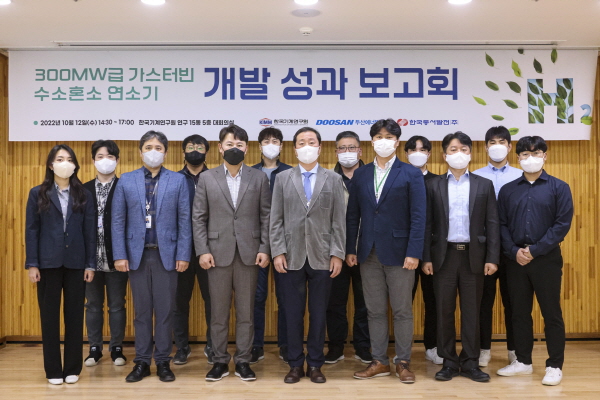
Participants in the development achievement report meeting for the 300MW-class gas turbine hydrogen co-firing combustor are posing for a commemorative photo.
A domestically developed eco-friendly combustor for gas turbines that reduces carbon dioxide emissions is set to undergo field testing.
The Korea Institute of Machinery and Materials (KIMM), under the Ministry of Science and ICT (President Park Sang-jin), announced on the 12th that it has developed the first hydrogen co-firing combustor for gas turbines used in LNG power generation in Korea and is pursuing a demonstration project to apply it to a power plant.
A research team led by Director Kim Min-guk of the Carbon-Free Fuel Power Generation Research Laboratory at the Carbon Neutrality Machinery Research Institute of the Korea Institute of Machinery and Materials (KIMM) has developed an eco-friendly combustor for domestic gas turbines with a 30% hydrogen co-firing level in collaboration with 13 industry, academia, and research institutes since July 2020. Based on this, they will begin power plant demonstrations in cooperation with Korea East-West Power, Doosan Energyability, and others starting in 2023.
Hydrogen fuel has a high reactivity with air, which acts as an oxidizer, posing a risk of causing high temperatures and flame flashbacks. To prevent these risks, the combustor developed by the Korea Institute of Machinery and Materials (KIMM) utilizing the only domestically produced gas turbine for LNG power generation developed by Doosan Energy, the fifth in the world, improved the fuel injection method and controlled the mixing degree of air and fuel to simultaneously reduce nitrogen oxides and combustion vibrations caused by high temperatures. In particular, it maintained the combustion performance of the existing LNG gas turbine while burning a mixture of 30% hydrogen fuel.
Although the development of hydrogen co-firing combustors had been pursued, performance verification was difficult due to the lack of domestic combustion test facilities necessary for such development. The hydrogen co-firing combustor for gas turbines developed this time was transferred to the German Aerospace Center (DLR) during the development process and successfully passed combustion tests in a high-pressure environment—the actual operating conditions of a gas turbine—thereby verifying its performance. Although overseas test facilities were utilized, this achievement is particularly significant as it represents the successful development of a hydrogen co-firing combustor using independent domestic technology.
Combusting 30% hydrogen in a gas turbine can reduce carbon dioxide emissions by 10.4% compared to conventional LNG power generation. The Korea Institute of Machinery and Materials (KIMM) plans to develop a 50% hydrogen co-combustion system capable of reducing carbon dioxide emissions by 21.4% by 2024, and is dedicating itself to research with the goal of developing 100% hydrogen combustion technology that emits no carbon at all by 2030.
Meanwhile, on the 12th, the Korea Institute of Machinery and Materials held a '300MW-class gas turbine hydrogen co-combustion system development achievement report meeting' at its headquarters in Daejeon. Along with the Korea Institute of Machinery and Materials' core technology for modifying gas turbine combustors into hydrogen co-firing combustors, Doosan Enerbility's high-pressure combustion test results and Korea East-West Power's Future Technology Convergence Institute announced plans for the demonstration of a hydrogen co-firing gas turbine power plant.
At the briefing, Park Sang-jin, President of the Korea Institute of Machinery and Materials (KIMM), emphasized, “The development of hydrogen fuel conversion technology for medium and large-sized gas turbines and power plant demonstrations are essential for the transition to an eco-friendly, carbon-free energy society. With technology development nearing completion and the strong commitment to demonstration from turbine manufacturer Doosan Enerbility and end-user Korea East-West Power, securing domestic hydrogen turbine technology early is possible.” He added, “For independent domestic technology to avoid becoming obsolete and to be commercialized in a timely manner, government interest and support are necessary for areas such as the selection of demonstration sites, as this is impossible with private sector will alone due to the nature of the power generation industry.”
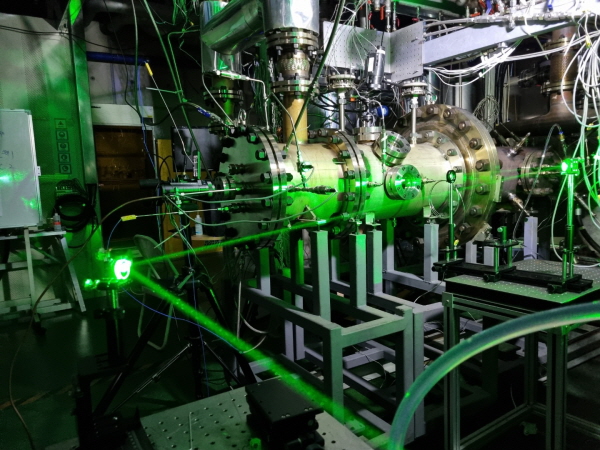
▲ 300MW class gas turbine hydrogen co-firing combustor

Comments
Related news
.jpg)
KIMM Overview of Thermal Energy Technology for Achieving Carbon Neutrality
As the urgency of achieving carbon neutrality is being emphasized in the face of climate crisis, including global abnormal high temperatures and natural disasters, the '2022 Global Mechanical Technology Forum,' which brought together the present and future of thermal energy technology for implementing a carbon-neutral society, has successfully concluded.
2022.09.22by 배종인 기자
KIMM Takes the Lead in Permanent Reuse of Organic Waste
The Korea Institute of Machinery and Materials (KIMM), under the Ministry of Science and ICT, is accelerating the realization of permanent reuse of waste organic materials such as waste plastics.
2022.10.04by 배종인 기자
KIMM Successfully Measures Fine Dust by Vehicle Type
The Korea Institute of Machinery and Materials (KIMM, President Park Sang-jin) under the Ministry of Science and ICT has successfully attempted for the first time in the world to conduct integrated measurement of fine particulate matter generated from vehicles, including not only engine combustion but also tire and brake wear, and is expected to be utilized as supporting data for future non-exhaust fine particulate matter reduction policies.
2022.10.07by 배종인 기자
Schneider Aims for Building Energy Savings and Operational Stability with Next-Generation HVAC Drives
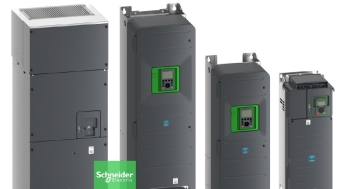
Schneider Electric has unveiled its next-generation HVAC drive product line 'Altivar HVAC'. The new product line's key features center on enhanced energy savings, system operational stability, and building management system integration. The products are divided into 'ATH200' for OEM and small equipment applications, and 'ATH600' for environments requiring continuous operation and advanced control. The company plans to expand the application scope from commercial buildings to facilities where HVAC system stability is critical, such as hospitals, airports, and data centers. The announcement includes over 30% energy savings, operation from -10°C to +60°C, Modbus and BACnet support, and compatibility with low global warming potential refrigerants.
2026.03.26by 명세환 기자
Ecolab Expands AI Data Center Cooling Business Through Acquisition of CoolIT
Ecolab has agreed to acquire CoolIT Systems, a liquid cooling company for AI data centers, for approximately $4.75 billion. The transaction is expected to close by Q3 2026, subject to regulatory approvals. CoolIT has been supplying direct-to-chip cooling-based coolant distribution units, cold plates, and manifolds, serving hyperscale data centers and colocation operators as customers. This acquisition is a measure to address the high-heat and high-density server environments created by AI proliferation. Ecolab plans to combine its water management and digital monitoring capabilities with CoolIT's hardware technology to expand its data center cooling business.
2026.03.26by 명세환 기자











