


Digital Transformation, "Flexible Edge and Distributed Strategies Are Essential"
 Published2022.10.19 15:15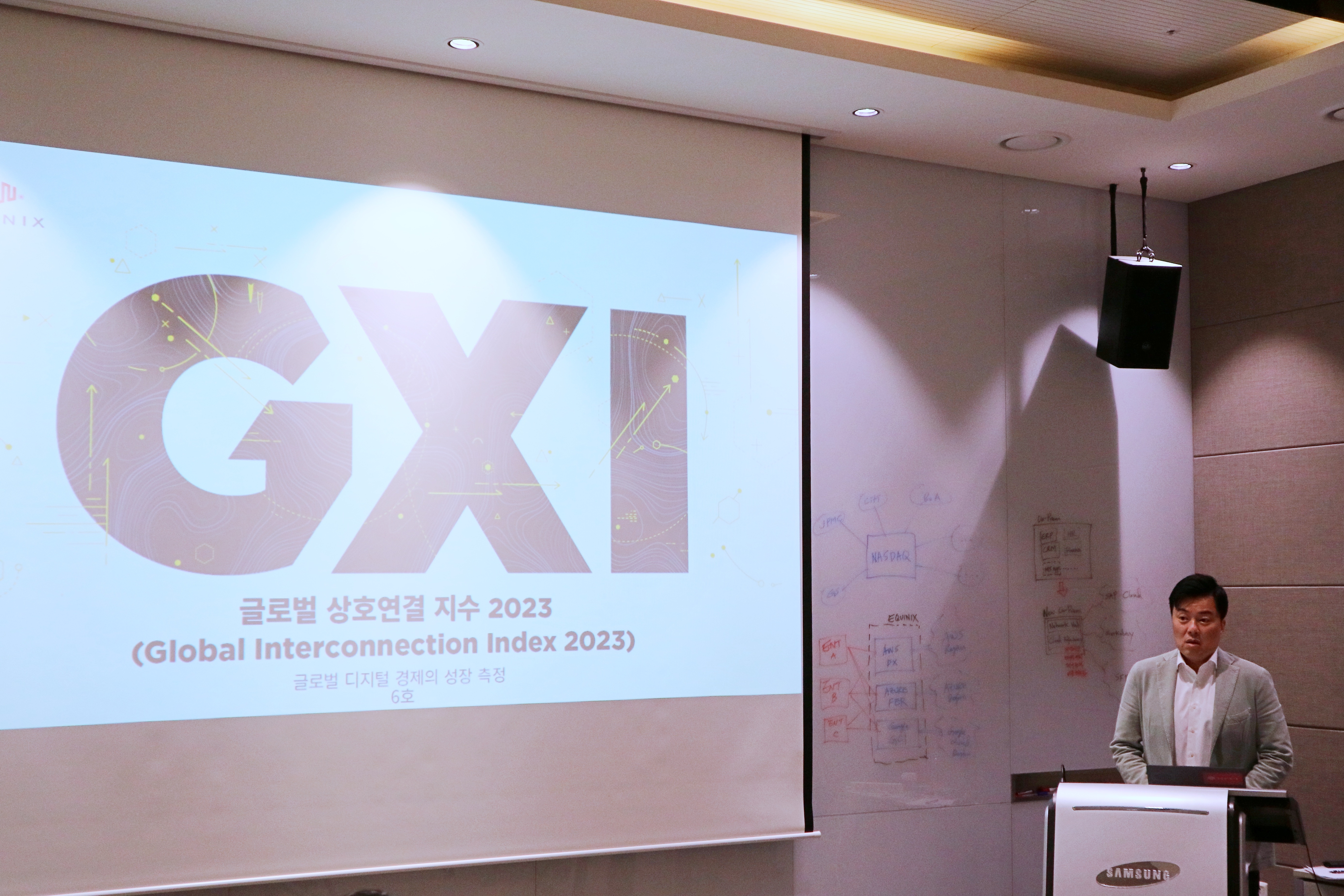
▲ The Equinix Korea press conference in progress.
Rapid growth in the digital edge sector rather than the digital core
The trend in IT infrastructure lies in distribution and interconnectivity through the edge. It is expected that the use of hybrid clouds, which combine numerous public and private clouds without relying on internal networks or a single data center, will become established.
On the 19th, Equinix Korea held a media briefing at the Samsung SDS Sangam Center to announce the latest report on the 'Global Interconnection Index'.
Interconnection refers to the direct and private exchange of IT traffic with various counterparts and providers at distributed IT exchange points located within carrier-neutral colocation data centers. This means that vendors, partners, and customers will constitute future infrastructure as a single interconnected ecosystem.
For example, by using AWS Direct Connect services to use a dedicated network connection on-premises, a diverse three-way interconnection ecosystem can be established, such as introducing SaaS to a company's enterprise systems and providing MyData and FinTech services to clients.
In the latest report on the Global Interconnection Index, Equinix projected that interconnection bandwidth in Seoul will reach 189 Tbps in 2025, with a compound annual growth rate (CAGR) of 47% over the next five years. Based on the seventh-highest growth rate in the Asia-Pacific region, Seoul was found to have the largest distribution of hyperscale providers among global hub cities.
According to the survey, it is projected that AI training for autonomous driving will generate approximately 70 terabytes of data annually, while connected cars using digital garages will generate over 2 petabytes per year. Furthermore, these technologies are expected to generate more than 20 times the amount of data globally compared to the Internet. This suggests that we can anticipate the growth and expansion of data services in the digitized automotive sector in the future.
At the global level, interconnect bandwidth is projected to reach 27,762 Tbps by 2025, based on a CAGR of 40% over the next five years. This represents a massive bandwidth equivalent to exchanging 110 zettabytes (ZB) of data annually, and is capable of supporting over 50 million autonomous vehicles, each with more than 2,000 terabytes (TB) of data connectivity.
Such growth in interconnect bandwidth will require growth at the edge rather than at the digital core, which can be considered the hub data center. Leading companies are seeing their annual digital infrastructure growth rates grow faster in the edge sector than in the digital core. The edge growth rate in Seoul is 47% CAGR, with hyperscale providers accounting for a relatively large portion of this.
In the Asia-Pacific region, which includes Seoul, leading companies achieved 3.9 times faster growth in digital infrastructure at the edge compared to the core, demonstrating a growth rate faster than the global average of 2.3 times. This is analyzed to be due to the high growth potential in Southeast Asian regions, such as Indonesia and Malaysia, within the Asia-Pacific area, leading to a succession of large-scale new investments.
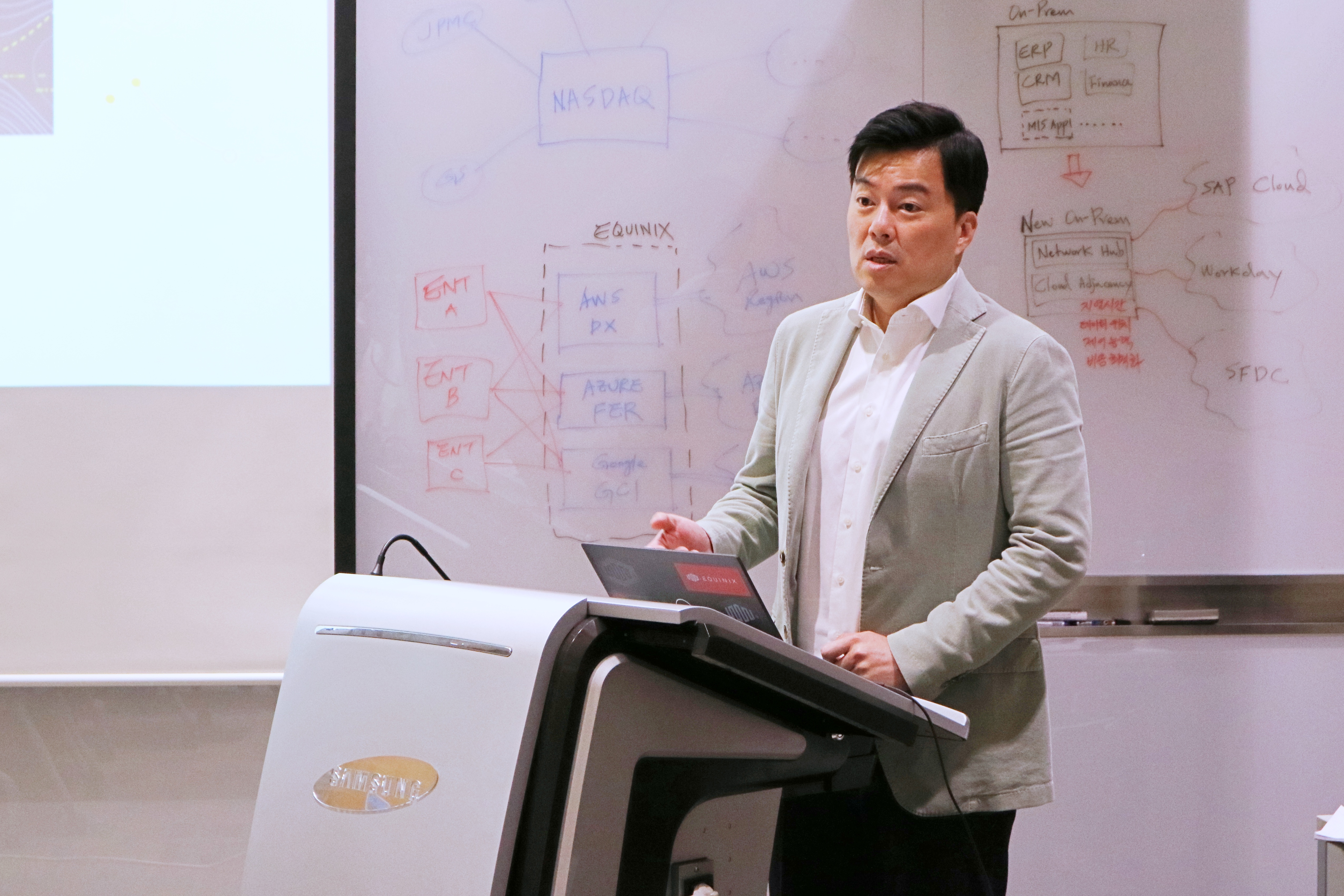
Jang Hye-deok, CEO of Equinix Korea
Jang Hye-deok, CEO of Equinix Korea, who conducted the briefing on this day, cited the manufacturing and distribution industries as the sectors where digital edge is expected to be most active in the future. She explained that this is because excessive data transfer is required to apply data necessary for sales in real time. This is because costs increase as the data transmission distance lengthens due to physical limitations.
CEO Jang Hye-deok explained, “Even amidst supply chain constraints and geopolitical and economic instability, more companies are shifting to ‘digital first’ policies to stay one step ahead,” adding, “The ecosystem is the infrastructure, and having interconnectivity with external cloud partners also constitutes the infrastructure.”
On this day, CEO Jang presented the following as essential tasks for digital leaders: developing a flexible edge strategy, designing with digital in mind, considering sustainability, investing in organizational strengths, and re-examining the core. In particular, it is necessary to shift from a rigid, centralized structure to a flexible, decentralized structure, as this can serve to buffer risks in the event of incidents caused by external or internal factors.

Comments
Related news

Equinix Unveils Fully Automated, Interconnected Bare Metal Service
Equinix announced bare metal service Equinix Metal. Equinix Metal is an automated service-oriented provisioning approach that enables digital enterprises to build foundational infrastructure and leverage global reach, interconnected ecosystems, and trusted partners from Platform Equinix.
2020.10.07by 김동우 기자
Equinix: “55% of Domestic IT Decision Makers Plan to Expand Business Within 12 Months”
Domestic IT decision-makers appear to focus relatively more on maintaining the status quo, in contrast to global IT decision-makers who actively pursue business expansion.
2022.08.31by 배종인 기자
.jpg)
Ministry of Science and ICT inspects SK C&C Pangyo data center for fire
The Ministry of Science and ICT held a "Broadcasting and Communications Disaster Management Headquarters Inspection Meeting" on the 18th, where it identified service disruptions at Kakao and other companies related to the SK C&C Pangyo data center fire that occurred on the 15th (Saturday), and encouraged rapid recovery efforts.
2022.10.19by 김예지 기자

Nvidia invests $5 billion in Intel
NVIDIA and Intel, leaders in global AI computing technology, are now forging ahead in providing cutting-edge solutions through NVLink-based architecture integration. NVIDIA and Intel have officially announced a strategic partnership and stated that they will jointly develop customized data center and personal computing products to accelerate diverse applications and workloads ranging from hyperscale to enterprise and consumer markets, thereby laying the foundation for the next generation computing era.
2025.09.22by 배종인 기자
.jpg)
Applied Materials Launches Environmental Protection Campaign to Mark World Cleanup Day
Applied Materials Korea (CEO Park Kwang-seon) is carrying out environmental cleanup activities with employees and their families around the Dongtan Sinricheon area on the occasion of World Cleanup Day, evolving into a company that engages with the local community beyond technological innovation.
2025.09.22by 명세환 기자











