



[Technical Contribution] Thomas Brand ADI - How to Perform Low-Power Analog-to-Digital Conversion in High-Precision Measurement Applications
 Published2022.10.21 13:48
Sigma-Delta ADCs have high power consumption despite high resolution
Instrumentation Amplifiers and SAR ADCs: Cost-effective and efficient with equivalent performance
■ When converting analog to digital, reduce power consumption by even 1mW further.
This article introduces low-power analog-to-digital converter (ADC) solutions for high-precision measurement applications. Various physical quantities can be measured using sensors and transmitted to a microcontroller for further processing. An ADC is required to convert these analog sensor output signals into digital signals. SAR ADCs or sigma-delta ADCs are primarily used in high-precision applications. In low-power applications, it is important to design systems that can reduce power consumption by even just 1mW.
■ Signal conversion using Sigma-Delta ADC
Compared to SAR ADCs, sigma-delta ADCs offer several advantages. First and foremost, sigma-delta ADCs enable higher resolution. Furthermore, sigma-delta ADCs commonly include programmable gain amplifiers (PGAs) and general-purpose input/output (GPIOs). Therefore, they are suitable for DC and low-frequency high-precision signal conditioning and measurement applications. However, sigma-delta ADCs consume more power because they utilize a high level of fixed oversampling rate. This will shorten battery life in battery-powered applications.
If the input voltage is low in the millivolt range, it needs to be amplified so that the ADC can process it more easily. A PGA Analog Front End (AFE) is required to connect low voltage levels with a 10mV output voltage.
For example, to connect a low-level voltage from a bridge circuit to a sigma-delta ADC operating in a 2.5V input range, the PGA gain must be 250.
However, doing this will introduce additional noise into the ADC input. This is because the noise voltage will also be amplified.
Therefore, the effective resolution of the 24-bit sigma-delta ADC is significantly reduced to 12 bits.
However, in some cases, it may not be necessary to use all the code in the ADC, and there may be a point where additional amplification no longer improves the dynamic range.
Another disadvantage of sigma-delta ADCs is that they are generally more expensive due to their internal complexity.
■ Advantages of using an instrumentation amplifier (In-Amp) and a SAR ADC together
A more cost-effective and efficient solution that achieves a level of accuracy similar to that of a sigma-delta converter is to use an instrumentation amplifier (In-Amp) and a SAR ADC together (Figure 1).
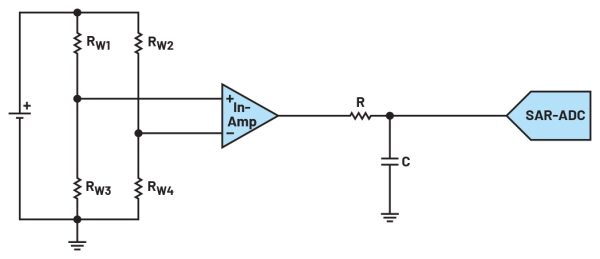
▲Figure 1: Schematic diagram of a bridge measurement circuit using an instrumentation amplifier and a SAR ADC together
The operation of a SAR ADC can be divided into two aspects: data acquisition and data conversion. Basically, current consumption is low during the data capture period. Additionally, most SAR ADCs switch to power-saving mode between conversions. Therefore, the most current is consumed during the conversion interval.
This power consumption depends on the conversion rate and increases linearly with the sample rate.
When the value to be measured changes slowly, such as in temperature measurement, a low conversion rate must be used to reduce current consumption. Figure 2 shows the power loss of the AD4003 according to the sampling rate. At 1 kSPS, the power loss is about 10 W, but at just 1 MSPS, it increases significantly to 10 mW.
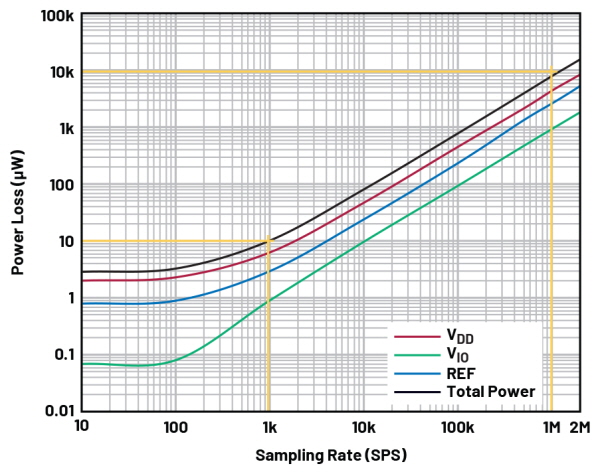
▲Figure 2: Power loss according to sampling rate with AD4003
Unlike such slowly changing measurements, the sigma-delta ADC has oversampling as a strength, allowing it to use an internal oscillator frequency much higher than the output rate.
Therefore, design engineers can choose to optimize sampling at a high speed and accept slightly worse noise performance, or improve noise performance by using more filtering and noise shaping (pushing noise outside the desired frequency band) at a slightly slower speed.
However, sigma-delta ADCs still consume more power compared to SAR ADCs. Since many sigma-delta ADCs mention effective resolution and noise-free resolution in their datasheets, you should refer to this information when designing.
■ In-Amp + SAR ADC, suitable for reduced power consumption and battery operation
Both using a sigma-delta ADC with a PGA and a SAR ADC with an instrumentation amplifier are suitable for signal conversion in high-precision measurement applications. The accuracy of the two solutions is similar.
However, for reducing power consumption or for battery-powered measurement applications, it is better to use a SAR ADC with an instrumentation amplifier (In-Amp).
This is because it consumes less power and is cheaper compared to solutions consisting of PGA and sigma-delta ADCs.
Furthermore, high-gain PGAs can limit performance because noise is also amplified.
For sigma-delta converters with the PGA integrated inside the converter, more integrated solutions such as the AD7124-4/AD7124-8 can also be used.
※ Author Introduction
Thomas Brand first became associated with Analog Devices in 2015 while writing his master's thesis. After graduating and completing his probationary period at Analog Devices, he became a Field Application Engineer in 2017. He currently supports major industrial customers in Central Europe and specializes in Industrial Ethernet. He majored in Electrical Engineering at Mosbach University of Industry and Academic Cooperation and earned a Master's degree in International Trade from the University of Konstanz of Applied Sciences.

Comments
Related news
ADI Unveils ADC with Built-in 102dB Anti-aliasing
Precision data acquisition signal chain design is time-consuming because it requires passive component tolerance, phase and gain error balancing based on high-speed ADC driving and anti-alias filtering requirements. In response, ADI announced the release of the AD7134 alias-free ADC, which simplifies front-end design for precision DC-350kHz applications and accelerates time to market.
2020.10.22by 강정규 기자
Low-power operational amplifiers, a 'starting point' for high-performance mobile device design
High performance and low power consumption are conflicting characteristics, yet they are becoming increasingly important values in more and more applications. This is especially true for battery-operated mobile devices. Various low-power and ultra-low-power components are now available on the market. Thomas Brand, Field Application Engineer at Analog Devices, explained how low-power operational amplifiers enable the implementation of high-performance, low-power mobile devices through an article titled "Power Performance Trade-offs in Operational Amplifiers."
2021.08.17by 이수민 기자
[Technical contribution] Thomas Brand ADI FAE-“Ethernet PHY must have low loss and withstand external conditions well”
We arranged a session to hear from Thomas Brand, Senior FAE at Analog Devices, about considerations when selecting an Ethernet PHY.
2022.03.15by 명세환 기자

Intel Unveils Next-Generation 'Core Ultra Series 3' and vPro Platform for Enterprise PCs
Intel has officially unveiled the "Intel Core Ultra Series 3" for next-generation enterprise PCs and the latest vPro platform, addressing a wide range of demands from enterprise notebooks to high-performance workstations.
2026.03.26by 배종인 기자

ROHM Launches ESD Protection Diode Compatible with High-Speed Interfaces of 10Gbps or Higher
Semiconductor specialist ROHM has developed the 'RESDxVx series' of ESD (electrostatic discharge) protection diodes capable of responding to next-generation high-speed data communication environments exceeding 10Gbps, simultaneously enhancing both signal quality maintenance required in high-speed interfaces and IC protection performance.
2026.03.26by 배종인 기자











