


A robotic hand with an elephant trunk that can even grasp micro-needles.
 Published2022.10.21 15:36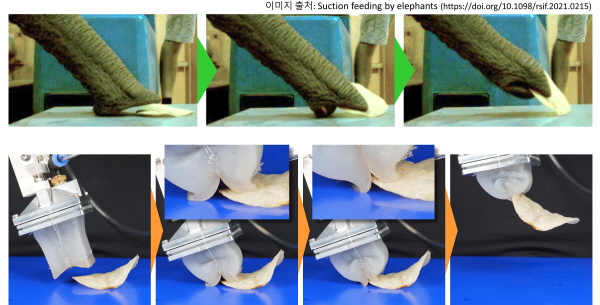
An elephant nose gripper robot capable of grasping everything from very thin or thin objects like needles to large objects like boxes has been developed, and is expected to be applied in various fields such as the effective transport of goods.
The Korea Institute of Machinery and Materials (President Park Sang-jin) under the Ministry of Science and ICT announced that it has developed the world's first gripper capable of both grasping by pinching and suction, mimicking the elephant's action of pinching the tip of its trunk to grasp small objects and sucking in air through its trunk to grasp large objects.
The research team led by Senior Researcher Song Seong-hyeok of the Robotics and Mechatronics Laboratory at the AI Robot Research Center of the Korea Institute of Machinery and Materials has developed a flexible structure, a wire that creates the deformation of the structure, and a flexible, thin-walled, tweezers-adsorption hybrid elephant trunk gripper.
It is expected to be applicable to various fields as it can stably grasp and assemble objects without damage without complex mechanical devices or sensors, and can even transport items effectively.
The flexible structure has several microchannels that create a vacuum inside, helping the gripper to adhere to the object. Each of these microchannels is flexible and when it comes into contact with an object, it deforms to match the shape of the object and adheres, so the flexible structure itself acts as an adsorbent.
Additionally, when the deformation wire in the center of the structure is pulled, the structure folds in half and acts as a gripper, compressing and grasping the object.
At this time, the gripper retracts and the flexible wall located on the outside wraps around the object, sealing it around the object.
It has high gripping power because it can greatly increase the force of wrapping an object by wrapping it and then creating a vacuum inside.
Previously, grippers were developed separately as grabbers and suction-type grippers. Grabbers cannot grasp objects larger than the maximum opening of the gripper. While suction-type grippers can grasp objects of various sizes, they struggle to grasp extremely thin objects like needles or thread, or thin objects that require pinching, such as fabric or overlapping sheets of paper.
The newly developed model utilizes both gripper-type and suction-type gripping mechanisms simultaneously, enabling gripping of objects of various sizes and shapes. It can grip a variety of objects, such as picking up a needle (0.25mm in diameter) smaller than 1/100th the size of the gripper from the floor, or lifting a box 10 times its size by suction.
Additionally, even in the process of grasping like a pair of tongs, it is possible to grasp various objects simply by turning on and off the pneumatic cylinder that moves the deformation wire without any complex sensors or controls.
Senior Researcher Song Seong-hyeok explained, “By placing the soft gripper against the floor and simultaneously performing a vacuum-like action while pulling it in, it creates the effect of strongly pinching the floor with your fingers, making it possible to easily grip even very thin objects.”
By taking advantage of these advantages, you can perform complex tasks such as wrapping a doll in a gift box, placing a paper cake topper on a cake, lighting a candle by stably holding a match on the floor to prepare for a party, or making a flower arrangement by holding branches of various irregularly shaped flowers lying on the floor.
Park Chan-hoon, head of the AI Robot Research Center, said, “The elephant nose gripper, which is a fusion of gripper and suction, is soft and poses no risk of injury even when working with people. In addition, it can easily handle objects of various sizes, from precise parts to boxes, without complex mechanical structures or sensors, so it can be applied to various industrial fields as well as daily life.” He added, “We expect it to be of great help to companies producing a variety of products and varying quantities, and to the development of service robots in everyday life.”
Meanwhile, this research was conducted with support from the basic project of the Korea Institute of Machinery and Materials, ‘Smart End Effector for All-in-One Robot Work System.’

Comments
Related news
OnRobot Announces MG10 Magnetic Gripper with Pressure Control
OnRobot has launched the MG10 magnetic gripper, which offers safety and precision. The new product can be utilized for various applications such as material handling, assembly, and machine tending in manufacturing, automotive, and aerospace industries, and is easy to use. It is compatible with all major robot brands and features improved pressure control and grip sensing performance.
2021.03.12by 이수민 기자
KIMM Takes the Lead in Developing Human-Robot Coexistence Technology
The Korea Institute of Machinery and Materials is leading the development of warm robot technology for a future where humans and robots coexist together, through the establishment of the Innovation Robot Center (Director Park Chan-hoon) for developing next-generation robot technology, along with the latest research achievements including robotic prosthetic limbs and prosthetic arms, wearable robots in clothing form, humanoid hands and universal grippers, and autonomous unmanned tractors.
2021.06.16by 배종인 기자
Machinery Research Institute develops versatile gripper for various tasks
A universal gripper designed to wrap around and grasp objects upon contact, similar to octopus tentacles, has been developed and is attracting expectations for potential applications in implementing various tasks in everyday life during the non-contact era.
2021.10.13by 배종인 기자
Schneider Aims for Building Energy Savings and Operational Stability with Next-Generation HVAC Drives
Schneider Electric has unveiled its next-generation HVAC drive product line 'Altivar HVAC'. The new product line's key features center on enhanced energy savings, system operational stability, and building management system integration. The products are divided into 'ATH200' for OEM and small equipment applications, and 'ATH600' for environments requiring continuous operation and advanced control. The company plans to expand the application scope from commercial buildings to facilities where HVAC system stability is critical, such as hospitals, airports, and data centers. The announcement includes over 30% energy savings, operation from -10°C to +60°C, Modbus and BACnet support, and compatibility with low global warming potential refrigerants.
2026.03.26by 명세환 기자
Ecolab Expands AI Data Center Cooling Business Through Acquisition of CoolIT
Ecolab has agreed to acquire CoolIT Systems, a liquid cooling company for AI data centers, for approximately $4.75 billion. The transaction is expected to close by Q3 2026, subject to regulatory approvals. CoolIT has been supplying direct-to-chip cooling-based coolant distribution units, cold plates, and manifolds, serving hyperscale data centers and colocation operators as customers. This acquisition is a measure to address the high-heat and high-density server environments created by AI proliferation. Ecolab plans to combine its water management and digital monitoring capabilities with CoolIT's hardware technology to expand its data center cooling business.
2026.03.26by 명세환 기자











