



KIMM Develops Self-Repairing Valve for Damaged Pipes
 Published2022.10.28 08:53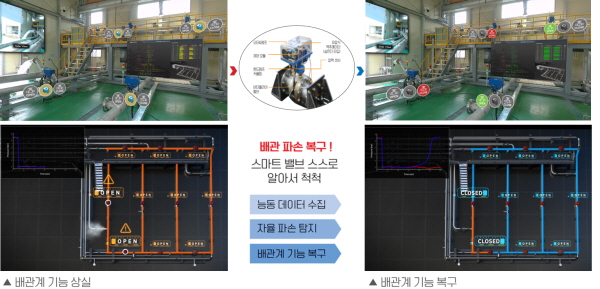
▲ Conceptual diagram of autonomous recovery for K-Smart Valve pipe damage accidents
A smart valve capable of automatically repairing pipes damaged by accidents has been developed for the first time in Korea, raising expectations that it will prevent major accidents by rapidly repairing pipe damage within the golden time in the event of future incidents.
The Korea Institute of Machinery and Materials (KIMM, President Park Sang-jin), under the Ministry of Science and ICT, has succeeded in localizing the 'K-Smart Valve,' which uses artificial intelligence technology to automatically locate and quickly repair damaged pipes within the golden time when a leak occurs due to unexpected pipe breakage at an industrial site, thereby preventing the spread of the accident into a major disaster.
The name "K-Smart Valve" was newly named by researchers at the Korea Institute of Machinery and Materials (KIMM) for a valve developed using a completely new operating method (algorithm), as the term is widely used as a proper noun due to its development by the U.S. Navy.
The research team led by Principal Researcher Jeong Byeong-chang of the System Dynamics Laboratory at the Korea Institute of Machinery and Materials (KIMM), which was responsible for this development, has developed the nation's first K-Smart Valve by applying artificial intelligence technology to existing valves. This valve autonomously recognizes accident situations without operator control, accurately locates damaged pipes, and shuts off surrounding valves. This valve can block leaks and quickly restore the original function of the piping system.
Most piping systems in military vessels, general ships, and onshore and offshore plant industrial sites are equipped with Valve Remote Control Systems, which allow operators to constantly monitor internal pressure, flow rate, and temperature and remotely open or close valves as needed.
On the other hand, when unexpected accidents such as pipe rupture occur, it is not easy for workers to calmly perceive the situation and respond. Moreover, if the golden time required for damage recovery is missed, it can lead to even greater secondary damage.
The newly developed K-Smart Valve was designed for priority application in piping systems, such as fire suppression and cooling systems, of domestic naval vessels. In the event of unexpected pipe damage caused by enemy fire during combat, the original function of the piping system can be restored within the golden time without crew control, thereby enabling the use of firefighting water or cooling water, which can minimize the spread of fire or secondary damage caused by overheating of weapon systems.
This valve consists of a valve body, a pressure sensor, an actuator, and a control module; it can be easily upgraded to a K-Smart Valve by adding a machine learning algorithm to the control module of an existing remote control valve that can detect pipe damage and block leaks.
Furthermore, since an accident response system equipped with K-Smart Valves can be easily established without significantly modifying the existing valve remote control system, it is possible to build a system capable of responding to safety accidents in the piping system at an economical cost.
Jeong Byeong-chang, a principal researcher at the Korea Institute of Machinery and Materials (KIMM), stated, “The K-Smart Valve can reduce casualties and property damage in various industrial sites through rapid repairs in the event of pipe ruptures, and it also possesses autonomous capabilities that allow it to make decisions and operate independently using sensor-based artificial intelligence technology.” He added, “In the future, it can be widely utilized as an unmanned technology not only in the military sector, such as naval vessels, but also in industrial sites including ships, onshore and offshore plants.”
Meanwhile, this research was conducted through the KIMM basic project 'AI-based mechanical system predictive diagnosis and accident response technology.' With the goal of actual application to naval firefighting systems, plans are underway to launch commercialization development through the Civil-Military Technology Transfer Project in collaboration with BY Co., Ltd. and Pusan National University starting in 2023. The results of this research were published in Issue 27 of IEEE/ASME Transactions on Mechatronics, a prominent academic journal in the field of automation and control systems.

Comments
Related news
KIMM Successfully Measures Fine Dust by Vehicle Type
The Korea Institute of Machinery and Materials (KIMM, President Park Sang-jin) under the Ministry of Science and ICT has successfully attempted for the first time in the world to conduct integrated measurement of fine particulate matter generated from vehicles, including not only engine combustion but also tire and brake wear, and is expected to be utilized as supporting data for future non-exhaust fine particulate matter reduction policies.
2022.10.07by 배종인 기자
KIMM Develops 30% Hydrogen Co-firing Combustor for Domestic Gas Turbines
A domestic environmentally-friendly combustor for gas turbines that reduces carbon dioxide emissions has been developed and is moving forward with on-site demonstration.
2022.10.13by 배종인 기자
A robotic hand with an elephant trunk that can even grasp micro-needles.
An elephant trunk-inspired gripper robot has been developed that can grasp everything from very thin objects like acupuncture needles to large objects like boxes, and is expected to be applicable to various fields including effective material handling.
2022.10.21by 배종인 기자
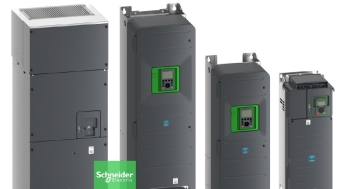
Schneider Aims for Building Energy Savings and Operational Stability with Next-Generation HVAC Drives
Schneider Electric has unveiled its next-generation HVAC drive product line 'Altivar HVAC'. The new product line's key features center on enhanced energy savings, system operational stability, and building management system integration. The products are divided into 'ATH200' for OEM and small equipment applications, and 'ATH600' for environments requiring continuous operation and advanced control. The company plans to expand the application scope from commercial buildings to facilities where HVAC system stability is critical, such as hospitals, airports, and data centers. The announcement includes over 30% energy savings, operation from -10°C to +60°C, Modbus and BACnet support, and compatibility with low global warming potential refrigerants.
2026.03.26by 명세환 기자

Ecolab Expands AI Data Center Cooling Business Through Acquisition of CoolIT
Ecolab has agreed to acquire CoolIT Systems, a liquid cooling company for AI data centers, for approximately $4.75 billion. The transaction is expected to close by Q3 2026, subject to regulatory approvals. CoolIT has been supplying direct-to-chip cooling-based coolant distribution units, cold plates, and manifolds, serving hyperscale data centers and colocation operators as customers. This acquisition is a measure to address the high-heat and high-density server environments created by AI proliferation. Ecolab plans to combine its water management and digital monitoring capabilities with CoolIT's hardware technology to expand its data center cooling business.
2026.03.26by 명세환 기자











