



Global smartphone shipments fell 7.6% YoY in Q3.
 Published2022.10.28 15:55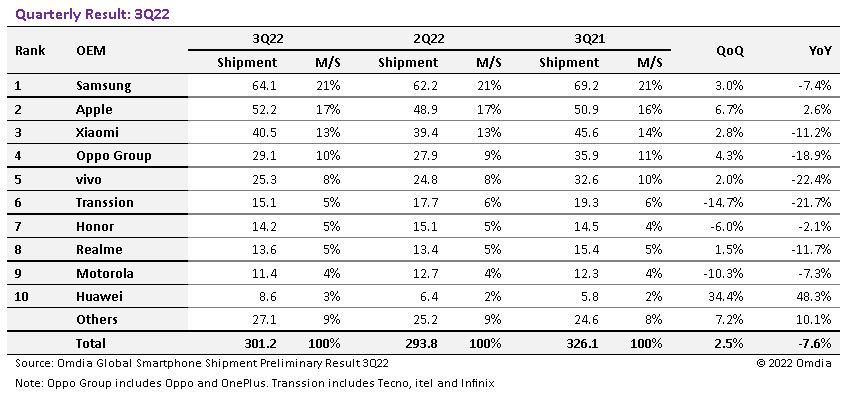
Smartphone shipments in the third quarter of 2022 (data from Omdia)
Annual shipments are expected to decrease by 8% year-on-year.
The Chinese domestic smartphone market has been hit hard by the global economic downturn and supply chain disruptions. Consequently, global smartphone shipments are also expected to decline year-on-year.
According to the latest smartphone shipment report for Q3 2022 released by Omdia, global smartphone shipments totaled 301.2 million units.
This represents a 7.6% decrease compared to the same period last year, but a 2.5% increase compared to the previous quarter. This decline was due to significant year-over-year declines in shipments from major Chinese OEMs, with Xiaomi, Oppo Group, Vivo, Transsion, and Realme all experiencing double-digit declines in shipments.
Samsung maintained its global lead in the third quarter, shipping 64.1 million smartphones. This represents a 3.0% increase from the second quarter but a 7.4% decrease compared to the same period in 2021. Apple ranked second, and only holds the top spot in the fourth quarter, when new iPhones are released each year. This quarter, Apple narrowed the gap with Samsung, shipping 52.2 million units, up 6.7% from Q2 and up 2.6% from 2021.
Apple, which dominates the premium market, saw its market share rise nearly 2 percentage points, from 15.6% in Q3 2021 to 17.3% in Q3 2022. Apple's iPhone shipments have continued to increase year-over-year for eight consecutive quarters since Q4 2020.
“Apple’s consumers are generally loyal, high-income customers and are less affected by the current economic downturn than mid-tier brands, which is why the company outperformed its competitors in the broader market in the third quarter,” said Hong Joo-sik, director of Omdia. “Despite rising gasoline prices, inflation, and lower disposable income, Apple’s iPhones are more resilient in the stagnant smartphone market.”
He also said, “Apple consumers have more purchasing power to upgrade to the latest iPhone than customers of major Android-based vendors like Samsung, Honor or OnePlus.”
Meanwhile, major Chinese OEMs appear to have failed to overcome the ongoing downturn. Xiaomi, Oppo, and Vivo, which ranked third to fifth in terms of shipments, all recorded sales declines of more than 20% in the second quarter compared to the first quarter.
Xiaomi's shipments rebounded slightly in Q3, growing 2.8% compared to Q2, but saw an 11.2% decline compared to the same period in 2021. Oppo grew 4.3% quarter-over-quarter but declined 18.9% year-over-year, while Vivo showed similar performance, growing 2% quarter-over-quarter but declining 22.4% year-over-year.
Zaker Li, senior researcher at Omdia, said the biggest factors contributing to the ongoing downturn include the slowdown in China's domestic smartphone market, the pandemic-related lockdowns of major Chinese cities, the Russia-Ukraine war, political conflict in India, and the economic downturn. He added that this is particularly true of "increasing competition from Honor and Huawei, which are growing rapidly in the Chinese domestic market."
He also said, “Xiaomi and Oppo experienced component shortages last year, and as a result, they significantly increased purchases early this year to secure components, but this year, sluggish smartphone demand has led to a significant increase in inventory, and as a result, they are suffering from the double whammy of sluggish demand and inventory problems.”
Honor appears to be doing relatively better than other Chinese OEMs, with shipments declining 2.1% year-over-year. While Honor's Q3 shipments totaled 14.2 million units, significantly exceeding previous levels, its shipments, which had been over 15 million units since Q3 2021, hit their lowest point in the previous quarter.
Realme ranked eighth with 13.6 million units sold. This represents a 1.5% increase from Q2 2022, roughly the same as the previous quarter. However, it still represents an 11.7% decrease year-over-year. This decline is attributed to sluggish sales in Realme's core markets, China and India.
Motorola ranked ninth with 11.4 million units shipped, its lowest shipments since the third quarter of 2021. This represents a 10.3% decrease compared to the previous quarter and a 7.3% decrease compared to the same period in 2021.
Huawei has re-entered the top 10, achieving consistent growth over the past four quarters. Compared to the same period last year, Huawei's shipments increased by nearly 50%, reaching 8.6 million units.
“According to Omdia’s forecast, OEM shipments and targets have decreased, and shipments in the fourth quarter of this year are also expected to decrease year-on-year,” said Hong Joo-sik, director of Omdia. “Many other negative factors, such as the overall global economic downturn, inflation, and the strong dollar, have also affected consumer demand for smartphones, and companies are reducing their component purchases due to inventory issues.”
Cumulative smartphone shipments from the first to third quarters of this year decreased by 8.2% compared to the same period last year, and as a result, Omdia predicted that annual shipments this year will also decrease by more than 8% year-on-year.

Comments
Related news
.jpg)
Global device shipments are down… "Hopeful for the 5G phone boom"
The global device market faces headwinds from geopolitical upheaval, high inflation, currency fluctuations, and supply chain disruptions, with forecasts pointing to a direct impact on declining shipment volumes. Meanwhile, the emergence of a 5G smartphone supercycle is creating optimism about future market prospects.
2022.07.04by 명세환 기자
The IT market continues to stagnate, with a rebound expected in the second half of next year.
The IT market is experiencing continued market stagnation as consumer demand has plummeted due to inflation and economic recession, with difficulties expected to persist through the third quarter of next year. Experts forecast that a solid recovery driven by robust industrial demand and demand elasticity will materialize in the second half of next year.
2022.09.27by 배종인 기자

SK Hynix reports 60% drop in third-quarter operating profit... "Memory business suffers unprecedented deterioration."
The semiconductor market is facing an unprecedented crisis. Due to sluggish consumer goods demand caused by economic downturn and inflation, as well as falling memory prices, semiconductor companies are experiencing sharp declines in revenue. As the crisis in the domestic semiconductor industry is intensifying due to the U.S. administration's sanctions on China's semiconductor industry, the management strategies of domestic semiconductor companies are becoming more critical than ever.
2022.10.26by 명세환 기자
ESP32 Development Environment Selection and GPS Application Implementation
The ESP32 is a microcontroller that integrates Wi-Fi, Bluetooth, 12-bit ADC, capacitive touch, PWM, DAC, and UART in a single SoC. However, the abundance of features does not by itself solve the designer's problems. The real challenges lie in selecting the appropriate development environment, determining which pins can be used and which must be avoided, and converting raw data from modules into usable information. This document addresses ESP32 peripheral constraints (ADC2 and Wi-Fi coexistence limitation, UART1 occupancy, ADC non-linear regions), the trade-offs between Arduino IDE and ESP-IDF, and the process from connecting NEO-6M/NEO-M8N GPS modules to UART2, parsing NMEA sentences, and visualizing routes in Google Earth, all organized based on documented references.
2026.10.12by 편집부
MIPI CSI-2, DSI-2, C-PHY, D-PHY Test Solution Technical White Paper
The MIPI interface adopts a burst mode that transitions between low-power (LP) and high-speed (HS) states for low-power consumption, and in return, strict timing rules are imposed on state transitions. Additionally, the high-speed section operates as a packet-based protocol with headers, ECC, and CRC, so verification engineers must handle waveforms and protocols simultaneously. Traditional configurations combining general-purpose oscilloscopes and AWGs reveal limitations in setup complexity, measurement uncertainty, and lack of reproducibility when faced with these requirements. This white paper, based on webinar materials, organizes the structure of this problem and describes how the SV5C-DPTXCPTX generator for receiver testing and SV5C-DPRXCPRX analyzer for transmitter testing integrate state transition testing, stressed eye testing, and protocol analysis into a single bench, along with their application boundaries.
2026.10.12by 편집부











