


AI Semiconductors Will Be a Breakthrough That Determines Technological Hegemony
 Published2022.11.07 16:45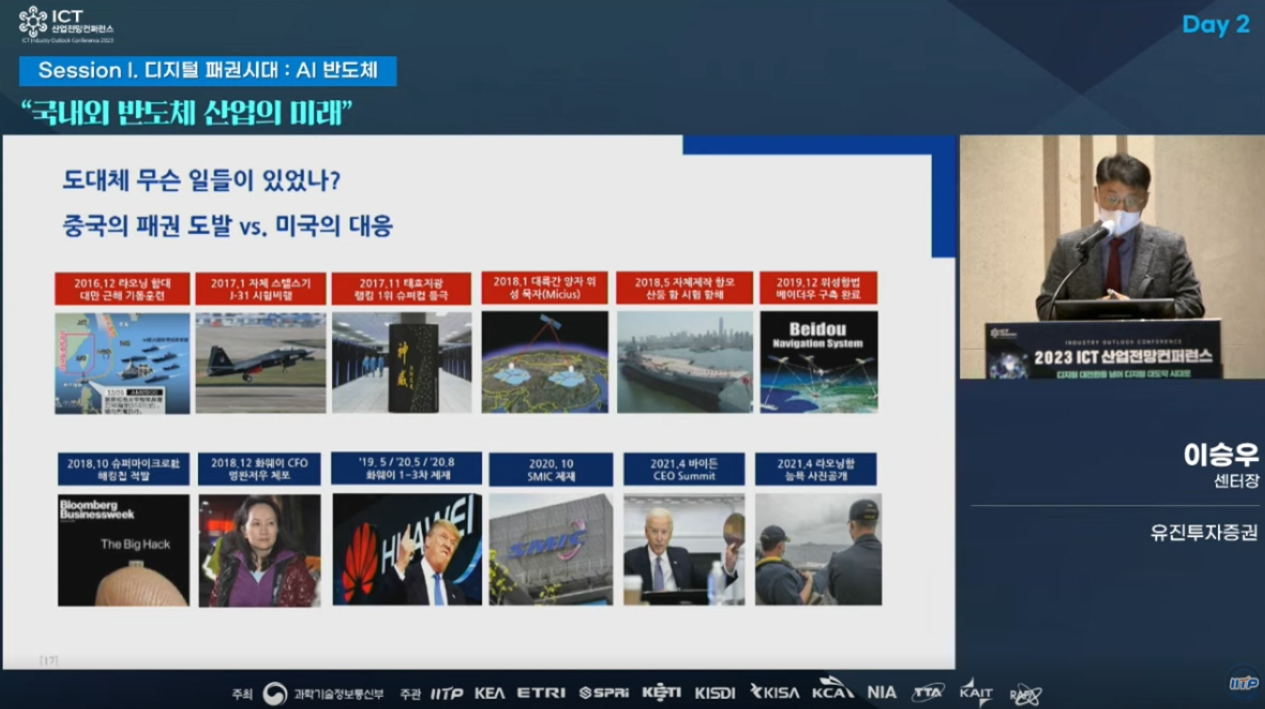
▲ During the online session of the ICT Industry Outlook Conference
Comprehensive semiconductor design capability is essential… Securing in-house competitiveness
Growth in AI Semiconductor Amidst Difficulties, “Ecosystem Management is Crucial”
Experts have suggested that AI technology, which has transformed the semiconductor paradigm, will determine dominance, and that semiconductors will be a key determining factor.
Lee Seung-woo, Head of Research at Eugene Investment & Securities, discussed domestic and international semiconductor industry trends and future prospects, including AI semiconductors, at the ICT Industry Outlook Conference held on the 3rd and 4th.
In his presentation, the center director argued, “As comprehensive semiconductor system design capabilities become increasingly important, AI semiconductor technology—which stores and processes data—is expected to rise in value as a core strategic resource for humanity.”
The semiconductor industry, which began in earnest in the 1990s, gradually underwent a division of labor, leading to the emergence of specialized companies such as fabless and foundries. In particular, while Samsung’s non-memory revenue accounted for 88% of TSMC’s total revenue, it was found to have fallen to a mere 33% share in 2021.
Ultimately, the semiconductor paradigm has shifted, with the top spot in operating profit among semiconductor companies—which had been the exclusive domain of Samsung Electronics and Intel—turning to TSMC as of this year. The value added of fabless and foundry companies rose from 8% in 2000 to over 30% in 2021, showing higher growth potential than the overall semiconductor industry.
The center director suggested, “Strategic decisions are needed to resolve this, and ultimately, comprehensive system design capabilities are crucial for the advancement of semiconductor design capabilities.”
Increasingly, many companies have ventured into semiconductor design to secure their own competitive edge. For instance, Apple and Samsung have developed their own smartphone design capabilities, and Nvidia has also expanded its semiconductor design capabilities to maintain the competitiveness of its graphics card products.
Meanwhile, the competitive factors for foundries lie in process technology, customer base, and ecosystem. The center director stated, "It is important who has more capable customers," and suggested that "the roles of design houses and back-end process companies specializing in packaging and testing will become particularly important."
To strengthen the foundry business, it appears necessary to establish a long-term plan to enhance the competitiveness of domestic design houses and back-end process companies.
■ The Key to Future Technology, AI Semiconductors
The center director argues that the key to this future semiconductor technology hegemony lies in AI.
Since the dawn of the third-generation AI computing era, AI has completely shifted the paradigm of familiar programming methods. Companies have embarked on expanding data center investments and Big Tech firms acquiring AI companies.
The United States imposed sanctions on China, controlling its entire export of semiconductor equipment and AI chips. This appears to be a cautious stance regarding China's growth in AI value added, and with Samsung Electronics and SK Hynix granted a grace period for separate consultations, additional investment by domestic companies in production facilities in China is expected to shrink.
Meanwhile, in Korea, Samsung Exynos 2100 and SKT Sapeon X330 are striving to develop domestic AI semiconductors, and KT and domestic startup More are collaborating with AMD to aim for the launch of their own NPU in the second half of 2023.
The center director added, “Managing the overall AI ecosystem is important for the AI industry to grow more fundamentally.”
In addition, while the semiconductor industry as a whole is contracting in the short term due to the recent economic downturn, AI technology is expected to show double-digit growth, and he added, “It is the area we are focusing on the most, and it could become a breakthrough for the Korean semiconductor industry in the future.”
As the conflict between the U.S. and China continues, hegemony is ultimately driven by the superiority of systems and technology, and AI is expected to become increasingly valuable as a major resource.
Comments
Related news

Intel Unveils Next-Generation 'Core Ultra Series 3' and vPro Platform for Enterprise PCs
Intel has officially unveiled the "Intel Core Ultra Series 3" for next-generation enterprise PCs and the latest vPro platform, addressing a wide range of demands from enterprise notebooks to high-performance workstations.
2026.03.26by 배종인 기자

ROHM Launches ESD Protection Diode Compatible with High-Speed Interfaces of 10Gbps or Higher
Semiconductor specialist ROHM has developed the 'RESDxVx series' of ESD (electrostatic discharge) protection diodes capable of responding to next-generation high-speed data communication environments exceeding 10Gbps, simultaneously enhancing both signal quality maintenance required in high-speed interfaces and IC protection performance.
2026.03.26by 배종인 기자
ST Launches 75V Drive IC Targeting 48V Industrial Motor Driving
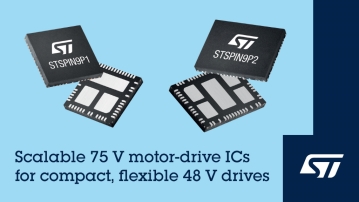
ST Microelectronics has unveiled the 'STSPIN9P' series of 75V motor drive ICs tailored for 48V-class industrial drive system design. The new product family is characterized by half-bridge and full-bridge configurations that enable design scalability according to motor type and output conditions. Power supply circuits, protection functions, and current sensing circuits are integrated on-chip to simplify system configuration, and the devices are designed to support applications up to 500W maximum. The company plans to provide reference designs and demo boards to support development and evaluation in industrial automation, robotics, pumps, fans, lighting, and textile machinery.
2026.03.26by 배종인 기자

Nordic supports security updates for the entire lifecycle of IoT devices at a single fixed cost
Nordic Semiconductor, a global leader in low-power wireless connectivity solutions, has unveiled a single fixed-cost licensing model that delivers FOTA (Firmware Over-the-Air) and device management capabilities throughout the device lifecycle via nRF Cloud, and introduced a new firmware update solution to prepare for the enforcement of the European Union's Cyber Resilience Act (CRA).
2026.03.26by 배종인 기자
Practical Training in Low-Noise, Low-Power Circuit Design All in One Place… Training Fee Support
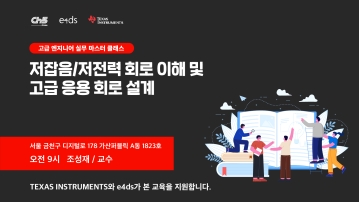
The "2026 Advanced Engineer Practical Masterclass" to strengthen competencies in high-sensitivity analog circuit and sensor-based system design will be held on April 16 at the e4ds Conference Center in Gasan-dong, Seoul. This program will be conducted as an offline paid hands-on training session, not online, and is targeted at engineers seeking on-site intensive learning. Texas Instruments will provide educational support for this training, allowing participation at 150,000 won, a 100,000 won discount from the original price of 250,000 won.
2026.03.26by 배종인 기자











