


Dr. Ahn Cheol-woo's research team at the Materials Research Institute selected as '2022 Outstanding Research Achievement'
 Published2022.11.11 10:23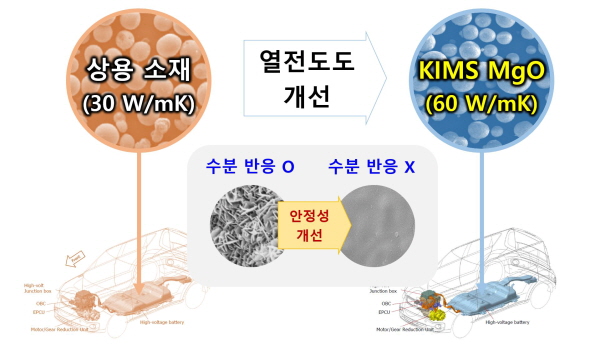
The technology that will give our country a lead in the global heat-dissipating ceramic material market has been selected as an outstanding research achievement by the Korea Institute of Radiological and Physical Sciences, and commercialization is expected in the future.
The Korea Institute of Materials Science (KIMS, President Lee Jeong-hwan), a government-funded research institute under the Ministry of Science and ICT, announced on the 11th that the 'KIMS MgO (magnesia) heat-dissipating new material technology' by Dr. Ahn Cheol-woo's research team at the Functional Ceramics Laboratory of the Ceramic Materials Research Division was selected for the '2022 Government-funded Research Outstanding Achievement'.
Although MgO material has excellent heat dissipation performance, it is difficult to manufacture and has the problem of reacting with water in the air, so it has not been used as a heat dissipation material for the past 200 years.
On the other hand, the selected technology is one that can be easily manufactured at low temperatures and provides moisture resistance, solving thermal management problems in electronic products such as electric vehicle explosion accidents.
Due to the lack of performance in heat-dissipating materials for electronic products, including electric vehicle batteries, various problems, including electric vehicle fires, are occurring.
The issue of thermal management in electronic products is directly related to national safety, so the introduction of high-performance new materials is urgent.
The research team determined that MgO could be a solution because its heat dissipation performance is more than twice that of commercial alumina (which accounts for more than 90% of the ceramic heat-dissipating filler market, thermal conductivity: 20–30 W/mK) while being similar in price.
The KIMS MgO material developed by the research team is the most Use inexpensive processes.
Since only a very small amount of additive of 0.2% is added to general MgO, it has the advantage of being easy to manufacture and commercialize using existing equipment used in the ceramic industry.
KIMS MgO produced in this way is manufactured at a lower temperature (1,100–1,400°C) than commercial alumina (1,500–1,600°C) and does not react with water in the air.
“KIMS MgO is the world’s only material that has completely solved all the problems of MgO materials that even leading Japanese companies have been unable to solve,” said Ahn Cheol-woo, a senior researcher at Materials Research Institute and the person in charge of the research. “Through this, we expect that Korea will have the opportunity to become the first country to become a leader in the heat-dissipating ceramic material market.”
In order to commercialize KIMS MgO material technology, Materials Research Institute established Soul Material Co., Ltd., a research institute, in September 2021.
Soul Material Co., Ltd. has been recognized for its potential by being selected as an excellent company among the 100 small business startups selected by the Ministry of SMEs and Startups (20 companies selected in 2022), with three companies selected.
Meanwhile, the National Research Council of Science and Technology (hereinafter referred to as the Research Council) has been selecting and announcing the Outstanding Research Achievements every year since 2014 with the aim of boosting the pride of scientists and engineers and encouraging the creation of excellent research results at government-funded research institutes.
The research association gave priority to recommending and selecting cases of groundbreaking achievements that are world-first or top-notch or equivalent, as well as cases of achievements that have made significant economic, industrial, and academic contributions, targeting fields of achievement creation in the basic-applied-developmental research and development stages.

Comments
Related news
KIMS Showcases Extreme Materials Technology
The Korea Institute of Materials Science (KIMS, Director Lee Jung-hwan), a government-funded research institute under the Ministry of Science and ICT, has organized an event to showcase extreme materials technology and lay the foundation for securing leading-edge extreme materials.
2022.09.21by 배종인 기자
.jpg)
KIMS Transfers High-Sensitivity Nanoplasmonic Sensor Substrate Manufacturing Technology to Zeus
The Korea Institute of Materials Science (KIMS, Director Lee Jung-hwan) is transferring high-sensitivity nanoplasmonic sensor substrate manufacturing technology to Zeus Co., Ltd., a specialized manufacturer in semiconductor, display, and robotics production, and is taking measures to comply with Restriction of Hazardous Substances (RoHS) regulations for electrical and electronic products.
2022.10.04by 배종인 기자
Materials Research Institute begins full-scale quarantine of film-type plasma devices
The Korea Institute of Materials Science (KIMS, Director Lee Jung-hwan), a government-funded research institute under the Ministry of Science and ICT, is launching a demonstration project to improve air quality using film-type plasma devices that have already completed verification testing, thereby advancing commercialization of the developed technology while making substantial contributions to society through public quarantine and disinfection activities.
2022.10.26by 배종인 기자
Schneider Aims for Building Energy Savings and Operational Stability with Next-Generation HVAC Drives
Schneider Electric has unveiled its next-generation HVAC drive product line 'Altivar HVAC'. The new product line's key features center on enhanced energy savings, system operational stability, and building management system integration. The products are divided into 'ATH200' for OEM and small equipment applications, and 'ATH600' for environments requiring continuous operation and advanced control. The company plans to expand the application scope from commercial buildings to facilities where HVAC system stability is critical, such as hospitals, airports, and data centers. The announcement includes over 30% energy savings, operation from -10°C to +60°C, Modbus and BACnet support, and compatibility with low global warming potential refrigerants.
2026.03.26by 명세환 기자
Ecolab Expands AI Data Center Cooling Business Through Acquisition of CoolIT
Ecolab has agreed to acquire CoolIT Systems, a liquid cooling company for AI data centers, for approximately $4.75 billion. The transaction is expected to close by Q3 2026, subject to regulatory approvals. CoolIT has been supplying direct-to-chip cooling-based coolant distribution units, cold plates, and manifolds, serving hyperscale data centers and colocation operators as customers. This acquisition is a measure to address the high-heat and high-density server environments created by AI proliferation. Ecolab plans to combine its water management and digital monitoring capabilities with CoolIT's hardware technology to expand its data center cooling business.
2026.03.26by 명세환 기자











