



Infineon Launches CMOS Transceiver for Automotive Radar
 Published2022.11.14 17:24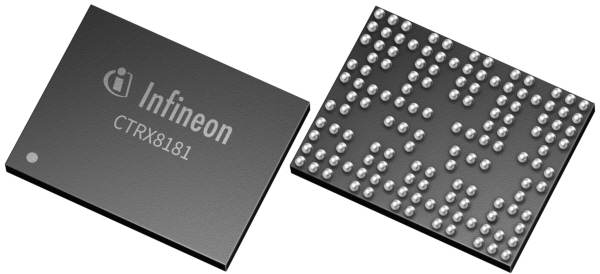
Infineon Transceivers Provide Enhanced SNR, System Performance, and Resilience
Assistance in the development of application modules such as corner and high-resolution radar
The enhanced SNR (Signal-to-Noise Ratio) and linearity of this transceiver provide high system performance and resilience.
This radar transceiver enables easily expandable platform access for various sensors, including corner radars, forward radars, and short-range radars.
Tomas Lucia, Marketing Director at Radar MMIC, Infineon Automotive, stated, “The new CTRX8181 transceiver enables reliable object recognition and differentiation to protect vulnerable road users, such as motorcycle riders, cyclists, and pedestrians,” adding that “reliable autonomous driving and for all SAE levels up to Level 4 and "Excellent RF performance is a prerequisite for the successful implementation of auxiliary functions," he said.
The CTRX8181 was developed in accordance with the latest ISO26262 safety standard and provides four transmit and four receive channels.
In addition, this product achieves an excellent signal-to-noise ratio (SNR) and increases the distance of standard modules by up to 25%.
With a high number of RF channels and improved linearity, it enables 33% higher vertical or horizontal angular resolution, making it possible to better distinguish various objects, such as pedestrians next to a car.
These features assist in the development of modules for all applications, ranging from corner radar to high-resolution radar.
The in-chip digital phase-locked loop (PLL) allows for faster ramps and ultra-fast flyback times for better distance resolution, which is a four-fold improvement over the best solutions available today.
This new feature reduces power consumption and provides more accurate speed information, allowing for better distinction between objects moving at similar speeds.
This allows for the ramp to be configured completely freely without sacrificing phase noise, thereby enhancing the robustness and reliability of the radar in various scenarios.
This point is particularly useful for interference avoidance methods using frequency, such as the compass technique.
The new CTRX family is the best match for Infineon's radar-dedicated AURIX™ microcontrollers (MCUs), the TC3x and the upcoming TC4x, which feature an embedded signal processing unit (SPU) and non-volatile memory for storing on-chip program code.
Combining the AURIX™ chipset with CTRX enables optimal performance in NCAP or real-world scenarios.
For example, it achieves enhanced reliability of radar functions even in bad weather.
This MMIC/MCU system partitioning enables various architectures, such as the conventional radar method of performing all signal processing within the module, or processing only partial signal processing and then streaming the processed data over 100 Mb/s or 1 Gb/s Ethernet with minimal effort.
In addition, it enables the selection of MMICs and microcontrollers suitable for the target application and allows for easy scalability according to various cost and performance requirements.
Since the connection between the MMIC and MCU supports both LVDS and CSI-2, it provides great flexibility in combining components.
Meanwhile, reliable high-performance radar modules play a key role in future enhanced autonomous driving assistance systems and autonomous driving.
For example, advanced features such as the Automatic Emergency Braking (AEB) system, which must respond immediately when a motorcycle passes, require higher performance and a larger number of radar modules per vehicle.
The main drivers of this growth are the NCAP program and legal regulations.
Infineon Technologies has been a key player in the market for over 15 years and has established itself as the number one supplier of radar monolithic microwave ICs (MMICs).
In addition, it achieved transceiver integration (integrating the transmitter and receiver into a single chip) and launched the world's first 77GHz automotive radar chip based on SiGe in 2009.
Infineon offers a diverse range of radar products to meet all market demands, from short-range radars (corner radars) to premium forward radars.
Comments
Related news
Infineon Launches EXCELON™ F-RAM Non-Volatile Memory
Infineon announced on the 3rd that it is launching 8Mb and 16Mb EXCELON™ F-RAM memory, the industry's densest serial F-RAM.
2022.11.04by 성유창 기자
Infineon Provides IoT Sensor Platform XENSIV™ CSK
Infineon Technologies (hereinafter Infineon) is addressing engineers' challenges with the Connected Sensor Kit (CSK) for rapid prototyping of connected IoT sensors.
2022.11.07by 성유창 기자
Infineon Launches PSoC™ 4100S Max Family with 5th Generation CAPSENSE™ Technology
Infineon Technologies (hereinafter Infineon) has introduced a product lineup that provides expanded flash memory and general-purpose input/output (GPIO) for advanced HMI applications supporting 5th-generation CAPSENSE™ touch technology.
2022.11.10by 성유창 기자

[e4ds Tech Day 2026 ⑨] Sim Sang-gyu, Autocrypt CTO: "In the Physical AI Era, Automotive Security Must Extend Beyond the Vehicle"
At e4ds Tech Day 2026, Sim Sang-gyu, CTO of Autocrypt, explained automotive cybersecurity strategies in the era of Physical AI and SDV (Software-Defined Vehicle). Automobiles are evolving as part of an ecosystem connected to AI, cloud, chargers, IoT, and robots, and he emphasized that the scope of security must expand beyond the vehicle interior to the entire connected environment. In particular, AI model tampering, adversarial attacks, OTA updates, and EV charger hacking were identified as major threats. He explained that response measures require zero trust, AI model integrity protection, intrusion detection, Security by Design and Default, and full lifecycle security management, and that proactive security system establishment beyond regulatory compliance is critical for securing future mobility competitiveness.
2026.10.12by 배종인 기자

Practical HIL Construction Strategy for Automotive and Off-Highway Controller Validation
As vehicle E/E architecture transitions to zonal structures and shifts to software-defined vehicles (SDV), the number of controllers (ECUs) requiring validation and software complexity are surging dramatically. Meanwhile, real vehicle testing cannot provide repeated verification under identical conditions and entails lead time and safety concerns. This white paper explains the principles of HIL (Hardware-in-the-Loop) validation and the structure of the NI platform composed of PXI, SLSC, and VeriStand, and through two actual implementation cases—Camera Record & Replay HIL for In-Cabin Monitoring Controller (ICMU) and Forklift Controller (VCU) HILS—describes how controller-level regression testing becomes possible. Additionally, it explicitly states application boundaries and limitations, such as lack of A2B support.
2026.10.12by 편집부











