



ETRI and KISTEP Present 15 Key Technologies to Address Digital Dysfunction
 Published2022.11.16 09:07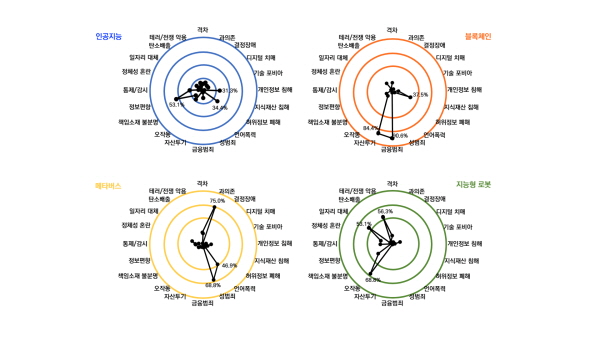
Digital dysfunctions classified into 20 categories in the report
Domestic researchers are garnering attention for presenting solutions and countermeasures regarding the negative aspects of future digital technology.
The Electronics and Telecommunications Research Institute (ETRI) and the Korea Institute of Science and Technology Planning and Evaluation (KISTEP) proposed 15 technology solutions and 8 policy directions to proactively respond to future digital dysfunctions through collaborative research.
The research findings announced by the research team were published as 'Outlook on Digital Dysfunctions and Response Directions'.
Digital dysfunction is a collective term for the side effects arising from the use of digital technology and its application services.
With the advancement of digital technology, the term is being used under various concepts, such as focusing on the negative aspects of specific technologies or services like the Internet, smartphones, and social media (SNS), or using terms like informatization dysfunction and cyber dysfunction.
The government has also presented key initiatives for a digital society, including digital safety, through this year's 'Republic of Korea Digital Strategy'.
As digital technology becomes an essential infrastructure in individuals' daily lives, business, and social relationships, the types, scope, and intensity of digital dysfunctions are expanding further.
In particular, the digital divide between generations, excessive reliance on smartphones and social media, game addiction, and cyber violenceIntellectual property infringement, fake news, and the reduction of human relationships are leading to serious social problems.
In this study, digital dysfunctions were classified into a total of 20 types, including the digital divide, digital overdependence, digital decision-making disorder, and digital dementia.
The research team published this report to serve as a cornerstone for creating a better future by raising awareness of the threats and harms caused by digital dysfunctions through the exploration of proactive response directions to prepare for digital dysfunctions.
In essence, it presents a direction for enjoying a safer future life by proactively and efficiently responding to various forms of threats in the future digital world—going beyond individual psychological and emotional disorders caused by digital dysfunctions to include widening economic inequality, ethical issues such as prejudice, discrimination, and accountability, and misuse for crime and terrorism.
In particular, this report identified the correlation between advanced ICT such as artificial intelligence (AI), blockchain, metaverse, and intelligent robots and dysfunctions, as well as the differential effects of dysfunctions based on the characteristics of each technology, and looked ahead to the future of 2030 based on technological evolution.
In addition, the research team explained that it is significant in that it simultaneously presented technical solutions and policy directions capable of responding.
Furthermore, if the technological solutions presented in the report are commercialized, it is expected to contribute to promoting the development of efficient technologies and policies for the formation of a better society and community, including helping victims suffering from emotional and economic difficulties due to digital dysfunctions as well as fostering social trust among members of society.
The research team cited 15 technology solutions with high technological and social impact and effectiveness, including personalized virtual assistants, technology supporting creative collaboration between humans and AI, digital financial crime detection technology, technology for ensuring algorithm reliability, and specialized digital treatment services for digital dysfunction.
In addition, eight major policy directions were presented, including △expansion of social capital oriented toward digital inclusion and trust △increased education and participation in responding to digital dysfunctions △development of AI-human collaborative jobs and roles.
"In the future, the impact of digital dysfunction on mental health, physical health, economic activities, and public safety is expected to expand further. I hope that the technology solutions and policy directions for digital dysfunction presented in this report will serve as a cornerstone for proactively responding to future digital dysfunctions and driving a society of safe coexistence between humans and digital technology," said ETRI President Kim Myung-joon.
KISTEP President Jeong Byeong-seon also stated, “This research will serve as an exemplary case of creating synergy in the formulation of national R&D strategies and planning, as it was presented through collaborative research among government-funded research institutes. I look forward to further activating research collaboration among government-funded research institutes on key issues in response to the rapidly changing ICT environment in the future.”
The research team explained that major countries are proactively driving related technology development and policies to actively respond to digital dysfunctions, emphasizing the urgent need to establish response strategies for the rapid advancement of digital technology and the potential negative consequences that may arise.
The report published by the research team can be found on the KISTEP and ETRI websites.

Comments
Related news

Nvidia invests $5 billion in Intel
NVIDIA and Intel, leaders in global AI computing technology, are now forging ahead in providing cutting-edge solutions through NVLink-based architecture integration. NVIDIA and Intel have officially announced a strategic partnership and stated that they will jointly develop customized data center and personal computing products to accelerate diverse applications and workloads ranging from hyperscale to enterprise and consumer markets, thereby laying the foundation for the next generation computing era.
2025.09.22by 배종인 기자
.jpg)
Applied Materials Launches Environmental Protection Campaign to Mark World Cleanup Day
Applied Materials Korea (CEO Park Kwang-seon) is carrying out environmental cleanup activities with employees and their families around the Dongtan Sinricheon area on the occasion of World Cleanup Day, evolving into a company that engages with the local community beyond technological innovation.
2025.09.22by 명세환 기자
.jpg)
The combination of electrical and electronic technologies like AI, semiconductors, and electric vehicles with renewable energy will determine industrial competitiveness.
Professor Lim Chun-taek from Gwangju Institute of Science and Technology (GIST) stated in his keynote speech at the '2025 e4ds Tech Day' on the 9th, "Global energy investment is already shifting from fossil fuels to renewable energy, and the trend of electrification combined with electrical and electronic technologies is changing the industrial landscape."
2025.09.12by 배종인 기자
.jpg)
"Data Center Power Demand Surges: Distributed Energy is the Solution"
The power demand of data centers is surging rapidly alongside the accelerating growth of artificial intelligence (AI), cloud, and electric vehicle industries. In particular, the global power supply and demand structure centered on the United States is undertaking a massive infrastructure reorganization to adapt to this change, and Korea is no exception in this trend. As an alternative to overcome the limitations of the existing centralized power system, distributed energy systems and smart grid technologies are gaining attention.
2025.09.02by 배종인 기자
Huawei Begins Full-Scale Training of Young Korean Global ICT Leaders
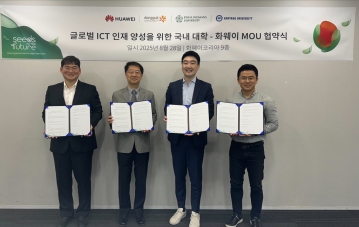
Global ICT company Huawei Korea has signed a Memorandum of Understanding (MOU) with Dongguk University, Ewha Womans University, and Hanyang University, and will jointly implement a global education program to nurture next-generation ICT leaders.
2025.08.29by 배종인 기자











