



VMware, “Korea Has the World’s Highest Level of Multi-Cloud Systems”
 Published2022.11.24 11:05
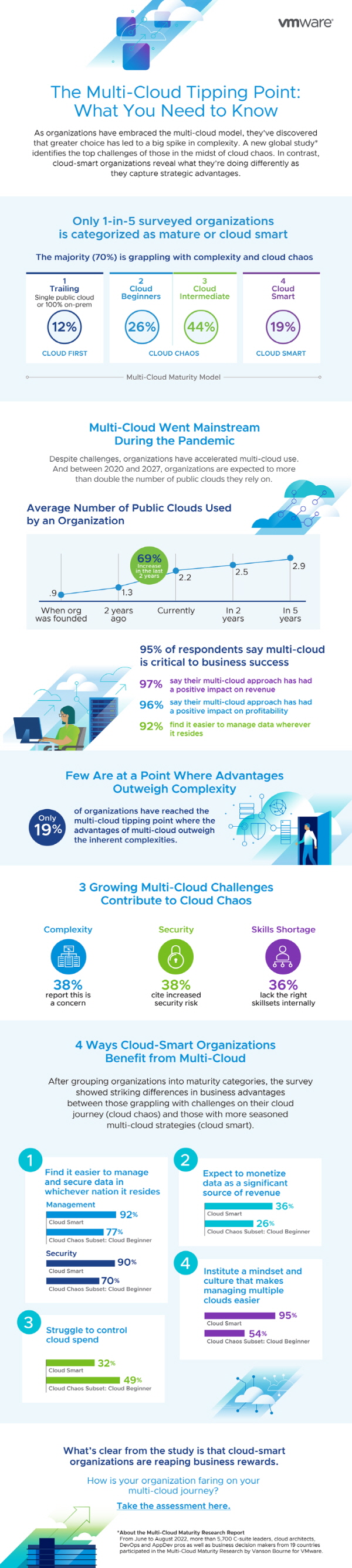
It is projected that in five years, the average number of public cloud usages by Korean companies will reach 3.8, the highest level in the world.
VMware (CEO Raghu Raghuram), a global leader in enterprise software, released a report on the 24th analyzing the achievements and challenges of multi-cloud transformation for organizations in South Korea, the Asia-Pacific region, and around the world.
According to the 'Multi-Cloud Maturity Study Report' commissioned by VMware and conducted by Vanson Bourne, while multi-cloud is taking root particularly rapidly in Korea, it was found that for domestic organizations to grow into 'cloud-smart' companies, the level of CEO involvement in the multi-cloud decision-making process needs to be improved.
First, the number of public clouds used by Korean companies was found to be very high compared to other countries that participated in the survey. Korean respondents answered that their organizations used 1.4 public clouds at the time of founding, 1.9 two years ago, and 2.5 currently, and stated that they plan to use 3.1 public cloud vendors in two years and as many as 3.8 in five years. In particular, the number of public clouds to be used in five years was found to far exceed the global average of 2.9 and the Asia-Pacific average of 3.2, recording the highest level in the world.
On the other hand, it was found that only 23% of these are 'cloud smart' companies that fully realize the potential and business value of multi-cloud.
The report classified the multi-cloud maturity levels of all organizations into three stages: 'Cloud First,' 'Cloud Chaos,' and 'Cloud Smart,' with 'Cloud Smart' signifying that an organization has resolved the complexity issues of multi-cloud and achieved a competitive advantage. Cloud Smart organizations accounted for 19% of the total organization globally and 21% in the Asia-Pacific region.
Korean respondents cited "lack of in-house personnel (48%)" as the biggest challenge in establishing a multi-cloud approach. This was followed by "establishing different skill sets and tools for each cloud (42%)" and "connecting different cloud environments (41%)" as difficulties. Notably, the percentage of respondents citing a shortage of in-house personnel in Korea was significantly higher than the global average (38%) or the averages for the Asia-Pacific and Japan regions (42%), indicating that Korean respondents perceive the shortage of cloud specialists as a relatively significant issue.
On the other hand, domestic companies' interest in data sovereignty recorded the lowest level in the Asia-Pacific and Japan (APJ) region. While 91% and 93% of Korean respondents agreed that consumers are increasingly interested in 'where their data is' and 'who can access it,' only about 36% of domestic respondents answered 'very much so' to the question, 'Is data sovereignty a concern for organizations?' This shows a significant difference from both the Asia-Pacific average (50%) and the global average (48%), suggesting that domestic companies need greater interest in sovereign cloud, which allows for easy data management and protection regardless of location, and in data sovereignty, which involves the application of personal information protection laws and governance structures within the countries or jurisdictions where data is collected, stored, processed, and used.
Interesting survey results regarding the operational and cloud costs of Korean companies have also emerged. Overall, compared to respondents worldwide, Korean respondents felt less need to improve visibility and control over their organization's operational and cloud costs. In particular, regarding the question "How much improvement is needed in visibility regarding your company's cloud costs?", 21% of global respondents answered that "significant improvement is needed," whereas only 13% of Korean respondents gave the same answer; furthermore, as many as 26% answered that "no improvement is needed at all." However, due to the rapidly changing economic situation and volatile exchange rates, the possibility of changes compared to the time of the survey (June to August 2022) is also noteworthy.
Finally, the level of participation and involvement of Korean CEOs in decision-making regarding multi-cloud strategies was found to be relatively low. In particular, the percentage of domestic respondents who answered that "CEOs are actively involved in the company's use of the cloud" was only 45%, which is significantly lower than the Asia-Pacific average of 56%. According to the report, to leap forward as a 'Cloud Smart' organization, a multi-cloud strategy must go beyond simply possessing the appropriate technology and be closely aligned with business objectives, and 'Cloud Smart' organizations are most likely to place the CEO as a key decision-maker when establishing multi-cloud strategies.
"Through this research report, we have once again confirmed that multi-cloud is establishing itself particularly rapidly in Korea and is leading the global market in public cloud adoption," said Jeon In-ho, President of VMware Korea. "On the other hand, for domestic companies to realize the value of multi-cloud and maximize its potential, CEOs must participate more actively in the multi-cloud decision-making process and cultivate a culture and mindset that enables continuous development."
Meanwhile, VMware contributes to strengthening the cloud smart strategies of Korean companies and supports them in identifying the elements necessary to fully realize their position in the multi-cloud maturity stage as well as the economic and innovation potential of the region. Interested companies can access free assessment tools and consultations through the website.

Comments
Related news
.jpg)
VMware Strengthens Partner Compensation Based on Capabilities and Performance
VMware, a global leader in enterprise software (CEO Raghu Raghuram), is revolutionizing its partner program with a focus on cloud and customer success, providing incentives for partners to accelerate their transition to SaaS, subscription, and service-based business models.
2022.08.22by 강정규 기자
.jpg)
VMware, “One-stop Solution for Complex Multi-Cloud Operations”
VMware will hold the VMware Explore 2022 multi-cloud conference on the 30th (California local time) to announce new solutions and an integrated platform. While domestic companies are recognizing the necessity of multi-cloud, there are concurrent concerns that multi-cloud operating environments are becoming increasingly difficult and complex. VMware is presenting successful multi-cloud operational strategies through simplified end-to-end tools and platforms spanning cloud, applications, devices, and workspaces.
2022.08.30by 김예지 기자
VMware Supports a Smart Cloud Approach
VMware, the global leader in enterprise software (CEO Raghu Raghuram), has announced a multi-cloud product suite that supports a cloud-smart approach.
2022.11.11by 배종인 기자
.jpg)
SalePoint Signs Multi-Year Partnership Agreement with AWS… Promoting Identity Security that Integrates Even AI Agents
Sailpoint has entered into a multi-year strategic partnership agreement with AWS and is moving forward with establishing an integrated governance system that manages both human and non-human identities together. The plan is to consistently manage access permissions in an environment where AI agents are increasing as work execution entities, while applying the principle of least privilege and automated policy enforcement. The two companies plan to jointly expand capabilities to manage the identities of various entities, including AI agents, within a single layer in the AWS environment. This collaboration is interpreted as a move to design security and governance together in corporate environments where AI adoption is expanding.
2026.03.26by 배종인 기자
.png)
Databricks Unveils Open AI Security Monitoring 'Lakewatch'
Databricks entered the security market on March 24 by unveiling LakeWatch, an open-source agentic SIEM. The core functionality of this product is to integrate and analyze security, IT, and business data in a single environment to support AI-based threat detection and investigation. The company explained that it reduces the limitations of existing security operations centers, which have had to forgo some data due to high cost structures, and enables large-scale data analysis and automation based on open formats and ecosystems. LakeWatch is currently offered as a private preview, with Adobe and Dropbox mentioned as early customers. Databricks also announced an expanded partnership with Anthropic as well as the acquisition of Antimatter and SiftD.ai.
2026.03.26by 배종인 기자











