



“Reorganization of electric vehicle subsidies and expansion of charging infrastructure”
 Published2022.11.25 09:17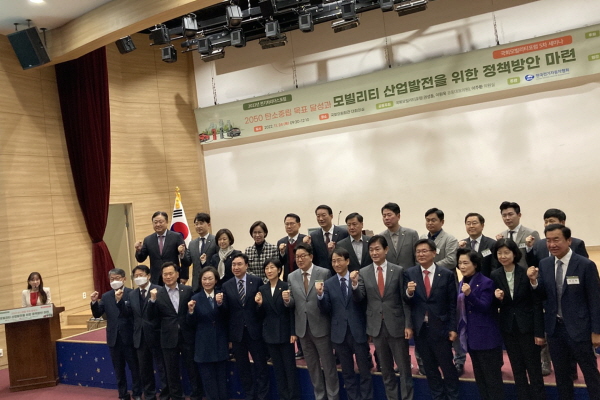
Ministry of Environment reorganizes electric vehicle subsidies to promote popularization
Target to install 500,000 electric vehicle chargers by 2025
Future Car Experts Shortage, Investment in Personnel and R&D Required
The National Assembly Mobility Forum (Co-chairs Kwon Seong-dong and Lee Won-wook) and the office of Rep. Lee Joo-hwan held the '2022 Electric Vehicle Leaders Forum (5th National Assembly Mobility Forum Seminar)' on the 24th at the National Assembly Members' Hall with the theme of 'Establishing Policy Measures for Achieving the 2050 Carbon Neutrality Goal and Developing the Mobility Industry.'
In his opening remarks, Rep. Kwon Seong-dong, co-chair of the National Assembly Mobility Forum, said, “Both the ruling and opposition parties are speaking with one voice on the development of the mobility industry,” and “We will do our best to accelerate the transition to a mobility revolution, including expanding the supply of electric vehicles and charging facilities and expanding low-carbon, eco-friendly R&D projects.”
In his congratulatory remarks, Minister of Environment Han Wha-jin said, “Major countries and automobile companies around the world are actively moving toward zero-emission vehicles,” and “The Ministry of Environment will also work to improve the industrial competitiveness of zero-emission vehicles as well as the environment by revising subsidy guidelines.”
Kim Ho-eun, head of the Ministry of Environment's Air Future Strategy Division, said, "We will promote the spread of electric vehicles and charging infrastructure. He gave a presentation on the topic of 'Policy Direction for Zero-emission Vehicles' and announced the Ministry of Environment's strategy for implementing the era of zero-emission vehicle popularization.
The Ministry of Environment has put forward three strategies: △subsidy support, △expanding the distribution base, and △charging convenience.
Director Kim said that the subsidy guidelines for 2023 are being revised and that the subsidy system will be revised to improve performance and promote popularization.
We plan to establish a subsidy linked to the launch of new vehicle models, such as medium- and large-sized electric cargo vehicles, and to induce performance improvement through differentiated support according to performance requirements.
For example, the plan is to differentiate subsidies based on driving distance, fuel efficiency, etc. for performance tests and evaluations of existing vehicle models.
In addition, incentives for achieving zero-emission vehicle goals will be added, and the subsidy limit for expensive vehicles will be revised by adjusting the support exclusion ceiling from 90 million won to 85 million won.
As electric vehicles become more popular, with the cumulative number of zero-emission vehicles expected to exceed 400,000 in October 2022, expansion of charging infrastructure is also being promoted.
The Ministry of Environment plans to increase the number of electric vehicle chargers from 176,701 in October 2022 to 500,000 in 2025.
Rapid chargers will be installed at transportation hubs such as rest areas and gas stations, and the optimal location will be selected using the optimal location selection index. Slow chargers will be installed mainly in apartment complexes and large marts with good accessibility, and commercial vehicle charging stations will utilize garages.
Director Kim Ho-eun said that to support these plans, the 2023 budget will increase by 30% compared to this year.
Hong Chung-wan, secretary of the Ministry of Trade, Industry and Energy's Automobile Division, gave a presentation on the topic of 'Strategy to Become a Global Top 3 Automobile Industry' and said that the public and private sectors should work together to find a way to become a global top 3.
We have the world's best competitiveness in core electric vehicle components such as batteries and fuel cells. there is.
On the other hand, challenges such as flexible transition of semiconductors, software, and the entire ecosystem and supply chain remain in the process of evolving into software-defined vehicles (SDVs).
Secretary Hong said, “In order to leap to the top tier of electrification, the government is aiming to strengthen the vehicle software and semiconductor ecosystem and enhance the core performance of electric and hydrogen vehicles,” adding, “The private sector should play a role in developing application software for each field, such as for the transition to SDV,” expressing his opinion that the public and private sectors should work together.
Lee Hang-gu, a research fellow at the Korea Automobile Research Institute, gave a presentation on ‘The direction of change in the electric vehicle industry and industrial ecosystem.’
He expressed concern, saying, “The profitability of internal combustion engines is decreasing and sales are shifting to electric and autonomous vehicles,” and “the lack of future vehicle experts is a major challenge for our country.”
The researcher said that the lack of professional manpower is a more urgent problem than concerns about a decrease in employment, and that investment in manpower and research and development should be made.
The number of eco-friendly car engineers in the US is insufficient even considering the total population, with 270,000 in the US and 70,000 in Korea in 2020. Germany has about 140,000 engineers, but Korea has only 37,000, which is also not much.
The researcher emphasized that investment in R&D related to the parts industry, including the parts industry, is essential because the decline in demand for internal combustion engine parts is expected to accelerate after 2025.
Comments
Related news
Lee Woo-jong, Vice President of Amotech, “SW-armed electric vehicles are the key to the future of cars”
Lee Woo-jong, Vice Chairman of Amotech, conveyed that the key to future vehicles is electric vehicles equipped with software, and communicated the trends and importance of the electric vehicle market.
2022.11.10by 성유창 기자
NXP Develops AI-Based Cloud-Connected Battery Management System for Electric Vehicles
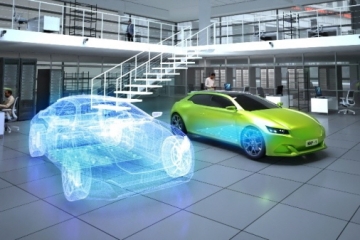
NXP Semiconductor presents a battery management system that can improve battery state of health (SOH) and state of charge (SOC) estimation for enhanced efficiency, lifespan, and cost improvement through an AI-based digital twin cloud service.
2022.11.14by 성유창 기자
.jpg)
“Digital Twin, Axis of Electric Vehicle Development”
Digital twin has been established as an important factor across all areas ranging from electric vehicle drivetrain component development to integrated development, as presented by an expert, along with case examples.
2022.11.18by 성유창 기자
[e4ds Tech Day 2026 ⑨] Sim Sang-gyu, Autocrypt CTO: "In the Physical AI Era, Automotive Security Must Extend Beyond the Vehicle"
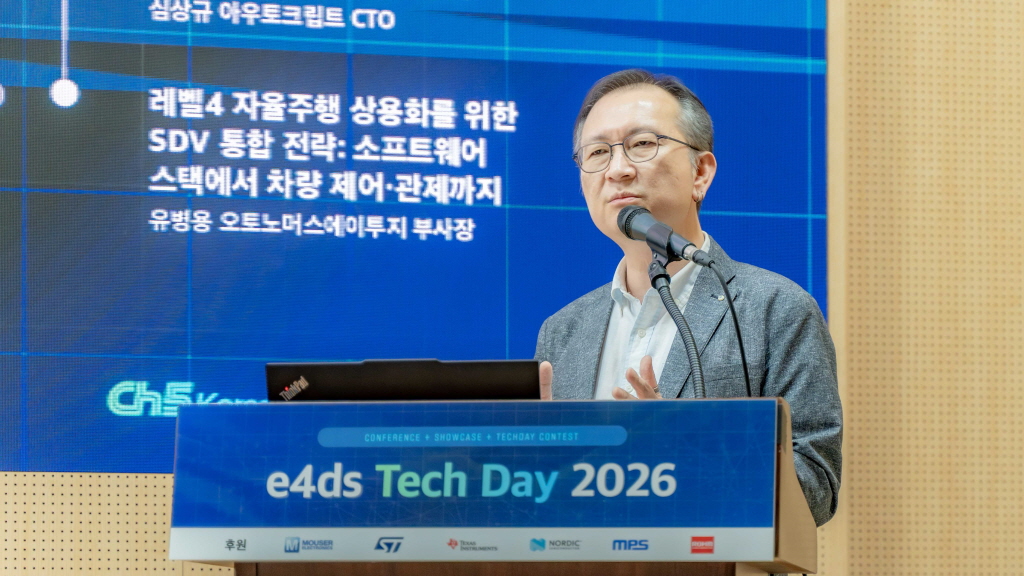
At e4ds Tech Day 2026, Sim Sang-gyu, CTO of Autocrypt, explained automotive cybersecurity strategies in the era of Physical AI and SDV (Software-Defined Vehicle). Automobiles are evolving as part of an ecosystem connected to AI, cloud, chargers, IoT, and robots, and he emphasized that the scope of security must expand beyond the vehicle interior to the entire connected environment. In particular, AI model tampering, adversarial attacks, OTA updates, and EV charger hacking were identified as major threats. He explained that response measures require zero trust, AI model integrity protection, intrusion detection, Security by Design and Default, and full lifecycle security management, and that proactive security system establishment beyond regulatory compliance is critical for securing future mobility competitiveness.
2026.10.12by 배종인 기자

Practical HIL Construction Strategy for Automotive and Off-Highway Controller Validation
As vehicle E/E architecture transitions to zonal structures and shifts to software-defined vehicles (SDV), the number of controllers (ECUs) requiring validation and software complexity are surging dramatically. Meanwhile, real vehicle testing cannot provide repeated verification under identical conditions and entails lead time and safety concerns. This white paper explains the principles of HIL (Hardware-in-the-Loop) validation and the structure of the NI platform composed of PXI, SLSC, and VeriStand, and through two actual implementation cases—Camera Record & Replay HIL for In-Cabin Monitoring Controller (ICMU) and Forklift Controller (VCU) HILS—describes how controller-level regression testing becomes possible. Additionally, it explicitly states application boundaries and limitations, such as lack of A2B support.
2026.10.12by 편집부











