



Catching 6G band electromagnetic waves
 Published2022.11.25 11:23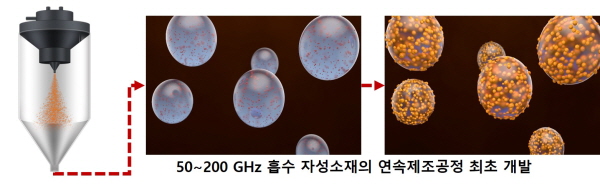
Materials Research, Continuous Manufacturing Technology for Millimeter Wave Absorbing Magnetic Materials
A material that absorbs ultra-high frequencies corresponding to the 6G band has been developed, and expectations are high that it will be used in various fields in the future information and communication and future mobility fields.
The Korea Institute of Materials Science (KIMS, President Lee Jung-hwan), a government-funded research institute under the Ministry of Science and ICT, announced on the 22nd that the research team of Dr. Baek Yeon-gyeong and Dr. Lee Jeong-gu of the Magnetic Materials Laboratory of the Powder Materials Research Division succeeded in developing the world's first technology to continuously manufacture epsilon iron oxide with millimeter wave absorption capability and high coercivity equivalent to that of neodymium (Nd) magnets.
The magnetic material that absorbs ultra-high frequencies corresponding to the 6G band is almost exclusively iron oxide material with epsilon crystal phase that exhibits high coercivity. On the other hand, up to now, this could only be expressed in the form of nano-sized particles of 50 nanometers or less. Japan has manufactured pure epsilon iron oxide through a wet process, but commercialization is difficult due to the limitations of low-yield multi-step processes.
The research team solved the low-yield manufacturing problem through the aerosol process. The research team succeeded in producing a composite powder in which epsilon iron oxide nanoparticles were embedded in silica particles through the process of spray drying and heat treating iron and silicon precursor solutions in a hot chamber. When the raw material solution is continuously injected and the spray solution is instantaneously dried, the iron raw material is trapped in the xerogel particles, which limits the growth of the particles during heat treatment. This is significant in that it enabled the continuous production of epsilon iron oxide nanoparticles using a micrometer-sized powder manufacturing process, demonstrating the possibility of commercializing millimeter-wave absorbing materials.
Compared to existing electromagnetic wave absorbing materials that have limitations such as reduced absorption capacity in high-frequency bands or difficulty in controlling the frequency band, epsilon iron oxide with absorption capacity in the extremely high frequency (30–200 GHz) band has high potential as a material for future communication components. The continuous manufacturing technology for epsilon iron oxide with millimeter wave absorption capacity can be used for 5G/6G wireless communication and low-orbit satellite communication components based on millimeter waves, stealth, radar sensors, etc., and as it is a high coercive force magnetic material, it can also be utilized in the field of electric components for future mobility.
There is currently no company that is mass producing and applying magnetic material technology capable of absorbing millimeter waves to its products, and only two or three countries, including the US, Japan, and Germany, have 5G band absorption shielding materials. Through this technology development, it is expected that not only will there be an import substitution effect through domestic production in the future, but exports to overseas countries will also be possible.
“The epsilon iron oxide developed through this study can selectively absorb ultra-high frequencies in a wide band (30–200 GHz), and it is particularly significant that we have developed a continuous manufacturing process that can be commercialized for the first time in the world,” said Baek Yeon-gyeong, a senior researcher at the Korea Institute of Materials Science and Engineering, who was in charge of the study. “We expect that this technology will accelerate the commercialization of absorber technology for wireless communication devices using millimeter waves, autonomous vehicle radar, and space satellite communications in the future.”
This research result was carried out through the 'Development of Performance-based Composite Magnetic Structure Magnetic Powder Material Technology' project of the Korea Institute of Materials Science with the support of the Ministry of Science and ICT. In addition, the research results were published on September 22 in Chemical Communications, a renowned academic journal in the field of materials science published by the Royal Society of Chemistry in the UK. The research team is currently discussing technology transfer with several companies regarding mass production technology for iron oxide absorbing materials, and is conducting additional research on ways to enhance terahertz wave absorption capacity of 100 gigahertz (GHz) or higher.

Comments
Related news

Materials Research Institute, Titanium Material Self-Sufficiency Contribution Recognized
The Korea Institute of Materials Science (KIMS), a government-funded research institute under the Ministry of Science and ICT, has been recognized for its contributions to achieving domestic self-sufficiency in titanium (Ti) materials.
2022.07.07by 배종인 기자
KIMS Showcases Extreme Materials Technology
The Korea Institute of Materials Science (KIMS, Director Lee Jung-hwan), a government-funded research institute under the Ministry of Science and ICT, has organized an event to showcase extreme materials technology and lay the foundation for securing leading-edge extreme materials.
2022.09.21by 배종인 기자
Materials Research Institute begins full-scale quarantine of film-type plasma devices
The Korea Institute of Materials Science (KIMS, Director Lee Jung-hwan), a government-funded research institute under the Ministry of Science and ICT, is launching a demonstration project to improve air quality using film-type plasma devices that have already completed verification testing, thereby advancing commercialization of the developed technology while making substantial contributions to society through public quarantine and disinfection activities.
2022.10.26by 배종인 기자
Schneider Aims for Building Energy Savings and Operational Stability with Next-Generation HVAC Drives
Schneider Electric has unveiled its next-generation HVAC drive product line 'Altivar HVAC'. The new product line's key features center on enhanced energy savings, system operational stability, and building management system integration. The products are divided into 'ATH200' for OEM and small equipment applications, and 'ATH600' for environments requiring continuous operation and advanced control. The company plans to expand the application scope from commercial buildings to facilities where HVAC system stability is critical, such as hospitals, airports, and data centers. The announcement includes over 30% energy savings, operation from -10°C to +60°C, Modbus and BACnet support, and compatibility with low global warming potential refrigerants.
2026.03.26by 명세환 기자
Ecolab Expands AI Data Center Cooling Business Through Acquisition of CoolIT
Ecolab has agreed to acquire CoolIT Systems, a liquid cooling company for AI data centers, for approximately $4.75 billion. The transaction is expected to close by Q3 2026, subject to regulatory approvals. CoolIT has been supplying direct-to-chip cooling-based coolant distribution units, cold plates, and manifolds, serving hyperscale data centers and colocation operators as customers. This acquisition is a measure to address the high-heat and high-density server environments created by AI proliferation. Ecolab plans to combine its water management and digital monitoring capabilities with CoolIT's hardware technology to expand its data center cooling business.
2026.03.26by 명세환 기자











